š Article 1: What Are Biofilms ā And Why Do They Matter in Aspergillosis?
š§« What is a biofilm?
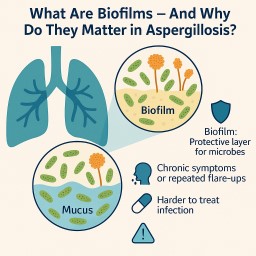
A biofilm is a protective layer that microorganisms (like fungi and bacteria) create when they stick to a surface ā such as the inside of airways, lung cavities, or medical devices. They secrete a sticky matrix of sugars, proteins, and DNA that holds them together and shields them from harm.
In aspergillosis, Aspergillus fumigatus forms biofilms on:
-
Mucus in the lungs
-
Cavities or damaged tissue (e.g. in CPA)
-
Surfaces of bronchial airways, especially in people with asthma or bronchiectasis
Pseudomonas aeruginosa, a bacterium often found alongside Aspergillus, also forms biofilms ā and they can even form mixed (dual-species) biofilms together.
āWhy does this matter?
Biofilms protect the microbes inside by:
-
Blocking immune cells from reaching them
-
Preventing antibiotics or antifungals from penetrating the biofilm
-
Allowing microbes to go dormant, then reactivate later
This is one reason why infections in aspergillosis patients can become chronic, relapse frequently, or be very hard to fully clear.
People with CPA, ABPA, SAFS, or fungal bronchitis may experience:
-
Repeated flare-ups or infections despite treatment
-
Persistent coughing, breathlessness, or mucus production
-
Ongoing inflammation in the lungs, even when cultures are negative
š How are biofilms treated?
Current options include:
1. Antifungals and antibiotics
-
Standard antifungals (like voriconazole, posaconazole, isavuconazole) can sometimes penetrate biofilms, but often require longer or higher doses.
-
Inhaled antibiotics (e.g. nebulised colistin or tobramycin) are used in bronchiectasis and can help break into bacterial biofilms.
-
Combined therapy (targeting both bacteria and fungi) may be used in patients with co-infection.
2. Disrupting the biofilm
-
DNase (Pulmozyme) in cystic fibrosis breaks up sticky DNA in mucus where biofilms form.
-
Future treatments aim to use enzymes, surfactants, or nanoparticles to dismantle biofilms.
3. Clearing mucus and infected secretions
-
Chest physiotherapy, postural drainage, and devices like the AcapellaĀ® or FlutterĀ® help remove secretions where biofilms sit.
-
Bronchoscopy is occasionally used to clear dense mucus plugs.
š¬ Looking ahead:
Researchers are studying:
-
Drugs that target the biofilm matrix directly
-
Ways to prevent biofilms from forming in the first place
-
New diagnostic tools that detect biofilm presence
š«ļø A Life Shaped by Mould: One Personās Journey with CPA and Lung Disease
Sadly, at the time of writing this story has to be paid for to read the full article. What follows is a summary of the free-to-access abstract.
āIt started with damp walls ā but it didnāt end there.ā
This is the story of someone who spent a lifetime battling the hidden effects of mould exposure and fungal lung disease, from childhood through adulthood. Their experience is a powerful reminder of how long-term exposure to poor indoor environments ā especially damp, flood-prone homes ā can leave a lasting imprint on lung health.
š§ Early Clues: Breathing Problems in Childhood
-
The author grew up in mouldy homes, regularly affected by floods.
-
As a teenager, they suffered from collapsed lungs, underwent pleurectomies, and were diagnosed with blebs (small air-filled sacs on the lung lining).
-
No one realised at the time that this could be linked to inhaled fungal spores.
𩺠The Long Road to Diagnosis
-
Years later, symptoms returned: chest infections, breathlessness, persistent coughing.
-
Eventually, doctors diagnosed:
-
Chronic pulmonary aspergillosis (CPA) ā a long-term fungal infection
-
Severe bronchiectasis ā a condition where the airways become damaged and inflamed
-
The root cause was now clear: years of breathing in airborne mould spores had likely caused permanent lung damage.
š Managing CPA: A Complex Balancing Act
The chapter describes the difficulty of living with CPA, including:
-
Strong antifungal medications (like itraconazole or posaconazole) and their side effects
-
Emergency lung procedures
-
Ongoing adjustments in daily life ā from avoiding certain environments to managing fatigue
š¤ What Helped Most: Self-Advocacy and Support
This is also a story of resilience and empowerment. The author learned to:
-
Ask better questions at medical appointments
-
Work closely with specialists in fungal lung disease
-
Use trusted online resources to understand their condition
-
Keep going, even when progress was slow
š¬ āI had to become my own advocate ā not to fight my doctors, but to work with them more effectively.ā
š§ Advice for Others
The author shares practical tips that could help anyone dealing with CPA, bronchiectasis, or long-term lung illness:
-
Track your symptoms and treatments
-
Stay informed ā but avoid misinformation online
-
Get help from respiratory physiotherapists
-
Donāt ignore your environment ā especially damp, mouldy places
-
Keep asking questions until the answers make sense
š A Message of Hope
This chapter isnāt just a medical account ā itās a message of hope and strength. It shows how understanding your own health, building a good medical team, and staying proactive can make a big difference, even in the face of serious illness.
š« Haemoptysis in Aspergillosis: A Complete Patient Guide
1. š” What Is Haemoptysis?
Haemoptysis means coughing up blood from the lungs. It might appear as:
-
Specks or streaks of blood in your sputum
-
Bright-red frothy sputum
-
Clots or large quantities of fresh bloodĀ aspergillosis.org/haemoptysis/
Itās common in conditions like chronic pulmonary aspergillosis (CPA) and sometimes in ABPA.
2. šØ When to Worry: Recognising Emergency Bleeding
Call 999 or go to A&E immediately if you experience:
-
More than 1 tablespoon (~15āÆml) of fresh blood in one episode aspergillosis.org/haemoptysis/
-
Bright-red, continuous bleeding
-
Feeling breathless, dizzy, or faint
-
Any sudden change in pattern or amount of bleedingĀ Ā aspergillosis.org/managing-life-with-haemoptysis/
Massive haemoptysis is defined as ā„150āÆml in 1āÆhour or ā„600āÆml in 24 hours .
3. š„ What Might Happen in Hospital
In more severe cases, you may receive:
-
Oxygen therapy, blood or fluid transfusion
-
Bronchoscopy to localise or control the bleed
-
Bronchial artery embolisation (BAE) guided by CT
-
Possible intubation if breathing is significantly compromised
-
Rarely, surgery or radiotherapy if bleeding persistsĀ aspergillosis.org/haemoptysis/
4. š Aftercare and Monitoring
Regular follow-up is essential:
-
Repeat chest CT to check healing or detect new issues
-
Sputum cultures, specifically for Aspergillus, TB, NTM
-
Blood tests for Aspergillus IgG/IgE ± galactomannan
-
Clinic review to adjust antifungal therapy, embolisation, or airway clearance
5. š Medications & Prevention
-
Tranexamic acid reduces bleeding and is prescribed short-term aspergillosis.org/haemoptysis/
-
Antifungals (itraconazole, voriconazole) for CPA/aspergilloma
-
Steroids ± antifungals for ABPA
-
Encourage adherence to antifungal/antibacterial treatments
6. š” Practical Advice at Home
-
Keep room air at moderate humidity, avoid dust, smoke, strong odours aspergillosis.org/managing-life-with-haemoptysis/
-
Stay hydrated, use warm teas or soups to soothe airways aspergillosis.org/managing-life-with-haemoptysis/
-
Avoid nebulisers or airway clearance devices until OKād by your specialist
-
Sleep propped-up, not flat, with slight elevation or on the affected side only if firmly advised
-
Maintain a rescue pack at home: tissues, water, mouth lozenges, emergency plan
7. š§ Reducing Cough & Airway Irritation
-
Practice gentle breathing techniques (pursed-lip, diaphragmatic, nasal breathing)
-
Use lozenges or warm honey drink for throat soothing
-
Consider mild codeine or inhaled tranexamic acid if prescribed
-
Avoid cough triggers (hot steam, cold air, vapours)
8. š Be Prepared: Know Your Plan
-
Carry a medical alert card (e.g., NAC wallet card) explaining your condition to paramedics
-
Keep a written chart of your medications, dosages, and emergency numbers
-
Remove air filters or masks if they are dusty/mouldy ā otherwise continue using HEPA systems
9. š Emotional & Psychological Support
-
Anxiety and fear of rebleeding are normal ā grounding techniques, breathing exercises, and coping strategies help aspergillosis.org
-
Join support groups to share experiences ā Aspergillosis.org has active patient forums
10. š What You Should Ask Your Specialist
-
What was the confirmed or suspected cause (CPA, aspergilloma, ABPA, infection)?
-
Are repeat scans or bronchoscopy needed?
-
Is my current antifungal or antibiotic strategy sufficient?
-
What is the safest way to reintroduce airway clearance or nebulizers?
-
Should I have a bronchial artery embolisation or surgery?
-
How and when can I resume daily activities, including physiotherapy?
After Antifungal Treatment: Can Aspergillosis Come Back?
If youāve finished a course of antifungal treatment for aspergillosis, itās natural to wonder:
āIs the fungus gone for good?ā
āCan it come back ā and if so, when?ā
This article explains what patients with aspergillosis need to know about recurrence, timelines, and the factors that increase the risk of the infection returning.
š§ What Is Aspergillosis?
Aspergillosis is caused by breathing in spores from a common fungus called Aspergillus fumigatus. Many people breathe in these spores without getting ill, but those with asthma, chronic lung disease, or a weakened immune system may develop one of several types of aspergillosis, such as:
-
Allergic Bronchopulmonary Aspergillosis (ABPA)
-
Chronic Pulmonary Aspergillosis (CPA)
-
Severe asthma with fungal sensitivity (SAFS)
-
Invasive Aspergillosis (mainly in severely immunocompromised patients)
Each of these conditions behaves differently ā and the chances of the fungus coming back depend on the type you have.
š Can Aspergillosis Come Back After Treatment?
Yes, it can. Even after a full course of antifungal medication, Aspergillus can return ā either because it was never fully cleared, or because itās been inhaled again from the environment.
Some people stay well for years after treatment. Others may experience a return of symptoms within months. There is no single timeline that fits everyone.
ā±ļø When Might Aspergillosis Come Back?
| Time After Treatment | Could It Return? | Why It Might Happen |
|---|---|---|
| Immediately | Yes | The infection was suppressed but not cleared fully |
| Within a few months | Common | Especially if there is lung damage, asthma, or exposure to fungal spores |
| After 1ā2 years | Possible | New flare-ups can occur with environmental triggers or immune changes |
| Never | Possible | In some cases, the infection does not return ā especially with early treatment and no underlying lung disease |
š§© What Increases the Risk of Aspergillosis Coming Back?
Several factors make recurrence more likely:
1. Type of Aspergillosis
-
ABPA and SAFS often flare up from time to time, especially with exposure to mould or allergens.
-
CPA usually requires long-term management and can relapse even after prolonged treatment.
-
Acute invasive aspergillosis needs close monitoring, especially in those with weak immune systems.
2. Stopping Treatment Too Early
-
If antifungal treatment is stopped before the fungus is fully under control, symptoms can return quickly.
3. Environmental Exposure
-
Aspergillus spores are common in the air ā especially in places like:
-
Compost heaps
-
Garden soil
-
Damp buildings
-
Renovation sites or dust
- Ploughed fields
-
-
Continued exposure may lead to reinfection or flare-ups.
4. Weakened Immune System or Damaged Lungs
-
People with bronchiectasis, asthma, COPD, or past lung infections are more at risk of recurrence.
-
Those on immunosuppressive treatments or with adrenal insufficiency may also be more vulnerable.
ā How Can You Reduce the Risk of Recurrence?
-
Complete the full course of antifungal medication, even if symptoms improve early.
-
Discuss with your doctor whether you need ongoing or maintenance therapy (especially in CPA or ABPA).
-
Avoid known triggers ā especially mould, compost, disturbed soil, damp environments, or construction dust.
-
Use a respirator mask (e.g. FFP2) when gardening or exposed to dusty air.
-
Monitor your health regularly:
-
Keep track of IgE levels (if you have ABPA)
-
Watch for changes in breathing or new coughing
-
Attend scheduled CT scans or blood tests as advised
-
š¬ What Do Other Patients Say?
āI felt great after treatment, but within a few months my symptoms started to creep back.ā
āIt was only after I started long-term antifungal treatment that I stabilised.ā
āWhenever Iām around compost or old sheds, I wear a mask ā it really helps.ā
𩺠What Should You Ask Your Doctor?
Here are some questions you may wish to discuss at your next appointment:
-
āDo I need a longer course or maintenance antifungal treatment?ā
-
āWhat are the signs that it might be coming back?ā
-
āHow can I protect myself from re-exposure?ā
-
āWould regular blood tests or scans help monitor for recurrence?ā
š§ Final Thoughts
Aspergillosis is often a long-term condition, especially in people with underlying lung problems. Finishing a course of antifungal treatment is a big step ā but follow-up care and prevention strategies are just as important.
If youāre concerned about recurrence or not sure what the plan is after treatment, itās perfectly reasonable to ask your doctor for a clear long-term strategy.
Youāre not alone ā and with the right support and information, many people live well with aspergillosis.
š§¾ Why Do Some People Need Higher Doses of Antifungal Medication?
If you're being treated for ABPA or another aspergillosis-related condition, you might wonder why your doctor has prescribed you a higher or lower dose of your antifungal medication than someone else. You're not aloneāthis is a common and important question.
The answer is that antifungal medicines don't work the same way in everyone. Your dose may need adjusting based on how your body handles the medication.
š Here's why doses can vary from person to person:
1. Absorption differences
Some antifungal medicines (like itraconazole capsules) are harder for the body to absorb.
Things like what you eat, how acidic your stomach is, or even other medications can affect how well your body takes in the drug.
For example, acid blockers like omeprazole can reduce absorption.
2. How your body processes the drug
Your liver breaks down antifungal medicines.
Some people process them very quickly (which can make the drug less effective), while others process them slowly (which can increase side effects).
This is due to genetic differences, and you canāt predict it without blood tests.
3. Other medications you're taking
Some drugs interfere with antifungals, making them work less well or increasing side effects.
Your doctor might need to adjust your antifungal dose to compensate.
4. Your weight and body size
People with larger body size or more body fat may need a slightly higher dose to get the drug to the right level in the lungs.
5. How severe your condition is
If your ABPA or infection is more severe, your doctor may aim for a higher drug level in your body to make sure it works well.
š§Ŗ Why do I need blood tests?
To make sure your antifungal is working properly, your doctor might check blood levels of the drug. This helps:
Avoid side effects if the level is too high
Make sure itās effective if the level is too low
This is especially important for itraconazole and voriconazole.
ā
Key points to remember:
Your dose is personalised to you.
Donāt compare your dose to someone elseāsāitās not a one-size-fits-all treatment.
Always take your medication exactly as prescribed, and let your doctor know if youāre taking any new medicines, including over-the-counter ones.
Are there withdrawal effects once voriconazole is stopped?
There are no classic withdrawal effects in the way we think of for drugs like steroids, opioids, or benzodiazepines when voriconazole is stopped. However, some patients do experience transient symptoms or rebound effects, especially if the drug was managing an active infection or inflammation.
Hereās what you should know:
ā What Usually Happens When Voriconazole Is Stopped?
1. No physiological withdrawal syndrome
-
Voriconazole does not cause dependence or withdrawal at a chemical level.
-
You donāt need to taper it for pharmacological reasons ā it can generally be stopped abruptly.
ā ļø But Some Symptoms May Still Appear
These arenāt āwithdrawalā symptoms in the classical sense, but can occur:
A. Return of underlying symptoms
-
If the aspergillosis was only partially controlled, symptoms like cough, chest pain, or fatigue may recur.
-
Especially in CPA or ABPA, stopping antifungals too soon can cause flare-ups.
B. Immune rebound
-
Very rarely, immune reconstitution reactions (like in ABPA or after neutropenia) may occur as the immune system re-engages with fungal antigens.
-
This is not true withdrawal, but a host response shift.
C. Psychological or sensory changes
-
Some patients who had visual disturbances or strange dreams while on voriconazole report a brief āreadjustmentā period after stopping (often relief, but occasionally some lingering discomfort).
-
These effects usually resolve quickly.
š©āāļø What To Watch For After Stopping
| Symptom | Likely Cause | What to Do |
|---|---|---|
| Return of cough, sputum, fatigue | Infection flaring again | Recheck IgE, CRP, imaging, sputum |
| Headache, dizziness | Rarely linked to stopping, more likely underlying illness or fatigue | Monitor; seek review if worsening |
| Mood shifts, anxiety | Possibly related to underlying illness stress, or stopping long-term meds | Supportive care, discuss with clinician |
š§¾ Summary
-
No true withdrawal syndrome with voriconazole
-
Symptoms that return are usually related to underlying disease or immune changes
-
Best to stop under specialist advice, ideally with a plan for monitoring over 2ā6 weeks
š How Medicines Are Approved ā and What āOff-Labelā Means
š¹ 1. What Is āLicensedā or āApprovedā Medication Use?
Before a medicine can be prescribed in the UK (or any country), it goes through a formal approval process:
| Step | What Happens |
|---|---|
| Clinical trials | The medicine is tested for safety, effectiveness, and quality. |
| Regulatory review | In the UK, the Medicines and Healthcare products Regulatory Agency (MHRA) or the European Medicines Agency (EMA) reviews trial data. |
| Marketing authorisation | If approved, the medicine is ālicensedā for specific conditions, doses, age groups, and methods of use. |
š¢ A licensed use means the drug has been judged safe and effective for that specific use, based on strong clinical evidence.
š¹ 2. What Is āOff-Labelā Use?
Off-label use means a doctor prescribes a medicine in a way that is not covered by its official license.
This could include:
-
Using a medicine for a different condition
-
Giving it at a different dose or frequency
-
Using a different route (e.g. inhaled instead of injected)
-
Giving it to a different age group (e.g. in children)
This is legal, but it means the prescriber is using their clinical judgement outside the official licensing terms.
š¹ 3. Why Might a Doctor Use a Medicine Off-Label?
| Reason | Example |
|---|---|
| There is no licensed treatment for a rare condition | e.g. inhaled amphotericin B for CPA or ABPA |
| The licensed treatment doesnāt work or causes side effects | e.g. switching antifungal drugs |
| New evidence supports another use, but the company hasnāt applied for a new licence | e.g. old drugs used in new ways based on research |
| Medicines used in children or elderly often lack specific licensing data |
š¹ 4. Is Off-Label Use Safe?
It can be, but it requires:
-
Good clinical judgement
-
Use of the best available evidence
-
Often, discussion with a multidisciplinary team
-
Informed consent from the patient (especially important in high-risk cases)
The prescriber takes more responsibility, because the use hasnāt been formally approved by regulators.
š¹ 5. Who Oversees This in the UK?
-
The MHRA licenses medicines.
-
The General Medical Council (GMC) and NHS allow doctors to prescribe off-label when itās in the patientās best interest.
-
NICE guidelines sometimes include off-label use if evidence supports it.
š¹ 6. Real-World Example: Inhaled Amphotericin
-
Licensed: Amphotericin B is approved for injection to treat fungal infections.
-
Off-label: Nebulised (inhaled) use is not officially licensed, but it is used in some centres to treat or prevent fungal lung disease (e.g. CPA, ABPA) where evidence and specialist experience supports it.
š¹ Summary: Key Points
| Term | Meaning |
|---|---|
| Licensed use | The use of a medicine that has been approved for a specific purpose by a regulator. |
| Off-label use | Prescribing a medicine in a different way than officially licensed ā legal, but used with clinical caution. |
| Who decides? | Ultimately, the prescribing clinician, supported by evidence, guidance, and the needs of the individual patient. |
š« Inhaled Amphotericin: What You Need to Know

For patients with CPA, ABPA, and other lung-based fungal conditions
What is Amphotericin B?
Amphotericin B is a powerful antifungal medicine used to treat serious fungal infections, including those affecting the lungs. It is most often given by intravenous (IV) infusion, but in some cases, it can be given through inhalation (nebulisation) to target the lungs more directly.
It may be considered in conditions such as:
-
Chronic Pulmonary Aspergillosis (CPA) ā a long-term infection of the lungs caused by Aspergillus fungi
-
Allergic Bronchopulmonary Aspergillosis (ABPA) ā an allergic lung reaction to Aspergillus, common in people with asthma or bronchiectasis
-
Fungal infections after lung transplants or in people with severely weakened immune systems
Why Use It Inhaled?
Inhaled amphotericin may be used to:
-
Treat lung-based fungal infections, especially in CPA
-
Help reduce the fungal burden in the lungs of patients with ABPA, when other treatments are not enough
-
Prevent fungal infections in at-risk patients (e.g. those undergoing chemotherapy or organ transplantation)
-
Lower the risk of systemic side effects compared to IV treatment
What Makes Inhaled Amphotericin Challenging?
Amphotericin B can be difficult to inhale because:
-
It doesnāt dissolve easily in water, making it hard to turn into a fine mist.
-
It can irritate the lungs, causing coughing, wheezing, or chest tightness ā which is particularly concerning for people with ABPA or asthma.
-
It may not reach all parts of the lung evenly, especially in patients with cavities or damaged lung tissue seen in CPA.
-
There is no licensed, standard inhaled product ā it is often used āoff-labelā under specialist care.
What is Liposomal Amphotericin (Ambisome)?
AmbisomeĀ® is a special formulation of amphotericin B. It uses tiny liposomes to deliver the drug.
What is a Liposome?
A liposome is a microscopic, fat-based bubble. It:
-
Protects the medicine until it reaches the right part of the body
-
Reduces irritation and side effects
-
Helps deliver amphotericin more gently to the lungs
You can think of liposomes like tiny protective vans, carrying the medicine where itās needed most ā often areas affected by CPA or ABPA.
Benefits of Inhaled Liposomal Amphotericin
-
Better tolerated than older versions (especially important for people with sensitive airways)
-
Safer for the lungs and kidneys
-
Can be used to target Aspergillus in the lungs directly
-
Suitable for people with CPA or difficult-to-control ABPA
-
May be used alongside antifungal tablets or corticosteroids
What to Expect During Treatment
-
Youāll use a nebuliser, a machine that turns liquid medicine into a fine mist.
-
Treatment usually takes around 15ā30 minutes.
-
You may be asked to use a bronchodilator inhaler first (e.g. salbutamol) to open up your airways.
-
Your first treatment may be supervised to check for any side effects.
Common Side Effects
Most people tolerate liposomal amphotericin well, but possible side effects include:
-
Mild coughing or throat irritation
-
Chest tightness or wheezing (more likely with non-liposomal versions)
-
Unpleasant taste or dry mouth
People with ABPA may be more sensitive to these effects due to their underlying allergic response. If you have CPA, itās important to report any new or worsening symptoms like increased coughing or breathlessness.
Inhalable antifungal medication for Aspergillosis

Inhaled antifungals are an area of active development, especially for targeting fungal lung infections like aspergillosis and candidiasis. This approach allows for high local drug concentrations in the lungs while minimizing systemic side effects. Hereās a summary of current and emerging inhaled antifungals:
ā Currently Available or in Clinical Use (select cases or trials)
| Antifungal | Formulation | Indication / Use | Notes |
|---|---|---|---|
| Amphotericin B (liposomal) | Inhaled (off-label) | Prophylaxis in immunocompromised patients (e.g. post-transplant) | Used for inhaled prophylaxis against invasive aspergillosis; available in some UK centres |
| Voriconazole | Inhaled (compounded) | Limited use in chronic fungal lung disease | Very limited data; some use in compassionate settings |
| Itraconazole | Inhaled (experimental) | Chronic pulmonary aspergillosis | Inhalable versions have been studied (e.g. PUR1900/Pulmazole) |
| Nystatin | Inhaled (rare/off-label) | Oropharyngeal candidiasis or tracheobronchial use | Sometimes nebulized in ICU; limited absorption |
š§Ŗ In Development / Clinical Trials
| Antifungal | Developer / Status | Target Use | Notes |
|---|---|---|---|
| Opelconazole (PC945) | Pulmocide Ltd ā in Phase 3 trials | Inhaled for chronic aspergillosis, prophylaxis | Designed specifically for inhalation; long lung retention, minimal systemic exposure |
| Pulmazole (PUR1900) | Pulmatrix (partnering with Cipla) ā early trials | ABPA, CPA in asthma/bronchiectasis | Inhaled itraconazole dry powder; promising lung targeting |
| Inhaled amphotericin B lipid complex | Aridis / others | Invasive fungal prophylaxis | Advanced animal and some early human data |
| Encochleated Amphotericin B | Matinas BioPharma (oral/inhaled being explored) | Aspergillosis, mucormycosis | Cochleate delivery protects drug; inhaled route under study |
š¬ Preclinical / Exploratory
| Antifungal Class | Notes |
|---|---|
| Echinocandins (e.g. caspofungin) | Not yet available in inhaled form, but being explored for nebulization |
| Azole reformulations | Research ongoing into nebulized posaconazole or isavuconazole for direct lung delivery |
| Novel agents (e.g. olorofim) | Olorofim is oral/IV only currently, but inhaled versions could emerge in future studies |
š§© Potential Advantages of Inhaled Antifungals
-
High concentration directly at the site of infection (lungs)
-
Reduced systemic toxicity
-
Less interaction with hepatic CYP450 pathways (important for azoles)
-
Better for long-term suppression in CPA, ABPA, SAFS
š§ Challenges
-
Delivery devices and patient technique (e.g. DPI vs nebuliser)
-
Ensuring adequate deposition in damaged or obstructed airways
-
Regulatory hurdles due to novel delivery routes
-
Limited real-world data so far
Do antifungals actually help with breathing in ABPA?
š¹ Sometimes, yes ā but it depends on the person and the stage of the disease.
In ABPA (Allergic Bronchopulmonary Aspergillosis), the main problem is an allergic reaction to Aspergillus, rather than a full-blown infection. This reaction causes inflammation, mucus plugging, and sometimes long-term damage like bronchiectasis.
š§Ŗ What do antifungals do?
Antifungal medicines like itraconazole or voriconazole donāt treat the allergy directly.
Instead, they reduce the amount of Aspergillus in your lungs, which helps:
-
Lower the allergic response (so less inflammation)
-
Reduce flare-ups
-
Sometimes reduce the need for steroids
-
May improve symptoms like wheezing, chest tightness, or mucus
Butā¦
ā ļø They donāt work instantly
-
You may not feel a dramatic improvement in breathing straight away.
-
The effect builds over weeks or months.
-
If your symptoms are caused more by scarring or fixed airway damage (like bronchiectasis), antifungals may not reverse that ā but they can still help prevent things getting worse.
š What does research say?
-
Studies show antifungals can reduce IgE levels, mucus plugging, and exacerbations in many people.
-
About 60ā70% of patients feel some improvement in symptoms or lung function.
-
Some donāt respond ā or get side effects and have to stop.
š¬ So, in short:
Antifungals can help breathing for many people with ABPA, especially if inflammation and allergy are still active. But theyāre not a guaranteed fix ā and they work best as part of an overall plan, not on their own.
If someoneās unsure whether to start, itās worth discussing a trial of antifungal treatment with their respiratory team, and seeing how symptoms, lung tests, and IgE levels respond over time.