If you have been diagnosed with aspergillosis and a CT scan has shown one or more cavities in your lungs, you may have an important question:
Can these cavities heal, or is the damage permanent?
The answer depends on what caused the cavity, how long it has been present, whether there is ongoing infection or inflammation, and how much permanent damage has occurred to the surrounding lung tissue.
Some cavities become smaller or occasionally disappear. Others remain visible even after treatment has successfully controlled the disease.
Importantly, a cavity does not have to disappear for treatment to be successful. Preventing further damage, controlling symptoms and keeping the condition stable are often realistic and valuable treatment goals.
What is a lung cavity?
A lung cavity is an abnormal air-containing space that develops within lung tissue. It forms when an area of tissue is damaged or destroyed, leaving a hollow space.
Cavities can vary considerably. Some have thin walls, while others have thick, irregular walls. They may be surrounded by inflammation or scarring, and some contain fluid or fungal material.
A cavity is not the same as a normal airway or an area of bronchiectasis, although these conditions can sometimes appear similar on imaging.
CT scans help doctors distinguish between these different changes and identify whether they are stable or progressing.
Why do lung cavities develop in aspergillosis?
Several forms of aspergillosis can be associated with lung cavities, but they do not all develop in the same way.
Chronic pulmonary aspergillosis (CPA)
CPA is one of the most important causes of persistent lung cavities associated with Aspergillus.
In some people, CPA develops in lungs that already contain cavities or other structural damage from a previous illness. In others, the disease causes existing cavities to enlarge or new cavities to develop.
Over time, cavity walls may become thicker, surrounding lung tissue may become inflamed, and fibrosis (scarring) may develop.
CPA can therefore involve both ongoing disease activity and permanent structural changes.
Aspergilloma (fungal ball)
An aspergilloma is a collection of fungal material that grows within an existing lung cavity.
The fungal ball is not the cavity itself. It occupies a space that has usually developed because of previous lung damage or disease.
Some aspergillomas remain stable for years, while others are associated with symptoms, particularly coughing up blood (haemoptysis).
Even if fungal material decreases or disappears, the underlying cavity may remain.
Invasive pulmonary aspergillosis
Invasive aspergillosis occurs mainly in people whose immune defences are significantly weakened, although it can also affect some critically ill patients and people with other important risk factors.
The infection can damage lung tissue rapidly. As damaged tissue breaks down, cavities may develop.
Some of these cavities subsequently shrink or heal as the infection is controlled, although residual scarring or other permanent abnormalities may remain.
Allergic bronchopulmonary aspergillosis (ABPA)
ABPA primarily causes allergic inflammation of the airways and is associated with asthma, mucus plugging and bronchiectasis.
Lung cavities are not a typical feature of ABPA itself.
If a patient with ABPA develops a cavity, doctors may investigate other explanations, including previous infection, coexisting CPA or another lung condition.
Other causes of lung cavities
Not every cavity seen in someone with aspergillosis is caused by Aspergillus.
Other possible causes include:
- Previous tuberculosis or other severe lung infections.
- Certain bacterial infections, including lung abscesses.
- Non-tuberculous mycobacterial (NTM) disease.
- Some inflammatory or autoimmune conditions.
- Occasionally, lung cancer or other serious conditions.
Doctors consider the patient’s history, symptoms, CT findings and laboratory results before deciding what a cavity represents.
Can lung cavities actually heal?
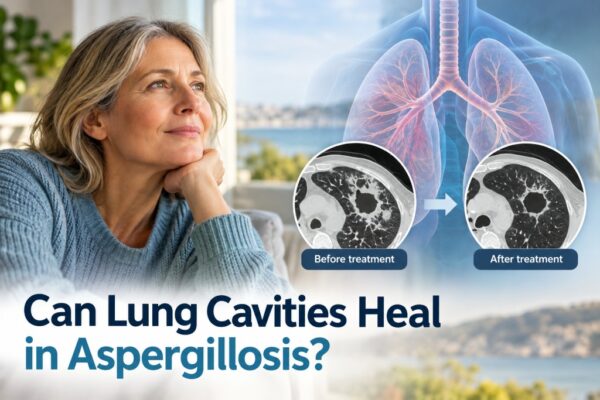
Yes, some lung cavities can become smaller or close over time, but complete healing is not always possible.
The likelihood of improvement depends on several factors, including the underlying disease, the amount of tissue destruction, whether the cause can be successfully treated and the extent of established scarring.
A cavity caused by an acute infection may gradually become smaller as inflammation resolves and the surrounding lung recovers.
However, a long-standing cavity associated with CPA, previous tuberculosis or extensive fibrosis may represent permanent structural damage.
In these circumstances, treatment may control the disease without restoring the lung to its original appearance.
What happens to cavities during treatment for CPA?
Antifungal treatment for CPA aims to control fungal disease, improve or stabilise symptoms, and prevent further lung damage.
Changes seen on CT scans may include:
- Reduced inflammation around a cavity.
- Thinner cavity walls.
- Less material within a cavity.
- Reduction in the size of some cavities.
- Stabilisation of previously enlarging cavities.
- Reduced development of new cavities or further fibrosis.
Not every patient will show all these changes. In some cases, the most important result is that the cavities have stopped enlarging and the surrounding lung tissue is no longer deteriorating.
Other patients may continue to have symptoms or radiological progression despite treatment and require reassessment.
A stable CT scan can be encouraging, even when the cavity is still visible. However, scans must always be interpreted alongside symptoms and other clinical findings.
Does a cavity remaining mean the Aspergillus infection is still active?
Not necessarily.
A cavity may remain because the lung tissue has been permanently altered. Its continued presence does not, by itself, prove that CPA is still progressing.
Equally, an unchanged cavity does not automatically mean the disease is completely inactive.
Doctors assess several pieces of information together, including:
- Changes in symptoms and general health.
- CT appearances over time.
- Aspergillus antibody results, particularly Aspergillus IgG where appropriate.
- Inflammatory markers and other blood tests.
- Sputum culture or molecular tests when indicated.
- Response to treatment and any treatment complications.
No single result reliably tells the whole story.
How do doctors monitor lung cavities?
CT scans
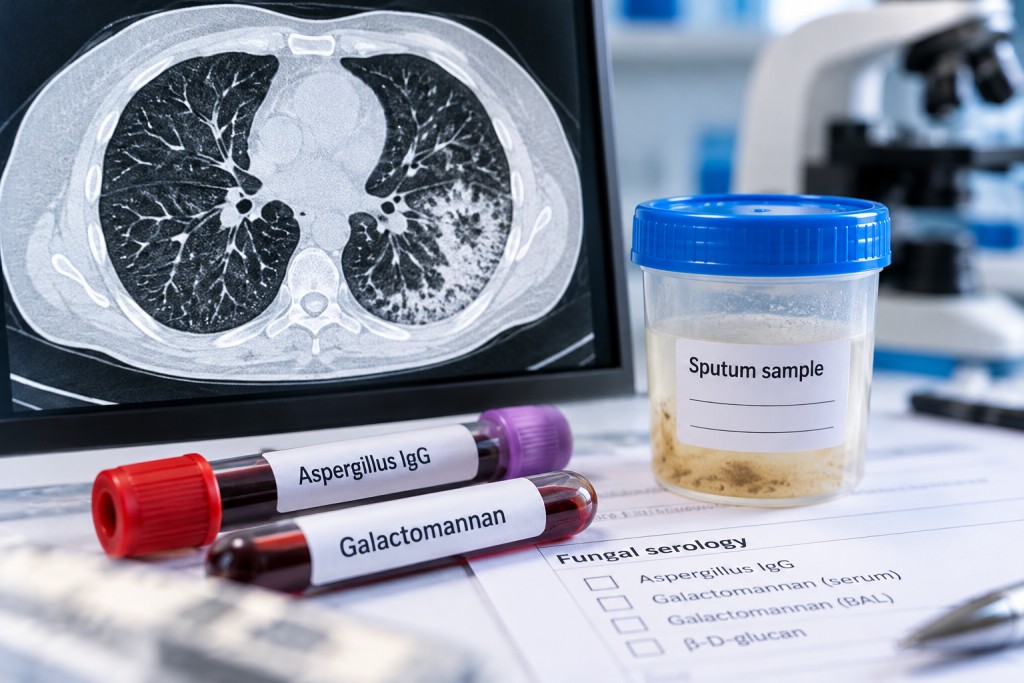
CT scanning is particularly useful because it provides detailed images of cavities, their walls and the surrounding lung tissue.
Doctors may look for:
- Changes in cavity size or wall thickness.
- New cavities.
- Fungal balls or other material within cavities.
- Inflammation around the affected areas.
- Progression or improvement in fibrosis.
- Changes elsewhere in the lungs.
Comparing scans taken at different times is often more informative than interpreting one scan in isolation.
The timing of repeat scans depends on the patient’s condition, treatment and previous findings.
Blood tests
Aspergillus IgG antibodies are an important part of diagnosing many forms of CPA.
Antibody levels may also be considered during follow-up, but they do not consistently reflect disease activity in every patient.
Other tests, such as C-reactive protein (CRP), may provide information about inflammation but are not specific to Aspergillus infection.
Blood tests are also important for monitoring the safety of antifungal treatment, including liver function and, for some medicines, drug concentrations.
Sputum testing
Sputum samples may be tested for Aspergillus and other organisms, including bacteria and mycobacteria.
However, a negative sputum culture does not exclude CPA, and a positive result must be interpreted in clinical context.
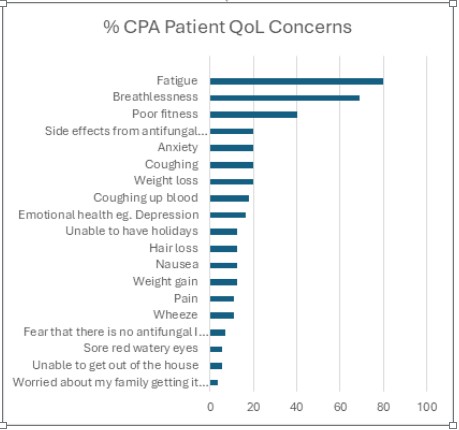
Symptoms and quality of life
Patients’ experiences are an essential part of monitoring.
Changes in breathlessness, fatigue, cough, sputum, weight, exercise tolerance or haemoptysis may be important even when imaging changes appear relatively small.
Tell your team how the illness affects everyday activities, not just whether individual symptoms are present.
Can damaged lung tissue grow back?
The lungs have some ability to recover after injury, particularly when inflammation resolves and the underlying tissue structure has been preserved.
However, lung tissue that has been extensively destroyed or replaced by fibrosis generally cannot regenerate into normal functioning lung tissue.
This explains why someone may have successful treatment for aspergillosis but continue to experience breathlessness or reduced lung capacity.
Recovery of lung function depends partly on how much healthy lung remains and whether other problems, such as asthma, bronchiectasis or deconditioning, can be improved.
What can patients do to protect their remaining lung function?
Although you cannot directly make a cavity close, there are practical ways to support your respiratory health.
Follow your agreed treatment plan
If antifungal treatment has been prescribed, take it as directed and attend recommended monitoring appointments.
Tell your team if you experience side effects or have difficulty taking your medication. Do not stop or change treatment without discussing it with your prescriber.
Manage other respiratory conditions
Asthma, bronchiectasis, COPD and other lung conditions may contribute to symptoms and further respiratory damage.
Appropriate management of these conditions is important alongside treatment for aspergillosis.
Corticosteroids may be necessary for ABPA, asthma or other illnesses, but they can also increase susceptibility to some infections. The benefits and risks need individual assessment.
Never reduce or stop prescribed corticosteroids abruptly without medical advice. Long-term treatment can suppress the body’s natural cortisol production.
Stay as physically active as your condition allows
Appropriate exercise and pulmonary rehabilitation can help maintain muscle strength, confidence and physical function.
They do not directly repair cavities, but they may help people make better use of their remaining lung capacity.
For further information, read our guide to physiotherapy for aspergillosis, breathing, mucus clearance and keeping active.
Seek help with airway clearance when needed
Some patients, particularly those with bronchiectasis, benefit from respiratory physiotherapy techniques to help clear mucus.
These techniques should be tailored to individual needs. People with a history of haemoptysis should seek professional advice about suitable airway-clearance methods.
Protect your general health
Avoid smoking, maintain adequate nutrition, discuss recommended vaccinations with your healthcare team and seek advice promptly when respiratory symptoms deteriorate.
These measures support general lung health, although they cannot reverse established cavities or scarring.
What if a cavity continues to grow?
An enlarging cavity does not always mean that antifungal treatment has failed, but it is a finding that requires careful assessment.
Doctors may consider:
- Whether CPA remains active or is progressing.
- Whether antifungal treatment is being absorbed adequately.
- Whether the Aspergillus is resistant to the prescribed medicine.
- Whether another infection or lung disease is contributing.
- Whether treatment needs to be changed.
- Whether specialist procedures or surgery should be considered in selected cases.
Management depends on the overall clinical situation. Surgery is not suitable for every patient, particularly when lung function is limited or disease affects several areas of the lungs.
What about the risk of bleeding?
Some people with CPA or an aspergilloma experience haemoptysis, which means coughing up blood.
Bleeding can occur because abnormal or enlarged blood vessels develop around areas of chronic inflammation and damaged lung tissue.
The risk cannot be determined simply by whether a cavity is large or small, or whether it contains a fungal ball.
If you cough up blood, seek prompt medical advice, even if the amount is small. Your clinical team can advise how to respond based on your individual circumstances.
Call 999 for heavy or ongoing bleeding, or if coughing up blood is accompanied by severe breathlessness, faintness or collapse.
For some patients with significant or recurrent haemoptysis, doctors may consider bronchial artery embolisation, a procedure intended to block blood vessels responsible for bleeding.
Questions to ask your specialist
If you have lung cavities, the following questions may help you understand your condition:
- What caused my lung cavity?
- Is the cavity associated with active CPA or mainly with previous lung damage?
- Has it changed since my previous CT scan?
- What signs would indicate that treatment is working?
- Is it realistic to expect the cavity to shrink, or is stability our main goal?
- How much of my breathlessness is caused by permanent lung damage?
- What can I do to maintain my remaining lung function?
- What symptoms should prompt me to contact the clinical team?
Understanding the purpose of treatment can make follow-up scans less worrying. A scan showing that nothing has deteriorated may represent an important achievement.
Key points: Can lung cavities heal?
- Some lung cavities can shrink or close, particularly when they develop following an acute illness and extensive permanent damage has not occurred.
- Long-standing cavities in CPA often persist, even when treatment successfully controls the disease.
- A persistent cavity does not necessarily mean ongoing active infection.
- Treatment success is not measured only by cavity disappearance. Stabilisation, symptom improvement and prevention of further lung damage are important outcomes.
- CT scans, symptoms and laboratory results must be considered together when assessing progress.
- Permanent scarring cannot usually be reversed, but rehabilitation and good respiratory care can help maintain function and quality of life.
The most important message
It is natural to hope that treatment will make a lung cavity disappear. For some people, that may happen. For many others, particularly those living with chronic pulmonary aspergillosis, the cavity will remain.
That does not mean treatment has been unsuccessful.
Preventing further damage, controlling the disease and helping you live as well as possible with your remaining lung function are meaningful goals.
The most useful question may therefore be not simply “Has my cavity disappeared?” but:
“Is my lung disease stable, and what can we do to protect my health and quality of life?”
This article provides general educational information and does not replace assessment by your respiratory specialist. The causes, risks and treatment of lung cavities vary between individuals.

Did this page help you?
Tell us in one minute