

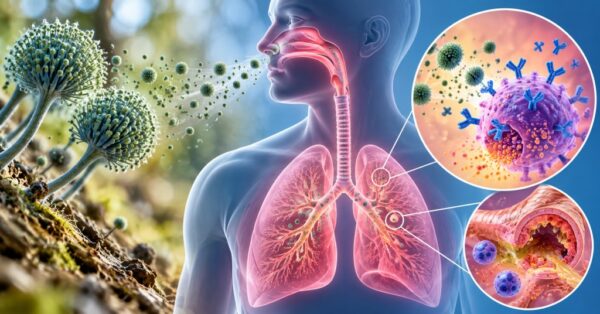
What happens when we develop an allergy, and why can a common fungus such as Aspergillus cause serious respiratory symptoms in some people but not others?
Allergies occur when the immune system reacts to something that is usually harmless. These substances are called allergens. Common examples include pollen, house dust mites, animal dander and fungal spores.
Most people breathe in Aspergillus spores every day without becoming ill. However, in some people, particularly those with asthma or certain other respiratory conditions, the immune system develops an exaggerated response.
Understanding this response helps explain conditions such as allergic asthma, fungal sensitisation and allergic bronchopulmonary aspergillosis (ABPA).
What is an allergy?
Our immune system protects us against infections and other threats. It recognises substances entering the body and decides whether a response is needed.
In an allergy, the immune system mistakenly treats a normally harmless substance as a threat.
This can trigger inflammation and symptoms such as:
- Sneezing, a runny nose or nasal congestion.
- Itchy, watery eyes.
- Coughing, wheezing or breathlessness.
- Skin irritation, itching or hives.
- Occasionally, severe allergic reactions affecting several parts of the body.
Not all allergic reactions involve the same immune mechanisms. Different types of allergy can affect different organs and produce different patterns of symptoms.
What happens inside the immune system?
One important form of allergy involves an antibody called immunoglobulin E (IgE).
When someone becomes sensitised to an allergen, their immune system may produce IgE antibodies that recognise it.
These antibodies can attach to immune cells called mast cells. When the allergen is encountered again, it can trigger the release of substances including histamine and other inflammatory mediators.
These substances contribute to swelling, mucus production, itching and narrowing of the airways.
In respiratory allergy, other immune cells, including eosinophils, may also contribute to inflammation.
However, having allergen-specific IgE antibodies does not necessarily mean that a person has symptoms or an allergic disease requiring treatment. This distinction is particularly important when interpreting Aspergillus blood tests.
What is Aspergillus?
Aspergillus is a group of fungi found widely in the environment. Its spores are present in outdoor air, soil, decaying vegetation and sometimes indoor environments.
Aspergillus fumigatus is one of the species most frequently associated with human respiratory disease.
Breathing in Aspergillus spores is a normal part of everyday life. Healthy lungs and immune defences usually remove them without difficulty.
Problems can arise when someone develops an allergic response, when the fungus persists in already damaged airways, or when the immune system cannot adequately control fungal growth.
These situations can produce different diseases and require different treatments.
What does Aspergillus sensitisation mean?
Aspergillus sensitisation means that the immune system has developed an allergic response to Aspergillus, usually demonstrated by a positive specific IgE blood test or skin-prick test.
Sensitisation does not automatically mean that someone has ABPA or an Aspergillus infection.
Some people with asthma are sensitised to Aspergillus and may experience worsening respiratory symptoms when exposed to fungal allergens.
Others have a positive test without clear symptoms attributable to Aspergillus.
Doctors interpret these results alongside symptoms, medical history, lung function and other investigations.
How is ABPA different from an ordinary allergy?
Allergic bronchopulmonary aspergillosis (ABPA) is a more complex allergic and inflammatory condition, most often associated with asthma or cystic fibrosis. It can also occur in some people with bronchiectasis or other pre-existing respiratory conditions.
In ABPA, Aspergillus may persist within the airways and provoke a substantial immune response.
This can cause:
- Worsening asthma symptoms or breathlessness.
- Persistent coughing and mucus production.
- Thick mucus plugs, sometimes brownish in colour.
- Inflammation and changes visible on chest scans.
- Elevated total IgE and other evidence of an allergic response.
- In some patients, bronchiectasis or additional lung damage over time.
ABPA is not the same as invasive aspergillosis, in which fungal growth invades tissues. Nor is it simply an ordinary seasonal allergy.
Because ABPA involves several immune pathways, diagnosis requires more than a single positive allergy test.
Treatment may involve corticosteroids to control inflammation, antifungal medicines to reduce fungal burden, and in selected cases biological therapies targeting specific inflammatory pathways.
The appropriate treatment depends on disease activity, previous treatment, other health conditions and individual risks.
What is severe asthma with fungal sensitisation?
Some people with severe asthma are sensitised to fungi, including Aspergillus, but do not meet the diagnostic criteria for ABPA.
This has sometimes been described as severe asthma with fungal sensitisation (SAFS).
Fungal sensitisation may be associated with more difficult-to-control asthma, although it is not always possible to establish how much of an individual’s symptoms are caused by the fungus itself.
Management focuses on optimising asthma treatment, assessing the contribution of fungal allergy and considering additional therapies when appropriate.
SAFS and ABPA are related concepts, but they should not be treated as interchangeable diagnoses.
Is fungal allergy the same as a fungal infection?
No. This is one of the most important distinctions.
Allergy describes an inappropriate or exaggerated immune response to fungal allergens.
Infection involves fungal growth causing disease in the body.
Some conditions, including ABPA, involve both fungal persistence in the airways and an exaggerated immune response. However, the disease mechanism is primarily allergic and inflammatory rather than tissue-invasive infection.
Chronic pulmonary aspergillosis (CPA), by contrast, is a long-term fungal infection usually associated with existing lung damage.
Different forms of aspergillosis can occasionally coexist, making specialist assessment important.
What about hypersensitivity pneumonitis?
Hypersensitivity pneumonitis is another immune-mediated lung disease that can be triggered by inhaled environmental substances, including some fungal antigens.
It is sometimes called extrinsic allergic alveolitis.
Despite the word “allergic” in its older name, hypersensitivity pneumonitis is not simply an IgE-mediated allergy.
It involves immune reactions affecting the small airways and lung tissue. Repeated exposure to a relevant trigger can cause inflammation and, in some cases, progressive lung scarring.
Diagnosis and treatment differ from those used for ABPA. Identifying and reducing exposure to the responsible antigen is often an important part of management.
How do doctors investigate Aspergillus allergy?
Depending on symptoms and the suspected diagnosis, investigations may include:
- Aspergillus-specific IgE: Looks for evidence of allergic sensitisation.
- Total IgE: Measures overall IgE levels and can help assess ABPA alongside other findings.
- Blood eosinophil count: May provide information about allergic or type 2 inflammation.
- Aspergillus-specific IgG: Can support assessment of certain Aspergillus-related conditions, but is not itself a test for IgE-mediated allergy.
- Chest CT: May identify bronchiectasis, mucus plugging or other lung abnormalities.
- Lung function tests: Assess airflow limitation and changes in respiratory function.
- Sputum testing: May identify Aspergillus or other organisms in respiratory samples.
Each test answers a different question. A diagnosis should not be based on one abnormal result alone.
Should I avoid Aspergillus spores?
It is impossible to avoid Aspergillus completely because its spores are widespread in the environment.
For most people, ordinary outdoor activities are not a reason for concern. However, some activities can generate unusually high concentrations of fungal spores.
These may include:
- Turning compost or handling mouldy, decomposing vegetation.
- Disturbing large amounts of damp or mouldy material.
- Cleaning heavily contaminated indoor spaces.
- Working in dusty environments containing organic material.
People with ABPA, severe fungal sensitisation or significant immune suppression may benefit from individual advice about higher-risk exposures.
This does not mean that everyone with Aspergillus allergy must stop gardening, avoid outdoor exercise or make major changes to everyday life.
Exposure reduction should be proportionate to the person’s condition and circumstances.
Can Aspergillus allergy go away?
Allergic sensitisation can persist for many years, but symptoms and disease activity may change over time.
Some people experience long periods of good symptom control. Others have recurring episodes of inflammation or asthma exacerbations.
In ABPA, treatment can bring the disease into remission, although relapse remains possible.
It is therefore more useful to distinguish between sensitisation, symptoms and active disease than to assume that a positive allergy test means someone will always be unwell.
What can patients do?
- Take prescribed asthma or ABPA treatment as directed.
- Attend recommended monitoring appointments.
- Discuss changes in symptoms with your clinical team.
- Ask what your allergy blood tests actually mean.
- Reduce exposure to obvious sources of heavy mould contamination where practical.
- Avoid making major lifestyle restrictions without individual clinical advice.
If breathing symptoms worsen suddenly or become severe, seek urgent medical assessment rather than assuming they are caused by allergy alone.
The most important message
Being allergic or sensitised to Aspergillus is not the same as having aspergillosis.
Aspergillus can be associated with several different respiratory conditions, ranging from allergic sensitisation to ABPA and chronic or invasive fungal disease.
Understanding which condition is present helps patients and clinicians choose appropriate treatment, interpret test results and avoid unnecessary worry.
Further reading
- NHS: Allergies
- NHS: Aspergillosis
- Revised ISHAM clinical practice guidelines for ABPA and allergic bronchopulmonary mycosis (2024)
- Allergy UK
Last reviewed: October 2026. This article provides general information and does not replace an individual clinical assessment.

Did this page help you?
Tell us in one minute