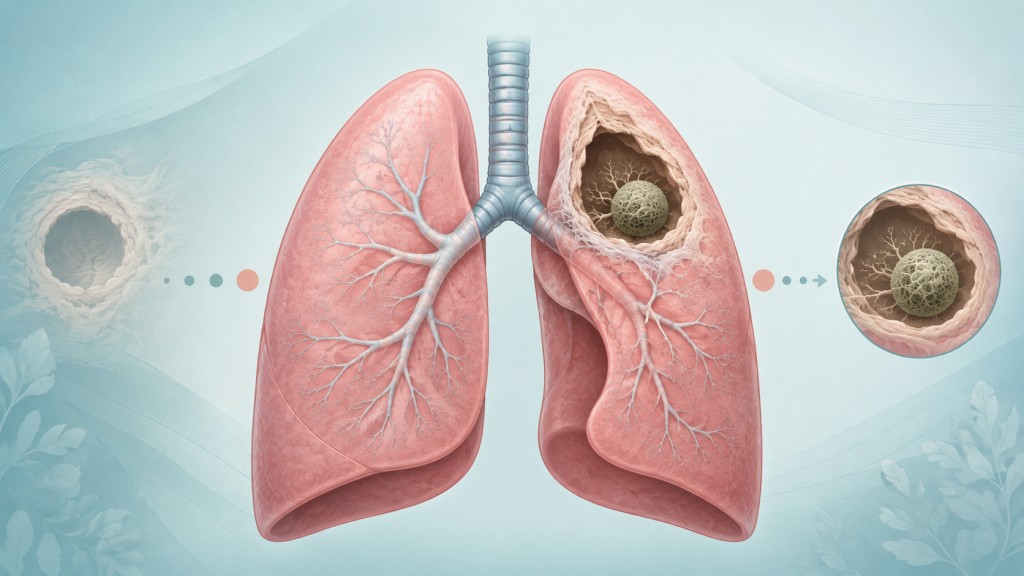
Most people who complete treatment for pulmonary tuberculosis do not develop aspergillosis. However, TB can leave cavities, scarring and widened airways in the lungs. These structural changes sometimes allow Aspergillus to grow and cause chronic pulmonary aspergillosis (CPA).
TB and chronic pulmonary aspergillosis can cause remarkably similar symptoms and changes on chest imaging. This means that aspergillosis may be mistaken for recurrent TB, treatment failure or simply permanent damage left by the original infection.
Recognising the connection is particularly important when cough, breathlessness, weight loss, fatigue or coughing up blood continue or return after apparently successful TB treatment.
What is pulmonary tuberculosis?
Tuberculosis (TB) is an infection caused by bacteria belonging to the Mycobacterium tuberculosis group. It can affect several parts of the body, but pulmonary TB affects the lungs.
Active pulmonary TB can cause inflammation and destroy areas of lung tissue. Treatment can remove the active bacteria, but it cannot always reverse the structural damage that has already occurred.
Changes remaining after treatment may include:
- scarring and fibrosis;
- persistent spaces or cavities within the lungs;
- bronchiectasis, in which damaged airways become widened;
- thickening of the lining around the lungs;
- reduced lung volume or distortion of the airways;
- impaired mucus clearance.
These changes are collectively described as part of post-tuberculosis lung disease. They can cause long-term symptoms even when no active TB bacteria remain.
How can previous TB lead to aspergillosis?
Aspergillus is a common mould found in soil, compost, dust and the air around us. Most people inhale its microscopic spores regularly without becoming ill.
A healthy lung usually clears the spores effectively. However, a cavity left by pulmonary TB provides an abnormal space in which Aspergillus may settle and grow.
This can lead to several different problems:
- Aspergilloma: a fungal ball that forms inside an existing lung cavity.
- Chronic cavitary pulmonary aspergillosis: one or more cavities that persist or gradually enlarge, sometimes containing a fungal ball.
- Chronic fibrosing pulmonary aspergillosis: extensive scarring and destruction that can develop when chronic disease progresses.
- Aspergillus nodules: one or more rounded abnormalities that may resemble cancer or another infection on a scan.
These forms sit within the spectrum known as chronic pulmonary aspergillosis.
Post-TB bronchiectasis may also impair mucus clearance and make the lungs more vulnerable to repeated bacterial or fungal infection.
Does everyone who has had TB need to worry?
No. Most people treated for TB will not develop CPA.
The risk is greater when pulmonary TB has left substantial structural damage, particularly one or more persistent cavities. Other factors may include:
- bronchiectasis;
- COPD or emphysema;
- low body weight or poor nutrition;
- diabetes;
- immune suppression;
- long-term or repeated corticosteroid treatment;
- more than one episode of pulmonary TB.
Latent TB—where TB bacteria are present without active disease—does not usually produce the same lung cavities and is not equivalent to having had destructive pulmonary TB.
Why are TB and CPA easily confused?
The two conditions share several possible symptoms:
- a persistent cough;
- increasing breathlessness;
- fatigue;
- weight loss or difficulty regaining weight;
- fever or night sweats;
- chest discomfort;
- coughing up blood (haemoptysis).
Both can also produce cavities, scarring and areas of inflammation on chest X-rays or CT scans.
When symptoms recur after TB treatment, it is therefore understandable that recurrent TB may be suspected first. In countries where TB is common but fungal diagnostic tests are difficult to obtain, some people may receive further courses of anti-TB treatment without convincing evidence that active TB has returned.
However, TB medicines do not treat Aspergillus. Delayed recognition allows CPA to continue damaging the lungs.
Can active TB and aspergillosis occur together?
Yes. Although CPA often becomes apparent after TB treatment, active TB and Aspergillus-related disease can occasionally coexist.
Finding evidence of one condition therefore does not always exclude the other. Clinicians may need to investigate for both, particularly when:
- symptoms or imaging do not improve as expected;
- TB tests are repeatedly negative despite continuing symptoms;
- the patient initially improves but then deteriorates;
- there is a persistent cavity or a possible fungal ball;
- significant coughing of blood develops.
Coexisting disease can make treatment more complicated. Rifampicin and some other TB medicines interact strongly with azole antifungal medicines, so treatment must be planned and monitored by clinicians experienced in managing these interactions.
When should CPA be considered after TB?
Further assessment may be appropriate when respiratory or constitutional symptoms persist for several months, return after treatment or gradually worsen—especially in someone with cavities or other substantial changes on lung imaging.
Symptoms warranting discussion with a healthcare professional include:
- a cough that does not settle;
- gradually worsening breathlessness;
- ongoing or unexplained fatigue;
- unintentional weight loss;
- recurrent chest infections;
- blood in the sputum;
- new or enlarging cavities on imaging.
These symptoms have many possible causes. They do not prove that CPA is present, but they should not automatically be attributed to old TB damage without considering other explanations.
How is chronic pulmonary aspergillosis diagnosed?
There is no single test that diagnoses every case. Clinicians combine the person’s history, symptoms, imaging and laboratory results. You can find a broader explanation on our diagnosis of aspergillosis page.
Chest imaging
A CT scan provides much more detail than a chest X-ray. Features that may raise suspicion include:
- one or more lung cavities;
- a cavity that is enlarging or developing a thicker wall;
- a fungal ball within a cavity;
- thickening around the cavity or lining of the lung;
- new areas of inflammation around an old cavity;
- progressive fibrosis or loss of lung volume;
- one or more nodules.
Comparison with older images is extremely valuable. A single abnormal scan may show the damage left by TB, but scans taken over time can reveal whether the disease is stable or progressing.
Aspergillus IgG blood testing
An Aspergillus IgG antibody test is one of the most useful blood tests for CPA. A positive result indicates that the immune system has made a significant response to Aspergillus.
The result must be interpreted alongside symptoms and imaging. A positive result alone does not prove active CPA, while a negative result does not exclude every case, particularly in someone whose immune system cannot produce a strong antibody response.
Sputum testing
Sputum may be tested using fungal culture or molecular techniques such as PCR. Finding Aspergillus supports the diagnosis, but cultures are often negative even when CPA is present.
A negative sputum culture should therefore not be used by itself to rule out CPA.
Sputum should also be tested for TB and, where appropriate, other bacteria or nontuberculous mycobacteria. More than one infection may be present.
Other investigations
Depending on the individual case, clinicians may use:
- lung-function testing;
- bronchoscopy and samples from the lower airways;
- biopsy of a nodule or other abnormal area;
- tests for other fungal infections found in particular parts of the world;
- assessment for lung cancer or another cause of cavitation.
How is CPA treated?
Treatment depends on the form and severity of disease, the person’s symptoms, whether imaging is progressing and their other medical conditions.
Oral antifungal medicines such as itraconazole or voriconazole are commonly used. Posaconazole or isavuconazole may be considered in some circumstances. Treatment frequently continues for many months and sometimes longer.
Monitoring is important because antifungal medicines can:
- interact with other medicines;
- affect the liver or cause other adverse effects;
- produce blood levels that are too low or too high;
- be ineffective if the infecting Aspergillus is resistant.
Blood tests, antifungal drug-level measurements and follow-up imaging may therefore be required. Read more about drug interactions with antifungal medicines.
A single stable aspergilloma without significant symptoms may sometimes be monitored rather than treated immediately. Surgery may be considered in selected patients with a localised fungal ball and adequate lung function. Significant bleeding may require urgent treatment, including a procedure to block the responsible blood vessel.
Why does earlier recognition matter?
Untreated CPA can gradually enlarge lung cavities, increase fibrosis and further reduce lung function. It can also cause severe or recurrent bleeding.
Earlier diagnosis offers several potential benefits:
- avoiding unnecessary repeat courses of TB medication;
- starting appropriate antifungal treatment when needed;
- monitoring cavities before extensive damage develops;
- identifying other causes of persistent symptoms;
- improving recognition of post-TB lung disease more broadly.
Not every person who has completed TB treatment needs extensive fungal testing. A more practical approach is to investigate people with persistent or recurrent symptoms, residual cavities or unexplained progression on imaging.
The global diagnostic gap
TB affects millions of people worldwide, particularly in countries where access to CT scanning, Aspergillus IgG testing and specialist fungal services may be limited.
Recent research has confirmed a substantial burden of CPA among people previously treated for TB. However, estimates vary widely between studies because the populations, diagnostic tests and definitions differ.
This is not simply a problem in countries with a high TB incidence. People may move between countries many years after treatment, and CPA can emerge or be recognised long after the original infection.
A history of pulmonary TB remains clinically relevant even if treatment took place decades earlier.
Healthcare professionals can read our specialist evidence summary on CPA during tuberculosis treatment for a more detailed discussion of recent research and diagnostic pathways.
What should patients do?
If you have previously been treated for pulmonary TB and continue to experience respiratory symptoms:
- tell your clinician about the previous TB, even if it occurred many years ago;
- ask whether old and current scans have been compared;
- ask whether cavities, bronchiectasis or substantial scarring remain;
- discuss whether Aspergillus IgG and sputum testing would be appropriate;
- seek prompt advice if you cough up blood;
- do not stop or alter TB or antifungal medication without medical advice.
Coughing up more than a few streaks or spots of blood, or bleeding accompanied by breathlessness, dizziness or weakness, requires urgent medical assessment. Call emergency services if the bleeding is substantial.
For more detailed information about recognising and responding to bleeding, see our patient guide to haemoptysis.
Key points
- Pulmonary TB can leave cavities, scarring and bronchiectasis even after the infection has been successfully treated.
- These structural changes can increase susceptibility to chronic pulmonary aspergillosis.
- TB and CPA can both cause cough, weight loss, fatigue, breathlessness, bleeding and lung cavities.
- CPA may be mistaken for recurrent TB or dismissed as permanent post-TB damage.
- Diagnosis usually requires a combination of CT imaging, Aspergillus IgG testing and microbiological evidence.
- A negative sputum fungal culture does not exclude CPA.
- Most people treated for TB do not develop CPA, but persistent or worsening symptoms deserve investigation.
Further information and evidence
- Systematic review of chronic pulmonary aspergillosis among people treated for pulmonary tuberculosis
- British Thoracic Society Clinical Statement on Aspergillus-related chronic lung disease
- World Health Organization: global burden of CPA following pulmonary tuberculosis
- Prospective study of CPA following tuberculosis in Nigeria
This article provides general information and does not replace assessment by a TB, respiratory or fungal-infection specialist.

Did this page help you?
Tell us in one minute