Our lungs change naturally as we get older. They gradually lose some of their ability to spring back after we breathe in, while the chest wall becomes less flexible. But what happens when someone also has aspergillosis, bronchiectasis or asthma?
Can these conditions make breathing more difficult as we age? And does becoming more breathless necessarily mean that aspergillosis is getting worse?
The answer is more complicated than simply saying that our lungs become less elastic.
Key points
- Healthy lungs gradually lose some of their elastic recoil with age.
- ABPA and bronchiectasis mainly affect the airways, causing inflammation, mucus plugging and sometimes air trapping.
- Chronic pulmonary aspergillosis (CPA) can cause fibrosis, making affected lung tissue stiffer and harder to expand.
- Increasing breathlessness does not always mean aspergillosis is progressing.
- Exercise, pulmonary rehabilitation and effective treatment can improve breathing and activity levels, even when some structural lung damage remains.
What does lung elasticity actually mean?
Healthy lungs contain networks of elastic fibres that allow them to stretch when we breathe in and spring back when we breathe out.
Two important properties help explain this:
- Elastic recoil is the tendency of the lungs to return towards their resting size after being inflated.
- Compliance describes how easily the lungs expand when pressure is applied.
These properties are related, but they are not the same.
A lung that has lost some elastic recoil may be easier to inflate but less effective at pushing air out. Conversely, a lung affected by fibrosis may have greater elastic recoil but be much harder to expand.
This distinction helps explain why different lung diseases can cause breathlessness in different ways.
Four ways lung mechanics can differ
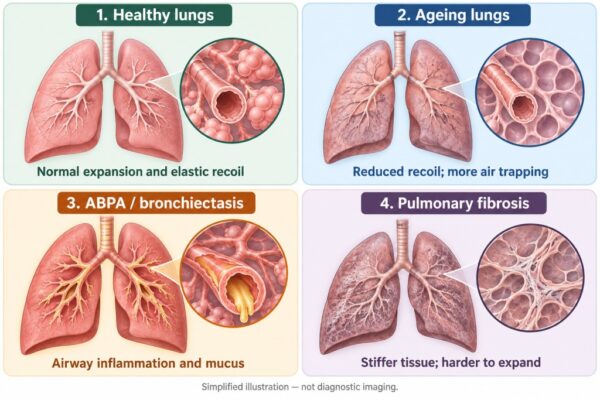
1. Healthy lungs
Normal expansion and elastic recoil
2. Ageing lungs
Reduced recoil and more air trapping
3. ABPA / bronchiectasis
Inflammation, mucus and airflow obstruction
4. Pulmonary fibrosis
Stiffer tissue, harder to expand
How do healthy lungs change with age?
As we grow older, the elastic properties of lung tissue gradually change.
The lungs generally lose some elastic recoil, meaning they do not spring back quite as effectively during breathing out. Small airways may close earlier during expiration, leaving more air trapped inside the lungs.
At the same time, the chest wall tends to become less flexible because of changes in the ribs, joints, muscles and surrounding tissues.
These changes can result in:
- More air remaining in the lungs after breathing out.
- A gradual reduction in the amount of air that can be forcibly exhaled in one second (FEV1).
- Less respiratory reserve during strenuous activity.
- Greater effort being needed to breathe during exercise.
These are normal features of ageing, although the rate of change varies considerably between individuals.
Importantly, ageing does not simply make lung tissue stiffer. The lungs themselves generally become easier to stretch, while the chest wall becomes less flexible.
How does aspergillosis affect lung elasticity?
Different forms of aspergillosis affect the lungs in different ways.
Allergic bronchopulmonary aspergillosis (ABPA)
ABPA primarily affects the airways through an allergic inflammatory response to Aspergillus.
Inflammation, mucus plugging and bronchiectasis can narrow or obstruct the airways, making it harder to move air in and out.
Some patients develop air trapping, particularly during breathing out.
This is not necessarily caused by a loss of elasticity in the lung tissue itself. Instead, the main problem may be increased resistance to airflow.
If inflammation and mucus plugging improve with treatment, lung function may improve too. However, established bronchiectasis and other structural changes may persist.
Chronic pulmonary aspergillosis (CPA)
CPA can affect the structure of the lung tissue more directly.
Over time, some patients develop fibrosis, pleural thickening, cavities and areas of damaged or destroyed lung.
Fibrosis makes affected lung tissue stiffer and less compliant, meaning that more effort is needed to expand it.
Interestingly, this is different from normal ageing.
While ageing generally reduces elastic recoil, fibrosis can increase the recoil of affected tissue. Unfortunately, this does not mean the lungs work better. Stiff, scarred tissue is harder to inflate and may reduce the volume of air the lungs can hold.
The degree of functional impairment depends on how extensive the changes are and how much healthy lung remains.
Aspergilloma
An aspergilloma is a fungal ball growing within an existing lung cavity.
A small, localised aspergilloma may have little direct effect on overall lung mechanics.
However, the disease that originally caused the cavity, or additional surrounding lung damage, may already have reduced lung function.
Bronchiectasis
Bronchiectasis often occurs alongside ABPA or CPA.
The affected airways become permanently widened and may be prone to mucus retention and recurrent infection.
This can increase resistance to airflow, cause air trapping and contribute to breathlessness.
Some people therefore experience a combination of obstructive and restrictive changes, depending on the extent and nature of their lung disease.
Does becoming more breathless mean aspergillosis is progressing?
Not necessarily.
Breathlessness is influenced by several factors, including lung structure, airway inflammation, mucus retention, respiratory muscle strength, cardiovascular fitness and other medical conditions.
Someone whose aspergillosis is stable may still notice gradually increasing breathlessness because of ageing, reduced physical activity, asthma or other conditions.
Conversely, increasing breathlessness can sometimes indicate a flare of ABPA, progression of CPA, infection or another complication.
The important point is that symptoms alone cannot reliably distinguish these possibilities.
New, persistent or worsening breathlessness should be assessed by a healthcare professional rather than assumed to be a normal consequence of ageing.
Sudden severe breathlessness, particularly with chest pain, fainting or blue lips, requires emergency medical attention.
Can lung function tests distinguish ageing from lung disease?
Lung function testing provides useful information about how well the lungs are working.
Spirometry measures how much air can be exhaled and how quickly.
Two important measurements are:
- FEV1: The volume of air forcibly exhaled during the first second.
- FVC: The total volume of air that can be forcibly exhaled after taking a full breath.
The relationship between FEV1 and FVC helps identify airflow obstruction.
More detailed pulmonary function tests may measure:
- Total lung capacity (TLC): The total amount of air the lungs can contain.
- Residual volume (RV): The air remaining after breathing out as fully as possible.
- Gas transfer (DLCO or TLCO): How effectively gases pass from the lungs into the blood.
These measurements help clinicians distinguish airflow obstruction, air trapping, restriction and impaired gas transfer.
However, they do not directly measure lung elasticity, and no single test can always identify the cause of breathlessness.
Results are interpreted alongside symptoms, examination, imaging and previous lung function measurements.
Because lung function normally changes with age, clinicians use reference values that account for factors including age, height and sex. Comparing results over time is particularly useful.
Can exercise improve lung elasticity?
Exercise cannot reliably reverse established pulmonary fibrosis or restore the elastic recoil of younger lungs.
However, this does not mean that exercise cannot help.
Regular physical activity and pulmonary rehabilitation can improve cardiovascular fitness, muscle strength and the body’s ability to use oxygen efficiently.
This may allow someone to undertake more activity before becoming breathless, even when their underlying lung structure has not changed.
Pulmonary rehabilitation can also help people develop breathing strategies, improve confidence and manage fatigue.
For patients with bronchiectasis, appropriate airway clearance techniques may help remove retained mucus and reduce some of the problems caused by airway obstruction.
Exercise programmes should be adapted to individual abilities and medical circumstances, particularly for people with severe respiratory disease or low oxygen levels.
Can treatment improve lung function?
Sometimes, yes.
If reduced lung function is partly caused by airway inflammation, bronchospasm or mucus plugging, effective treatment may improve airflow.
For example, treating an ABPA flare may reduce inflammation and help restore some previously lost lung function.
However, treatment cannot necessarily reverse permanent structural changes such as established fibrosis or bronchiectasis.
In CPA, successful antifungal treatment may help control infection and limit further damage, but improvement in lung function is not guaranteed.
This is one reason why controlling active disease and preserving the remaining healthy lung are important treatment goals.
What should patients take away from this?
Our lungs change naturally as we age, but these changes are not identical to those caused by aspergillosis.
- Ageing tends to reduce elastic recoil.
- Fibrosis makes affected lung tissue stiffer.
- Airway inflammation and bronchiectasis can make it harder to move air through the lungs.
All three processes may contribute to breathlessness, sometimes in the same person.
Worsening breathlessness does not automatically mean aspergillosis is progressing. Equally, it should not simply be dismissed as ageing.
Understanding the different causes can help patients and clinicians identify which problems might respond to treatment, exercise, airway clearance or pulmonary rehabilitation.
And perhaps most importantly, breathing and exercise tolerance can sometimes improve even when permanent structural changes remain.
Further information
Explore related information on aspergillosis.org:
- Understanding lung function tests
- Pulmonary rehabilitation
- Airway clearance techniques
- Allergic bronchopulmonary aspergillosis
- Chronic pulmonary aspergillosis
This article provides general patient information and is not a substitute for individual medical advice. If you notice a change in your breathing, discuss it with your healthcare team.

Did this page help you?
Tell us in one minute