People with chronic sinusitis sometimes also have asthma, raised eosinophils or allergies to fungi such as Aspergillus. Are these conditions connected, and does having fungal sinusitis mean the fungus has spread into the lungs?
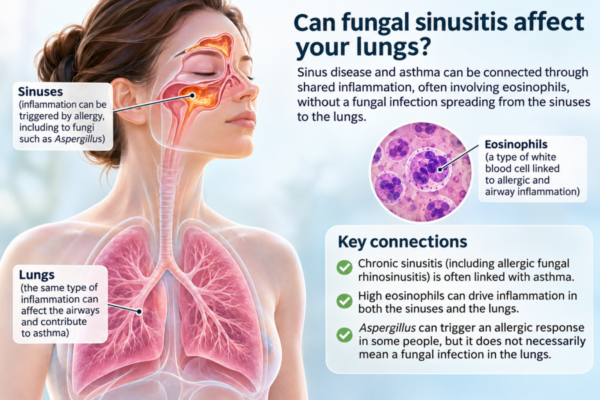
The short answer is that sinus disease can contribute to problems with asthma, but this usually happens through inflammation rather than fungal infection spreading from the sinuses into the lungs.
Understanding this connection can help explain why some people experience persistent sinus problems alongside asthma that is difficult to control.
Your nose, sinuses and lungs are connected
The nose, sinuses and lungs form part of one respiratory system. Although they have different functions, they share many of the same immune defences.
Doctors sometimes describe this as the united airways concept.
Inflammation in the nose and sinuses often occurs alongside inflammation in the lungs. For example, people with chronic rhinosinusitis (long-lasting inflammation of the sinuses) are more likely to have asthma, particularly if they also have nasal polyps.
This does not mean that an infection has travelled from the sinuses into the lungs. Instead, the same underlying inflammatory process may be affecting both areas.
Treating sinus inflammation can sometimes improve asthma symptoms and quality of life, although it does not necessarily cure asthma.
What role do eosinophils play?
Eosinophils are a type of white blood cell involved in immune responses, particularly allergic inflammation and defence against certain parasites.
In some people, eosinophils become unusually active and contribute to inflammation in the airways.
This is sometimes called type 2 inflammation, a pattern of immune activity involving signalling molecules such as interleukin-4 (IL-4), IL-5 and IL-13.
These signals can contribute to:
- Swelling and irritation of the airways
- Increased mucus production
- Nasal polyps and persistent sinus inflammation
- Wheezing, coughing and breathlessness
- Asthma that remains difficult to control despite treatment
People with eosinophilic asthma may also have chronic sinusitis with nasal polyps. The same inflammatory pathways can be active in both conditions.
However, raised eosinophils do not automatically mean that someone has a fungal allergy. Eosinophils can be elevated for several reasons, and their significance depends on the wider clinical picture.
What is allergic fungal rhinosinusitis?
Allergic fungal rhinosinusitis (AFRS) is a particular form of chronic sinus disease associated with a strong inflammatory response to fungi.
Fungal material may be present in the sinuses, but the main problem is usually the immune response rather than fungal invasion into surrounding tissues.
People with AFRS may experience persistent nasal blockage, thick mucus, nasal polyps, reduced sense of smell and recurrent sinus problems.
Some require surgery to remove obstructing material and restore sinus drainage. However, inflammation can return after surgery, so ongoing medical treatment and monitoring are often needed.
Importantly, not everyone with chronic sinusitis or nasal polyps has allergic fungal rhinosinusitis. The diagnosis depends on clinical findings, imaging and sometimes examination of material removed during surgery.
Can Aspergillus affect both the sinuses and lungs?
Yes. Aspergillus is a common environmental fungus whose spores are regularly inhaled.
In most people, these spores cause no illness. However, in susceptible individuals, Aspergillus may be associated with several different conditions.
In the sinuses, it can be associated with allergic fungal rhinosinusitis, a non-invasive fungal ball or, much less commonly, invasive fungal infection.
In the lungs, Aspergillus can be associated with allergic sensitisation, allergic bronchopulmonary aspergillosis (ABPA), chronic pulmonary aspergillosis (CPA) and other forms of fungal disease.
These conditions are different and require different approaches to diagnosis and treatment.
Having Aspergillus-related sinus disease does not automatically mean that Aspergillus is causing disease in the lungs.
What is the difference between eosinophilic asthma and ABPA?
Both conditions can involve asthma, eosinophils and inflammation, but they are not the same.
Eosinophilic asthma is a form of asthma in which eosinophilic inflammation contributes to airway symptoms. It can occur without any fungal involvement.
Allergic bronchopulmonary aspergillosis (ABPA) is a more specific condition involving an exaggerated immune response to Aspergillus in the airways. It may cause worsening asthma, mucus plugging, recurrent chest abnormalities and sometimes bronchiectasis.
ABPA is diagnosed using a combination of clinical findings, blood tests and imaging. No single symptom or positive antibody test is sufficient.
People with difficult-to-control asthma may benefit from specialist assessment to determine which inflammatory processes are involved.
Why might Aspergillus IgG be positive when IgE is negative?
This can be confusing because the two tests measure different types of immune responses.
Aspergillus-specific IgE helps identify allergic sensitisation to Aspergillus. A negative result makes ABPA much less likely, although specialists interpret it alongside the clinical picture and other investigations.
Aspergillus-specific IgG indicates an immune response to Aspergillus. It may be elevated in several circumstances, including some fungal lung diseases, but a positive result alone does not establish an active infection.
Galactomannan is a fungal antigen test used mainly in particular settings when invasive aspergillosis is suspected. It is not recommended as a diagnostic test for ABPA, and a negative result does not exclude allergic fungal disease.
Therefore, someone can have positive Aspergillus IgG, negative Aspergillus IgE and negative galactomannan without these results being contradictory.
The tests answer different questions.
What if asthma remains difficult to control?
Persistent asthma symptoms deserve further assessment, especially when they occur alongside chronic sinusitis, nasal polyps or raised eosinophils.
A respiratory specialist may review:
- Whether the asthma diagnosis and current inhaler treatment are appropriate
- Inhaler technique, adherence and possible environmental triggers
- Blood eosinophil levels and total IgE
- Evidence of fungal sensitisation or ABPA, where clinically indicated
- Whether ongoing sinus inflammation is contributing to symptoms
- Whether lung function tests or chest imaging are needed
An ENT specialist may also reassess the sinuses, particularly when there is a history of repeated surgery.
Other causes of difficult-to-control asthma may need consideration. These include bronchiectasis, reflux, vocal cord or laryngeal problems and, in selected cases, other eosinophilic disorders.
The aim is to understand what is driving the symptoms rather than assuming that fungi are responsible.
Can biologic medicines help?
For some people with severe eosinophilic asthma, newer treatments called biologics can make a substantial difference.
These medicines target particular parts of the immune response.
Examples include:
- Mepolizumab and benralizumab, which target the IL-5 pathway involved in eosinophilic inflammation
- Dupilumab, which blocks signalling through the IL-4 and IL-13 pathways
- Tezepelumab, which targets an upstream inflammatory signal called TSLP
Some biologics are also approved for chronic rhinosinusitis with nasal polyps, depending on the medicine and the country.
This means that a treatment selected for severe asthma may sometimes also improve associated sinus disease.
Biologics are not suitable for everyone. Eligibility depends on the diagnosis, severity, previous treatments and specialist assessment.
They are not antifungal medicines and do not directly eliminate Aspergillus.
When might a doctor prescribe antifungal treatment?
If Aspergillus is involved in sinus or lung disease, it may seem logical to prescribe an antifungal medicine. However, antifungals are not always necessary or helpful.
The decision depends on the type of disease.
For allergic fungal rhinosinusitis, treatment usually focuses on controlling inflammation, often with surgery, saline rinses and nasal corticosteroids. Oral antifungals are sometimes considered by specialists for disease that repeatedly returns or is particularly difficult to control, but evidence of benefit is limited.
For eosinophilic asthma, antifungals are not normally used unless there is evidence of an additional fungal-related condition.
For ABPA, antifungals have a more established role. Itraconazole can reduce the amount of Aspergillus in the airways and therefore reduce the stimulus for the allergic response. It is one of the recommended initial treatment options for active ABPA.
For chronic pulmonary aspergillosis, antifungal treatment is often needed when disease is symptomatic or progressing.
Antifungal medicines can cause side effects and interact with other medications, including some asthma inhalers. Specialists may need to monitor liver function and antifungal blood levels during treatment.
A positive Aspergillus antibody test alone is not a reason to start antifungal treatment. Doctors need to establish which condition is present and whether antifungal therapy is likely to provide a meaningful benefit.
What if you have already had several sinus operations?
Repeated sinus surgery does not necessarily mean that previous treatment has failed.
Some forms of chronic sinusitis are persistent inflammatory conditions that can recur even after technically successful surgery.
Surgery may improve drainage, remove obstructing material and allow topical medicines to reach the affected areas more effectively.
However, controlling the underlying inflammation remains important.
For someone who has had several operations and now has poorly controlled asthma, it may be particularly useful for respiratory and ENT specialists to consider the conditions together.
When should you seek medical advice?
If asthma is becoming more difficult to control, arrange a prompt review with your asthma or respiratory team. Increasing reliever use, worsening breathlessness, disturbed sleep or reduced ability to carry out normal activities should not be ignored.
If you are having a severe asthma attack, struggling to speak because of breathlessness or not improving with your prescribed reliever treatment, seek emergency medical help.
The key message
Sinusitis and asthma can be connected without a fungal infection spreading between them.
In many people, particularly those with raised eosinophils or nasal polyps, the connection involves shared inflammatory pathways affecting both the upper and lower airways.
Aspergillus may sometimes contribute to this inflammation, but positive fungal blood tests do not automatically mean that fungi are causing active lung disease.
Understanding the type of inflammation involved can help specialists select more appropriate treatments, including targeted biologic medicines for some patients.
This information is intended to support discussions with healthcare professionals and does not replace individual medical advice.

Did this page help you?
Tell us in one minute