


Article 4: Why This New Information on Biofilms Can Be Reassuring — Not Frightening
💬 A Message to Patients: Why This New Information Can Be Reassuring — Not Frightening
We understand that learning about things like biofilms, the lung microbiome, or how different bugs work together might feel a little overwhelming or even alarming. These topics are complex and unfamiliar to many.
But we want you to know: this science is already improving care for people with aspergillosis — and you don’t need to understand every detail for it to help you.
✅ Examples of How Biofilm Awareness Is Already Helping Patients
🧪 1. Combined Treatment for Coinfection
People who have both Aspergillus and Pseudomonas infections are now more likely to be:
-
Tested for both microbes
-
Given combination therapy (e.g. antifungals + inhaled antibiotics)
This reduces the risk of persistent symptoms and lowers the chance of hospital admission.
🌬 2. Inhaled Therapies That Reach Biofilms
Doctors are now using or trialling inhaled medications that can:
-
Reach fungal and bacterial biofilms more directly
-
Work even when oral drugs can’t penetrate
For example, inhaled colistin or tobramycin is used in bronchiectasis; inhaled antifungals (like opelconazole) are in trials for aspergillosis.
💡 3. Chest Physiotherapy and Mucus Clearance
Biofilm research has shown that many infections hide in thick mucus. So, clearing mucus isn't just for comfort — it’s a critical part of treatment.
-
More patients now receive airway clearance devices
-
Some are referred for specialist physiotherapy to support this
🧼 4. Better Infection Control in Hospital
Because we understand that biofilms form on equipment and even in hospital air systems, specialist centres like NAC use:
-
HEPA-filtered rooms
-
Strict protocols to prevent airborne contamination
This lowers the risk of acquiring new fungal infections during hospital stays.
📊 5. More Personalised Care
Some patients now receive tailored treatment plans based on:
-
Sputum cultures that show which organisms are present
-
Whether biofilm-forming species are involved
-
Coexisting inflammation, allergies, or colonisation patterns
This is a big shift from one-size-fits-all prescriptions.
💬 Final Reassurance
These discoveries don’t mean there’s something worse going on. They mean that:
Doctors now understand more
Treatments are becoming more precise
We can often treat fewer times, more effectively
You're not alone — and you're not expected to keep up with every detail. This information helps your care team make better choices for you, reduce flare-ups, and improve quality of life. And that’s what really matters.

📝 Article 3: When Microbes Work Together – Aspergillus, Pseudomonas, and Lung Inflammation
🤝 Not all microbes are rivals — some collaborate
Recent research shows that Aspergillus fumigatus and Pseudomonas aeruginosa can cooperate, particularly in people with weakened lungs or structural damage (e.g. from bronchiectasis, CF, or CPA).
Examples of how they interact:
-
Pseudomonas produces toxins (phenazines) that sometimes stimulate Aspergillus growth in low doses
-
Aspergillus produces substances like gliotoxin that weaken immune responses and protect both microbes
-
Both can form mixed biofilms, making them more drug-resistant and more inflammatory
⚠️ Clinical implications:
Coinfection with Aspergillus and Pseudomonas is associated with:
-
Worse lung function in CF, bronchiectasis, CPA
-
More frequent exacerbations and hospital admissions
-
Longer recovery times and lower quality of life
🧠 Why is this important for treatment?
Doctors are now:
-
Testing for multiple microbes during exacerbations
-
Using combination therapy — antifungals and antibiotics together
-
Supporting the immune system with:
-
Airway clearance
-
Nutrition
-
Steroid balancing (not too much, not too little)
-
🧬 New tools on the horizon:
-
Drugs that block microbial signalling (quorum sensing)
-
Microbiome profiling to predict flare-ups
-
Biofilm-dissolving agents in development
-
Inhaled antifungals under trial (e.g. opelconazole)
🌟 Final Summary: A Shift in Perspective
| Old Approach | New, Holistic Approach |
|---|---|
| Target a single infection | Understand the whole lung ecosystem |
| Treat only during active infection | Focus on prevention, balance, resilience |
| One-size-fits-all antibiotic use | Tailored therapy, minimise microbiome damage |
| Ignore biofilms | Disrupt biofilms and support mucus clearance |
| Fungal and bacterial issues separate | Recognise synergy and co-infection |

📝 Article 2: The Lung Microbiome – More Than Just Aspergillus
🌱 What is the lung microbiome?
The lung microbiome is the collection of bacteria, fungi, and viruses that naturally live in your respiratory system. For a long time, lungs were thought to be sterile — we now know that they host complex microbial communities, even in healthy people.
In people with chronic lung conditions like CPA, ABPA, asthma, bronchiectasis, and cystic fibrosis, the lung microbiome can become unbalanced. Certain harmful microbes may overgrow, while beneficial ones disappear.
🤝 Why is this important?
The balance of microbes in your lungs affects:
-
How your immune system responds
-
Whether inflammation is triggered or controlled
-
How easily infections take hold
In aspergillosis patients:
-
Disruption of the microbiome may encourage fungal growth
-
Frequent antibiotics (for chest infections) can kill good bacteria, giving fungi and drug-resistant bacteria an advantage
-
Some microbes may protect against Aspergillus or help modulate inflammation
This is particularly important during flare-ups and exacerbations.
🧪 What are researchers doing?
Lung microbiome research is growing rapidly. Scientists are:
-
Identifying "protective" microbes that might reduce disease severity
-
Studying how antibiotics, steroids, and antifungals alter the microbiome
-
Investigating faecal or airway microbiota transplants in severe lung disease
-
Developing tests that detect imbalances in lung flora before symptoms worsen
💡 What can you do as a patient?
-
Avoid unnecessary or repeated broad-spectrum antibiotics unless clearly needed
-
Use airway clearance techniques to keep mucus and debris low
-
Ask your clinician if your sputum cultures test for both bacteria and fungi
-
Consider probiotics cautiously, though evidence for lung benefit is still limited
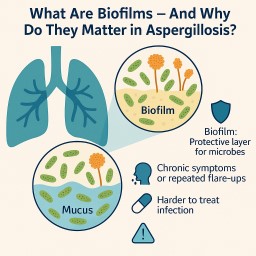
📝 Article 1: What Are Biofilms – And Why Do They Matter in Aspergillosis?
🧫 What is a biofilm?
A biofilm is a protective layer that microorganisms (like fungi and bacteria) create when they stick to a surface — such as the inside of airways, lung cavities, or medical devices. They secrete a sticky matrix of sugars, proteins, and DNA that holds them together and shields them from harm.
In aspergillosis, Aspergillus fumigatus forms biofilms on:
-
Mucus in the lungs
-
Cavities or damaged tissue (e.g. in CPA)
-
Surfaces of bronchial airways, especially in people with asthma or bronchiectasis
Pseudomonas aeruginosa, a bacterium often found alongside Aspergillus, also forms biofilms — and they can even form mixed (dual-species) biofilms together.
❗Why does this matter?
Biofilms protect the microbes inside by:
-
Blocking immune cells from reaching them
-
Preventing antibiotics or antifungals from penetrating the biofilm
-
Allowing microbes to go dormant, then reactivate later
This is one reason why infections in aspergillosis patients can become chronic, relapse frequently, or be very hard to fully clear.
People with CPA, ABPA, SAFS, or fungal bronchitis may experience:
-
Repeated flare-ups or infections despite treatment
-
Persistent coughing, breathlessness, or mucus production
-
Ongoing inflammation in the lungs, even when cultures are negative
🛠 How are biofilms treated?
Current options include:
1. Antifungals and antibiotics
-
Standard antifungals (like voriconazole, posaconazole, isavuconazole) can sometimes penetrate biofilms, but often require longer or higher doses.
-
Inhaled antibiotics (e.g. nebulised colistin or tobramycin) are used in bronchiectasis and can help break into bacterial biofilms.
-
Combined therapy (targeting both bacteria and fungi) may be used in patients with co-infection.
2. Disrupting the biofilm
-
DNase (Pulmozyme) in cystic fibrosis breaks up sticky DNA in mucus where biofilms form.
-
Future treatments aim to use enzymes, surfactants, or nanoparticles to dismantle biofilms.
3. Clearing mucus and infected secretions
-
Chest physiotherapy, postural drainage, and devices like the Acapella® or Flutter® help remove secretions where biofilms sit.
-
Bronchoscopy is occasionally used to clear dense mucus plugs.
🔬 Looking ahead:
Researchers are studying:
-
Drugs that target the biofilm matrix directly
-
Ways to prevent biofilms from forming in the first place
-
New diagnostic tools that detect biofilm presence
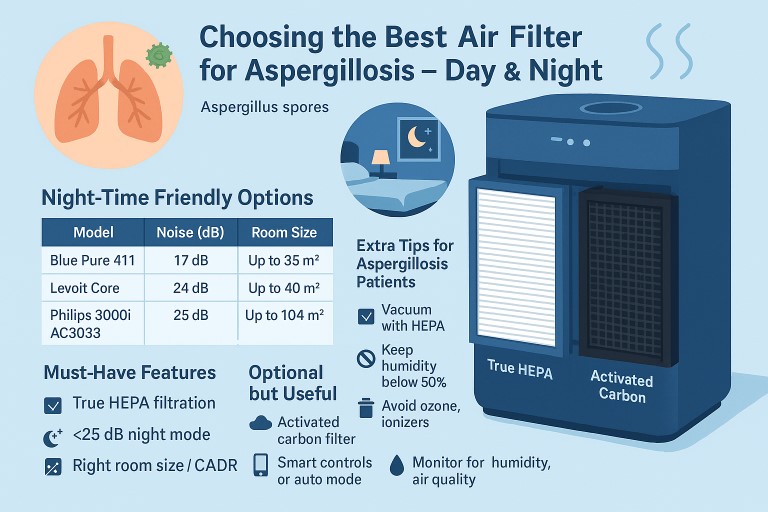
🛡️ Choosing the Best Air Filter for Aspergillosis – Day & Night
Living with aspergillosis (such as ABPA, CPA, aspergillus bronchitis, or SAFS) means taking extra care to avoid airborne Aspergillus spores, which can be found both outdoors and indoors. One of the most effective ways to protect yourself at home is by using a high-quality air purifier.
This guide will help you choose a purifier that works for you — especially for bedroom use at night, where quiet operation is just as important as clean air.
🎯 Why Use an Air Filter?
-
Aspergillus spores are tiny (2–3 microns), invisible to the eye, and can remain airborne for long periods.
-
Indoor sources include dust, damp areas, stored food, compost, or even indoor plants.
-
A HEPA air purifier can trap these particles, helping reduce airway irritation, infections, or allergic reactions.
✅ What to Look For
| Feature | Why It Matters |
|---|---|
| True HEPA Filter | Captures ≥99.97% of particles ≥0.3 microns — includes Aspergillus spores |
| Activated Carbon Filter | Helps remove odours, gases, VOCs (optional bonus) |
| Room Size & CADR | Clean Air Delivery Rate (CADR) should match or exceed your room’s size |
| Quiet Operation | For night-time use, look for ≤25–30 dB (whisper-quiet) |
| Sleep Mode / Dim Lights | Prevents disturbance from lights or fan noise overnight |
| Filter Replacement | Easy to change, ideally with indicator for when to replace |
| No Ozone or Ionisers | Avoids irritation to sensitive lungs — stick with mechanical HEPA filtration |
🌙 Night-Time Friendly Options
| Model | Noise (dB) | Room Size | Notes |
|---|---|---|---|
| Blueair Blue Pure 411 Auto | 17 dB | Up to 35 m² | Super-quiet, ideal for small bedrooms |
| Levoit Core 300S | 24 dB | Up to 40 m² | Quiet, smart controls, affordable |
| Philips 3000i AC3033 | 25 dB | Up to 104 m² | Excellent for larger spaces, smart app |
| IQAir Atem Desk | <22 dB | Personal zone | Ultra-quiet, high-quality for desks/bedsides |
| Dyson Purifier Cool | ~24–32 dB | Medium–large | Stylish, also a fan, more expensive |
Tip: Choose a unit slightly larger than your room size for best effect.
💡 Extra Tips for Aspergillosis Patients
-
✅ Vacuum with a HEPA filter weekly
-
✅ Keep humidity below 50% (use a dehumidifier if needed)
-
✅ Avoid ionizers or ozone generators — these can irritate your lungs
-
✅ Close windows at night during high pollen or spore seasons
-
✅ Clean or change filters regularly (check manufacturer’s guide)
🛏 Night Setup Checklist
-
Place the purifier 1–2 metres from your bed (not right next to your face)
-
Use “Sleep Mode” or low fan for silent overnight cleaning
-
Turn off indicator lights (if bright)
-
Close doors and windows to keep clean air contained
-
Replace filters every 6–12 months or as prompted
📌 Summary
| Must-Have Features | Optional but Useful |
|---|---|
| ✅ True HEPA filtration | 🌫 Activated carbon filter |
| ✅ Quiet night mode (<25 dB) | 📱 Smart controls or auto mode |
| ✅ Right room size / CADR rating | 🌡 Monitor for humidity or air quality |
| ✅ No ozone, no ionizers | 🔁 Filter change indicator |
🗨️ Final Thought
For aspergillosis patients, an air purifier is a worthwhile investment in long-term lung health — especially in sleeping areas where your body is most vulnerable. Choosing the right device helps reduce exposure to fungal spores and improves quality of life, one breath at a time.

📁 Coping with Steroid Side Effects and Finding Balance: A Guide for Aspergillosis Patients
Living with chronic forms of aspergillosis—such as chronic pulmonary aspergillosis (CPA), allergic bronchopulmonary aspergillosis (ABPA), severe asthma with fungal sensitisation (SAFS), or Aspergillus bronchitis—often means taking corticosteroids like prednisolone or hydrocortisone. These powerful medicines can be life-saving, but they also come with physical and emotional side effects, especially at high doses or when taken over long periods.
This guide is here to support you with practical tips, patient stories, and advice on reducing steroids while maintaining your quality of life.
🔊 What Do Steroids Do?
Steroids reduce inflammation and calm overactive immune responses. They're commonly used in aspergillosis to:
- Manage allergic reactions (e.g. in ABPA)
- Control lung inflammation
- Treat adrenal insufficiency or steroid withdrawal symptoms
🔁 Why Reducing Steroids Can Be So Difficult
Steroids are very effective but also powerful. Tapering the dose can cause:
- Return of pain, fatigue, breathing problems, or inflammation
- Steroid withdrawal symptoms (fatigue, low mood, joint pain)
- Adrenal suppression if the body has stopped making its own cortisol
Many patients report:
“I reduced by 1mg and everything fell apart.” “I want to be on less, but life is unbearable when I try.”
You are not failing. Finding the right dose is a balance between lowering risks and keeping your life manageable.
🛋 Common Side Effects and What You Can Do
| Side Effect | Tips to Cope |
|---|---|
| Increased appetite | Plan balanced meals, high-fibre snacks, drink water, be kind to yourself |
| Weight gain / swelling | Gentle movement, reduce salt, try pressotherapy (discuss with your team) |
| Mood swings or anxiety | Talk about it, track your feelings, ask about counselling or peer support |
| Insomnia | Avoid caffeine late, consider timing of dose, try a calming bedtime routine |
| "Moon face" / puffiness | Often fades when dose is reduced; hydrate and moisturise |
| Muscle/joint pain or weakness | Gentle stretches, walking, low-impact activity, speak to a physio if needed |
| Bruising/thin skin | Moisturise, protect from bumps, avoid strong detergents |
| Raised blood sugar | Eat regularly, reduce sugary drinks, ask about monitoring if concerned |
| Bone thinning | Ask about calcium, vitamin D, or bone-protecting medications |
| Adrenal suppression | Never stop suddenly; always taper with a doctor's guidance |
👥 Real Patient Stories and Analogies
🐻 Alison's Bears
“There are two bears inside me. Prednisone Bear is wild and wants to eat and sleep and snap. But Rusty McTravel Bear is my real self—gentle, curious, slowly trying to get back on the road. I’ve learned to recognise the first and nurture the second.”
🏎️ The Revving Car
“Being on steroids sometimes feels like a car with the engine revving but the brakes on. You’re buzzing, but you’re stuck. Try easing the brakes: take a walk, make tea, do something simple to use the energy.”
🚩 Finding Your Balance: When Less Isn't Always Better
✅ Go slow
- Taper in small steps—as little as 0.5–1mg at a time
- Wait several weeks between reductions
✅ Keep a steroid diary
- Note dose, mood, sleep, symptoms, activity
- This helps identify your "minimum effective dose"
✅ Accept that a small maintenance dose may be necessary
- You are not failing if you need 2mg, 5mg, or 7.5mg long-term
- The goal is a life worth living, not perfection
✅ Ask about alternatives
- Inhaled steroids, antifungals, or biologics might help reduce systemic steroid use
✅ Consider adrenal testing
- Especially if you feel unwell during tapering or on low doses
🛏️ Other Strategies That May Help
- Pressotherapy for leg pain and swelling
- Mindfulness or breathing exercises for anxiety or insomnia
- Peer support (online or in person)
- Short-term plans: some patients use a "rescue dose" plan for flare-ups
- Talk to your care team: never reduce on your own without guidance
💼 Summary
Reducing or living with steroids is not just about doses. It’s about protecting your body and your sense of self. If a small daily dose keeps you functioning, that is not weakness—it’s balance.
You are not alone. Many in the aspergillosis community are navigating this same path.
“The right dose is the one where I can breathe, move, smile — and still feel like myself.”
🛡️ Staying Safe with Self-Treatment and Complementary Therapies: A Guide for Aspergillosis Patients
Living with a chronic condition like aspergillosis — whether chronic pulmonary aspergillosis (CPA), allergic bronchopulmonary aspergillosis (ABPA), severe asthma with fungal sensitisation (SAFS), or aspergillus bronchitis — can be exhausting. Many patients explore over-the-counter (OTC) products, natural remedies, or complementary therapies to gain a sense of control.
But how can you be sure a product or therapy is safe, effective, and not a waste of money?
This guide aims to help.
🔍 Why Do Patients Try Things on Their Own?
In many countries, it’s common to self-medicate or explore alternative treatments without consulting a healthcare professional. Reasons include:
-
Limited access to specialist care
-
Cultural norms that favour self-management
-
Easy access to remedies and supplements online or in shops
-
Feeling unheard or unsupported in mainstream medical care
Even in the UK, patients with aspergillosis may turn to:
-
Herbal products
-
Nutritional supplements
-
Creams or gels with capsaicin (chilli), turmeric, or menthol
-
Breathing techniques, steam inhalation
-
“Immune-boosting” diets or over-the-counter fungal cleanses
Some of these may be helpful — but not all are safe or worthwhile.
✅ Step 1: How to Check if a Product or Therapy Is Safe
Before trying anything new, ask:
1. Is it approved or regulated in the UK?
Medicines and certain creams should have a Product Licence (PL) number, issued by the Medicines and Healthcare products Regulatory Agency (MHRA).
You can check the licence on the MHRA product registry.
2. Could it interact with your prescribed medications?
-
Some herbal remedies affect azole antifungal drugs (like itraconazole or voriconazole) or oral steroids.
-
Ask your GP (General Practitioner), specialist, or pharmacist before combining treatments.
3. Is it safe to apply or inhale?
-
Never use essential oils, menthol, or herbal mixtures in a nebuliser unless clearly intended for lung use.
-
Avoid applying hot or irritating creams to broken or sensitive skin.
4. Is it mentioned in NHS guidance?
Stick to advice on:
-
Your local hospital trust’s respiratory or infectious disease guidelines
-
National Institute for Health and Care Excellence (NICE) recommendations
-
Cochrane Reviews or published clinical trials
⚠️ Watch Out for Red Flags
Be cautious of any product, practitioner, or website that:
| 🚩 Red Flag | ⚠️ Why It’s a Concern |
|---|---|
| Claims to “cure” aspergillosis | There is no cure — only long-term management |
| Says it’s “100% natural with no side effects” | Natural products can still be harmful |
| Uses high-pressure sales tactics | Legitimate care is never urgent or fear-based |
| Recommends stopping your prescribed treatment | Stopping antifungals or steroids can be dangerous |
🧪 Step 2: Look for Evidence, Not Just Testimonials
Some treatments are promising — but we need solid evidence to know they work.
✅ Good sources of trustworthy evidence:
-
Cochrane Library (systematic reviews of healthcare studies)
-
Electronic Medicines Compendium (EMC): www.medicines.org.uk
-
NHS Trust guidelines or clinical leaflets
-
Published studies on PubMed, ClinicalTrials.gov, or from recognised research institutions
💬 Can You Trust a Pharmacist?
Yes — in most cases, UK pharmacists are highly trained and regulated. However, there are two kinds to be aware of:
| Type of Pharmacist | What to Know |
|---|---|
| Retail Pharmacist | May sell you products directly; still bound by safety standards |
| Clinical Pharmacist (in GP surgeries or hospitals) | Focused entirely on clinical care and not sales-driven |
Both are regulated by the General Pharmaceutical Council (GPhC) and must put patient safety first, regardless of sales.
🟢 Ask them:
-
“Will this interact with my medications?”
-
“Is this supported by NHS or NICE?”
-
“Would this be suitable for someone with CPA or ABPA?”
🧘 What About Complementary Therapies?
Some patients explore:
-
Acupuncture
-
Herbal medicine
-
Osteopathy or chiropractic
-
Reflexology or massage
-
Nutritional therapy
-
Mindfulness and yoga
These may help with:
-
Muscle or joint pain
-
Fatigue and sleep problems
-
Emotional stress or anxiety
They can complement your medical treatment — but should never replace it.
✅ Safe if:
-
Practitioner is registered with a reputable UK body
-
The therapy does not interfere with prescribed medications
-
It is used for symptom relief, not for “cleansing” or treating the infection
❌ Risky if:
-
It’s marketed as a cure for aspergillosis
-
It encourages you to stop medical treatment
-
It is expensive, secretive, or vague about its effects
Reputable UK Registers:
| Practitioner Type | Regulator / Body |
|---|---|
| Acupuncturists | British Acupuncture Council (BAcC) |
| Herbalists | National Institute of Medical Herbalists (NIMH) |
| Osteopaths | General Osteopathic Council (GOsC) |
| Chiropractors | General Chiropractic Council (GCC) |
| Nutritionists | Association for Nutrition (AfN) |
🧾 Summary: A Safer Way to Explore New Treatments
| ✅ Do This | ❌ Avoid This |
|---|---|
| Check the MHRA or NHS website | Trusting social media or forums alone |
| Look for a PL number and regulated status | Using unlicensed creams, drops, or nebuliser fluids |
| Ask your pharmacist or GP about interactions | Assuming “natural” means harmless |
| Use one new treatment at a time | Trying multiple new remedies together |
| Start with low doses or small trial sessions | Buying expensive long-term “packages” up front |
📘 Real Example: Using Capsaicin Cream for Pain
Some patients with back pain or joint discomfort have tried capsaicin cream (chilli-based), especially if they cannot tolerate non-steroidal anti-inflammatory drugs (NSAIDs) like ibuprofen.
✅ It’s safe for many people when:
-
Applied in small amounts to intact skin
-
Hands are washed after use
-
Used up to 4 times daily
-
Product is licensed (e.g. Zacin® 0.025%)
⚠️ It may cause a burning feeling for the first few days.
Avoid contact with eyes, mouth, or mucous membranes.
Ask a pharmacist before use — especially if you’re on steroids, have skin thinning, or are very sensitive to heat or irritation.
🗂️ Want to Learn More?
-
Visit www.aspergillosis.org
-
Contact the National Aspergillosis Centre (NAC) in Manchester
-
Speak to your GP or hospital respiratory specialist
-
Ask in trusted support groups like the Aspergillosis Support Facebook Group
🧪 Why Are Some Studies So Small?
A smaller study is less powerful and less influential when it comes to trying to prove something, so why do them?
✅ 1. Rare Conditions
-
Diseases like chronic pulmonary aspergillosis (CPA), STAT3-HIES, or NTM lung disease affect relatively few people.
-
It’s often not possible to recruit large numbers, especially within one country or timeframe.
-
Even 20–50 patients may provide meaningful insight if the study is well-designed.
✅ 2. Early-Stage (Phase 1 or Pilot) Trials
-
These studies aim to test safety, dosage, or feasibility — not yet effectiveness.
-
Example: A new antifungal drug might first be given to 10–20 patients to check side effects before moving to large-scale trials.
✅ 3. Expensive or Complex Interventions
-
Trials involving biologics, surgery, gene therapy, or advanced imaging may be very expensive.
-
Researchers may limit numbers to control cost while still collecting useful data.
✅ 4. Intensive Data Collection
-
Some studies gather deep, highly detailed data from each participant — interviews, scans, biopsies, genetic tests.
-
In this case, quality > quantity.
✅ 5. Time-Limited Opportunities
-
COVID-19, for example, created fast-changing clinical situations.
-
Researchers sometimes work with who is available, especially in early observational studies.
⚠️ When It’s Less Ideal
Some small studies are due to:
-
Poor recruitment (e.g. patients don’t want to join, or the trial is poorly advertised)
-
Overambitious study designs
-
Lack of funding
These can lead to underpowered results, meaning the study is too small to detect real effects — or risks false positives/negatives.
🔍 How Do Researchers Handle Small Numbers?
| Strategy | Why It Helps |
|---|---|
| Clear inclusion/exclusion criteria | Reduces noise in small samples |
| Matching or adjusting for variables | Helps control bias |
| Use of qualitative methods | Adds depth to small studies |
| Transparency about limitations | Builds trust and prevents overclaiming |
📌 Summary
| Reason for Small Study Size | Acceptable? | Notes |
|---|---|---|
| Rare condition | ✅ | May be the best evidence available |
| Early phase (safety trial) | ✅ | Not meant to prove effectiveness yet |
| Cost or logistics | ✅/⚠️ | Should be explained in methods |
| Poor design or recruitment | ⚠️ | Reduces confidence in conclusions |
🧠 Tip for Patients:
Always check the sample size, and ask:
-
Is this a pilot study or full trial?
-
Is this a rare disease?
-
Are results meant to guide treatment or explore possibilities?
Even small studies can be powerful if they’re well-designed and honest about their limitations.
🧪 A Patient’s Guide to Understanding Clinical Research
This guide is designed to help patients, carers, and the public understand how medical research works, why it matters, and how you can get involved. Whether you’re considering joining a trial or simply want to make sense of the headlines, this article breaks down key parts of the research process in a clear, patient-friendly way.
🔍 Why Do We Need Research?
Medical research helps us:
- Discover new treatments
- Improve existing care
- Understand diseases better
- Protect patients and public health
Without research, most of the medicines, scans, and therapies we rely on today wouldn’t exist.
🧪 Types of Research and What They’re For
| Type of Research | What It’s Used For | Strength of Evidence |
|---|---|---|
| Systematic Review | Summarising all high-quality studies | 🔷🔷🔷🔷 |
| Randomised Controlled Trial | Testing new treatments | 🔷🔷🔷 |
| Cohort Study | Following people over time | 🔷🔷🔷 |
| Case-Control Study | Looking backward to find causes | 🔷🔷 |
| Cross-sectional Study | Surveying people at one time | 🔷🔷 |
| Qualitative Research | Exploring patient experiences | 🔷🔷 |
| Lab/Animal Studies | Testing how something works at the earliest stage | 🔷 |
| Audit/Service Evaluation | Checking how well care is delivered | 🔷🔷 |
Each type plays a role. Stronger evidence often comes from well-designed trials and systematic reviews.
🧠 Why Does Research Need Ethical Approval?
All studies involving people or their information must be reviewed by an independent Research Ethics Committee. This is to:
- Protect patients from harm
- Make sure people give informed consent
- Ensure privacy and fairness
- Check the research is worth doing
No ethics = no go. Studies can’t legally proceed without this protection.
💊 Why Are Pharmaceutical Companies Involved?
Pharmaceutical companies ("Big Pharma") often fund or run trials because:
- They develop and manufacture new drugs
- They are legally required to test them
- They have the funding and expertise
But concerns include:
- Profit over patient need
- Selective publishing of positive results
- High drug prices
This is why all industry-sponsored research must follow strict rules, with transparency and oversight from regulators like the MHRA, FDA, and NICE.
🔒 How Is Big Pharma Regulated When It Comes to Patients?
Pharmaceutical companies are not allowed to contact patients directly about joining trials unless specific safeguards are in place. Regulations include:
- No direct advertising to patients about prescription drugs (in the UK and most of Europe)
- Trial invitations must go through NHS staff, researchers, or ethics-approved patient registries
- Informed consent must be handled by trained professionals, not company representatives
- Patient data must be handled according to GDPR and confidentiality laws
These rules protect patients from being misled, pressured, or targeted unfairly.
🗣️ Where Does Patient Input Come In?
Patient and public involvement (PPI) happens throughout the research process:
| Stage of Research | How Patients Contribute |
| Planning | Help choose what questions matter |
| Designing the Study | Make it practical and patient-friendly |
| Writing Materials | Ensure clear, respectful consent forms |
| Trial Oversight | Sit on steering committees, monitor fairness |
| Understanding Results | Review findings for meaning and clarity |
| Sharing Results | Create leaflets, videos, and public talks |
Your voice can shape better, fairer, and more relevant research.
🛏️ How to Tell if Research Is Reliable
Look for:
- Was it peer-reviewed (e.g. Journal Impact Factor >1)?
- Was the sample size big enough?
- Did it include a control group?
- Is it published in a medical journal?
- Who funded it — and is that clearly stated?
And remember — a single study doesn’t prove everything. Strong conclusions need multiple good studies.
✅ Final Takeaways
- Clinical research helps improve care and save lives
- Ethical approval protects patients
- Pharma companies are involved, but must be held accountable
- Patients can help shape research at every stage
- Understanding study types helps you spot trustworthy evidence
If you're interested in joining a study or helping shape future research, ask your doctor or visit websites like Be Part of Research (UK) or ClinicalTrials.gov (US & global).
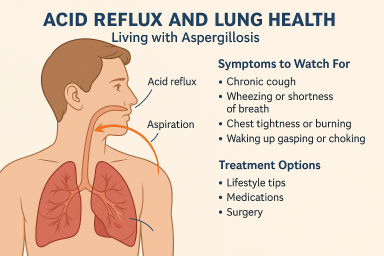
Acid Reflux and Lung Health: What Aspergillosis Patients Should Know
Living with aspergillosis already means managing delicate lung health — so when acid reflux (GERD) or silent reflux (LPR) starts affecting your breathing or causing discomfort, it’s important to know what’s going on and what can be done to help.
This article explains how reflux can impact the lungs, why it may be especially important for aspergillosis patients, and what steps you can take to reduce the risk of further lung irritation or damage.
🔄 What Is Acid Reflux?
GERD (Gastroesophageal Reflux Disease) occurs when stomach acid regularly flows back into the food pipe (esophagus). Sometimes, this acid can reach the throat or even be breathed into the lungs — especially during sleep — causing aspiration. This is more common than people think and is often silent (without heartburn).
🫁 Why Does It Matter for Aspergillosis?
For those with chronic pulmonary aspergillosis (CPA), ABPA, or aspergillus bronchitis, the lungs are already inflamed or damaged. Repeated exposure to stomach acid or bile from reflux can:
-
Worsen coughing and breathlessness
-
Mimic or worsen asthma and wheezing
-
Trigger new infections or inflammation
-
Possibly accelerate lung damage, especially if reflux goes untreated
-
Confuse your diagnosis (e.g. is it infection, inflammation, or reflux?)
In some cases, reflux and aspiration can contribute to lung conditions like bronchiectasis — which is often seen in people with aspergillosis.
🔍 Symptoms to Watch For
If you’re living with aspergillosis and experience any of the following, reflux could be playing a role:
-
Chronic cough or throat clearing
-
Wheezing not relieved by inhalers
-
Chest tightness or “burning” sensation
-
Sour taste in the mouth, especially in the morning
-
Hoarseness or sore throat
-
Waking up gasping or choking
-
Repeated chest infections
These symptoms may be worse after eating or when lying flat.
🧪 Diagnosing Reflux Aspiration
Ask your doctor about the following tests if reflux is suspected:
-
24-hour pH and impedance testing: Measures acid and non-acid reflux
-
Barium swallow or endoscopy: Checks for structural issues
-
Lung function tests: Identify asthma-like patterns
-
CT scan: To detect aspiration-related changes like bronchiectasis
-
Sputum tests: To rule out infection
💊 Treatment Options (and What Helps Most)
Lifestyle Tips
-
Raise the head of your bed 6–8 inches
-
Avoid eating 2–3 hours before lying down
-
Eat smaller meals more frequently
-
Avoid reflux triggers (spicy, fatty, or acidic foods, caffeine, chocolate)
-
Maintain a healthy weight if possible
Medications
-
Proton Pump Inhibitors (PPIs) like omeprazole: reduce stomach acid
-
H2 Blockers like ranitidine or famotidine
-
Prokinetic agents: Improve stomach emptying (check local availability)
-
Always take reflux medications under medical guidance, especially if you’re also taking antifungals (to avoid drug interactions)
Surgical Options
-
Fundoplication: Strengthens the barrier between stomach and esophagus
-
LINX device: A newer, less invasive option using magnetic beads
These may be considered if reflux is proven and not controlled with medications.
🤝 A Joined-Up Approach: Respiratory + Gastro Teams
Many patients benefit most when their respiratory doctor and gastroenterologist work together. For example:
-
Treating reflux may improve cough and wheeze
-
Addressing aspiration may reduce lung infections
-
Reflux control may improve response to antifungal treatment
If you’re under a specialist for aspergillosis and have reflux symptoms, let them know — a referral to a gastroenterologist may be appropriate.
🧠 Summary: Reflux and Aspergillosis
| Concern | Reflux Connection |
|---|---|
| Cough and throat clearing | ✅ Common sign |
| Worsening lung symptoms | ✅ Possible |
| Chest infections | ✅ Aspiration risk |
| Poor response to inhalers | ✅ Reflux-related inflammation |
| Lung scarring/bronchiectasis | ❗ Possible with repeated aspiration |
🫶 You’re Not Alone
Many people with aspergillosis struggle with reflux or silent aspiration without realising it. The good news is that recognising the issue early — and getting the right help — can protect your lungs and improve your quality of life.
Speak to your team, keep a symptom diary, and don’t hesitate to push for answers. Every little improvement in reflux control helps your lungs, too.