

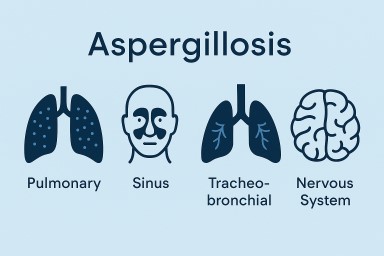
Other forms of Aspergillosis
The majority of patients with aspergillosis will have forms that affect their lungs, as of course, that is where most exposure to Aspergillus occurs when we inhale the spores. There are, however, many more areas of our bodies that can be infected with Aspergillus. The sites of infection are much more difficult for spores to reach, so these forms of aspergillosis are much rarer compared with pulmonary forms, but they do occasionally happen, and as this is a website concerned with all forms of aspergillosis, we will try to summarise each form in this series of articles.
If you have been diagnosed with one of these rarer forms of aspergillosis you are welcome to join our support groups on Facebook, but be sure to explain which form you have, in any questions that you may ask, to avoid confusion. Different forms of aspergillosis can be treated in very different ways so be sure that the information you read is relevant to your aspergillosis.
There has long been a listing of other forms of aspergillosis in the treatment section of the Aspergillus & Aspergillosis website. These articles are intended for medical specialists so we will attempt to interpret them here for patients & non-specialists and also provide updated information where appropriate.
- Acute Invasive Aspergillus Sinusitis (AIAFS)
- Airways (tracheobronchial)
- Aspergillus Empyema
- Aspergillus Endocarditis

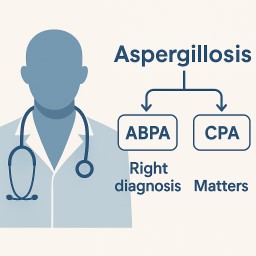
🩺 Why an Accurate Diagnosis Matters in Aspergillosis
If you've been told you have aspergillosis — or one of its forms like ABPA or CPA — you may wonder:
"Why does the exact diagnosis matter?"
Isn’t treatment just treatment?
Actually, no. In aspergillosis, getting the right diagnosis makes a huge difference to your care, safety, and long-term health.
This article explains why an accurate diagnosis is essential – not just for treatment, but also for recovery, monitoring, access to specialist care, and living well with the condition.
🔍 What Are ABPA and CPA?
Both ABPA and CPA are caused by the Aspergillus mould, but they affect the body in very different ways:
| Condition | Description |
|---|---|
| ABPA (Allergic Bronchopulmonary Aspergillosis) | An allergic reaction to Aspergillus in the lungs. Most common in people with asthma or cystic fibrosis. |
| CPA (Chronic Pulmonary Aspergillosis) | A chronic lung infection with Aspergillus. Often seen in people with damaged lungs (e.g. past TB, COPD, bronchiectasis). |
Because the symptoms can overlap (like coughing, mucus, or fatigue), it's not always easy to tell them apart — but the treatments are completely different.
🎯 Why Accurate Diagnosis is So Important
1. ✅ Get the Right Treatment
Different types of aspergillosis need very different medicines.
| Diagnosis | Main Treatment | Notes |
|---|---|---|
| ABPA | Steroids (e.g. prednisolone), sometimes antifungals (like itraconazole) | Helps control inflammation and allergy |
| CPA | Long-term antifungals (e.g. itraconazole, voriconazole, posaconazole) | Steroids may make CPA worse |
A wrong diagnosis can lead to the wrong treatment — and that can delay recovery or cause harm.
2. 📆 Plan Your Long-Term Care
Each condition has its own journey:
-
ABPA tends to flare up and settle down, often alongside asthma.
-
CPA is usually chronic and progressive, slowly damaging the lungs if untreated.
Knowing your diagnosis helps your doctors decide:
-
How often to scan your lungs (CT or X-rays)
-
What blood tests to monitor (e.g. IgE for ABPA, IgG for CPA)
-
How long to continue medication
-
What symptoms need urgent review
3. ⚠️ Avoid Side Effects and Harm
If you're given steroids for the wrong condition (e.g. CPA), they can:
-
Weaken your immune system
-
Let the fungal infection get worse
-
Increase the risk of diabetes, weight gain, or bone thinning
And if you’re given antifungals for ABPA without treating the allergy side, you might still keep having flare-ups.
A correct diagnosis helps your team weigh up risks and benefits — and adjust safely.
4. 🏥 Access the Right Specialist Services
In the UK, some treatments are only available for specific diagnoses:
-
Biologic drugs like omalizumab or mepolizumab are only available for severe ABPA under strict NHS criteria.
-
Long-term antifungal treatment for CPA is provided by highly specialised services, such as the National Aspergillosis Centre in Manchester.
Without the right diagnosis on record, access to these treatments may be delayed or blocked.
5. 🧭 Understand What to Expect
An accurate diagnosis helps you understand:
-
What symptoms are normal, and what should be reported
-
Whether your condition is likely to get better, stay the same, or slowly worsen
-
What lifestyle changes, home monitoring, or support groups might help
It also allows your care team to link you to others with similar conditions — for advice, reassurance, and shared experiences.
🧪 What Tests Help Make the Diagnosis?
Your specialist may request:
-
Blood tests (e.g. IgE, IgG antibodies to Aspergillus)
-
CT scans to look at the shape of your lungs
-
Sputum or bronchoscopy samples to grow or detect the fungus
-
Breathing tests (lung function) to assess airflow and trapping
These help build a full picture — no one test is enough on its own.
💬 In Summary
“Aspergillosis” is an umbrella term — but the exact type you have really matters.
Getting the correct diagnosis helps ensure:
-
🧬 You get the most effective treatment
-
📊 You avoid unnecessary harm
-
📆 You have the right follow-up plan
-
🧠 You understand your condition better
-
🩺 You can access the right NHS services
If you're not sure which type of aspergillosis you have — or you feel your diagnosis hasn’t been reviewed in a while — speak to your GP or respiratory team.

🫁 Understanding Bronchiectasis, COPD, and Aspergillosis: What Patients Need to Know
Living with a lung condition can be confusing — especially when the symptoms of bronchiectasis, COPD, and aspergillosis are so similar. This guide explains the differences, how they are diagnosed, and why many people are wrongly diagnosed (or underdiagnosed) at first.
🌬️ What Are These Conditions?
Bronchiectasis
A condition where the airways become damaged, widened, and scarred, often from past infections, immune problems, or conditions like ABPA or CPA. This makes it hard to clear mucus, leading to regular infections.
COPD (Chronic Obstructive Pulmonary Disease)
A group of conditions — including emphysema and chronic bronchitis — that cause narrowed airways and damaged air sacs. Most often caused by smoking or long-term exposure to fumes or dust.
Aspergillosis
An infection or allergic reaction caused by the fungus Aspergillus. Types include:
-
ABPA (allergic bronchopulmonary aspergillosis) — mostly in asthma or bronchiectasis
-
CPA (chronic pulmonary aspergillosis) — causes lung cavities and fungal balls
-
Aspergillus bronchitis — low-grade infection in people with bronchiectasis
🔄 Shared Symptoms
All three can cause:
| Symptom | Bronchiectasis | COPD | Aspergillosis |
|---|---|---|---|
| Chronic cough | ✅ | ✅ | ✅ |
| Sputum (phlegm) | ✅ (often a lot) | ✅ (varies) | ✅ (sticky, sometimes brown) |
| Breathlessness | ✅ | ✅ | ✅ |
| Recurrent infections | ✅ | ✅ | ✅ |
| Fatigue | ✅ | ✅ | ✅ |
| Wheezing | Sometimes | ✅ | ✅ in ABPA |
| Coughing blood (haemoptysis) | ✅ | ⚠️ | ✅ (especially in CPA) |
Because the symptoms are so similar, many people with aspergillosis are first told they have COPD or bronchiectasis until further tests are done.
🖥️ How Are They Diagnosed?
🧪 Tests Used
| Test | Helps Diagnose |
|---|---|
| Spirometry (lung function) | COPD or asthma (airflow obstruction) |
| High-resolution CT scan | Bronchiectasis, CPA, emphysema |
| Aspergillus IgG & IgE blood tests | CPA (IgG), ABPA (IgE) |
| Sputum culture or PCR | Finds Aspergillus or bacterial infections |
| Eosinophil count | High in ABPA |
| Chest X-ray | May show cavities, but CT is better |
🫁 CT Scan Signs: What Do Radiologists Look For?
| Feature | Bronchiectasis | COPD | CPA / Aspergillosis |
|---|---|---|---|
| Airway shape | Widened, thickened (signet-ring sign) | Narrowed or normal | May have overlapping bronchiectasis |
| Lung tissue | Scarring, mucus plugging | Blackened areas (emphysema) | Cavities, fungal balls, fibrosis |
| Mucus | Often present | Sometimes present | Mucus or fungus in airways |
| Other signs | Tree-in-bud, cystic changes | Air trapping, flattened diaphragm | Thickened cavity walls, pleural changes |
💨 What Are Air Trapping and Hyperinflation?
These are signs that air is getting stuck in the lungs — common in asthma, COPD, ABPA, and sometimes CPA.
🔹 Air trapping
Air gets into the lungs but can’t get out fully. You may feel like you can’t finish exhaling.
-
Seen on CT scan as dark areas during breathing out.
-
Lung function tests show high residual volume (RV).
-
Common in asthma, ABPA, bronchiectasis, and COPD.
🔹 Hyperinflation
The lungs are permanently overfilled with air, even when you’re not trying to breathe in.
-
Seen on CT/X-ray as large lungs, flattened diaphragm, and horizontal ribs.
-
Lung function shows high total lung capacity (TLC).
-
Common in emphysema, severe asthma, and ABPA.
Why it matters: Both conditions make breathing harder and less efficient, especially when active. Treatment like inhalers, antifungals, airway clearance, or biologics may help.
💊 Treatment Approaches
| Treatment | Bronchiectasis | COPD | Aspergillosis |
|---|---|---|---|
| Airway clearance physiotherapy | ✅ Essential | Sometimes | ✅ Often vital |
| Antibiotics | ✅ Regularly used | During flares | ✅ For Aspergillus bronchitis/CPA |
| Inhalers (bronchodilators) | Sometimes helpful | ✅ Core treatment | ✅ In ABPA if asthma is present |
| Steroids | In flares or ABPA | ✅ Often | ✅ In ABPA |
| Antifungals (e.g. itraconazole, voriconazole) | ❌ Not routine | ❌ | ✅ Main treatment for CPA/ABPA |
| Pulmonary rehab | ✅ | ✅ | ✅ May help fatigue/breathlessness |
| Oxygen | Rare | ✅ In advanced disease | ✅ In some advanced cases |
🧠 Why It’s Complicated
Many patients are misdiagnosed at first:
-
Aspergillosis can develop on top of COPD or bronchiectasis
-
A long delay in diagnosis is common
-
Some people have all three conditions, or overlapping features (e.g. COPD + ABPA)
That’s why blood tests and CT scans are so important — symptoms alone aren’t enough.
✅ Summary Table
| Feature | Bronchiectasis | COPD | Aspergillosis |
|---|---|---|---|
| Cause | Infection, immune issues | Smoking, pollutants | Fungal allergy or infection |
| Airway problem | Widened, mucus-filled | Narrowed, damaged sacs | Cavities, fungus growth or allergy |
| Diagnostic test | CT scan | Spirometry | CT + Aspergillus IgG/IgE |
| Key treatment | Clearance + antibiotics | Inhalers, steroids | Antifungals ± steroids |
💬 What Should I Ask My Doctor?
-
Could my symptoms be due to more than one condition?
-
Have I had a CT scan and Aspergillus blood tests?
-
Should I be seen by a specialist centre (e.g. for ABPA or CPA)?
-
Am I using the right inhalers or physiotherapy?
-
Could I benefit from a sputum test or antifungal treatment?

🩺 Lung Function Tests Explained: What They Tell Us About Asthma, COPD, Bronchiectasis, and Aspergillosis
If you’re living with a lung condition like asthma, COPD, bronchiectasis, or aspergillosis, you may be asked to have a lung function test. These tests help your medical team understand how well your lungs are working — and how best to treat you.
🌬️ What Are Lung Function Tests?
Lung function tests (also called pulmonary function tests) measure:
-
How fast and deeply you can breathe
-
How well your lungs move oxygen into your blood
-
How much air gets trapped in your lungs
🔬 Main Tests and What They Measure
| Test | What It Measures | Why It Matters |
|---|---|---|
| Spirometry | Speed and volume of air breathed out | Shows obstruction or reversibility (e.g. in asthma) |
| Lung volumes | Total size of the lungs and air left after exhaling | Detects air trapping and hyperinflation |
| Gas transfer (DLCO) | How well gases pass from lungs to blood | Can show scarring, emphysema, or CPA |
| Bronchodilator test | Measures response to inhaler | Helps diagnose asthma or ABPA |
🧠 What Do These Tests Tell Us?
Here’s how different conditions show up in lung function testing:
🟢 Asthma
-
Airways are narrowed, but often improve with inhalers.
-
Shows obstruction that improves significantly after a bronchodilator (reversible).
-
Lung volumes usually normal; DLCO often normal or high.
🔵 COPD
-
Shows irreversible obstruction — lungs are stiff and narrowed.
-
Often shows air trapping and hyperinflation.
-
DLCO is reduced, especially in emphysema.
🟠 Bronchiectasis
-
May show mild-to-moderate obstruction or mixed patterns.
-
Sometimes reversible, depending on overlapping asthma or infection.
-
Lung volumes and DLCO often normal unless CPA or emphysema is also present.
🟣 Aspergillosis
-
ABPA: Like asthma — obstruction, often with reversibility, air trapping, high IgE and eosinophils.
-
CPA: May cause a restrictive pattern (lower lung volumes) or reduced DLCO if fibrosis or cavities are present.
-
Aspergillus bronchitis: May look like bronchiectasis with some obstruction.
💨 What Is Air Trapping?
Air trapping happens when you breathe in, but can’t get all the air back out. Some air stays stuck in the lungs.
| Sign | What It Means |
|---|---|
| High residual volume (RV) | Too much air remains after breathing out |
| Expiratory CT scan shows dark areas | Parts of the lungs aren’t emptying properly |
Common in:
-
Asthma
-
ABPA
-
Bronchiectasis
-
COPD
🎈 What Is Hyperinflation?
Hyperinflation means your lungs are constantly overfilled with air — not just trapped temporarily, but stretched long-term.
| Sign | What It Means |
|---|---|
| High total lung capacity (TLC) | Lungs are too large due to long-term air trapping |
| Flattened diaphragm | Lungs are pressing downward on breathing muscles |
Common in:
-
Severe asthma
-
Emphysema (COPD)
-
ABPA (when uncontrolled)
📊 Summary Table
| Condition | Common Lung Test Features |
|---|---|
| Asthma | Obstruction, reversible, normal DLCO |
| ABPA | Obstruction, reversible, air trapping, high IgE |
| COPD | Fixed obstruction, hyperinflation, low DLCO |
| Bronchiectasis | Variable obstruction, sometimes reversible |
| CPA | Restriction or mixed pattern, reduced DLCO |
| Aspergillus bronchitis | Similar to bronchiectasis, sputum positive for fungus |
💬 Why These Tests Matter
-
They help distinguish what’s causing your symptoms.
-
They track whether treatment is working (inhalers, steroids, antifungals).
-
They identify complications like scarring, cavities, or fungal infection.
-
They help guide eligibility for biologic drugs or oxygen therapy.
📣 Ask Your Doctor:
-
Have I had a bronchodilator response test?
-
Do I have air trapping or hyperinflation?
-
Should we test for Aspergillus (IgG, IgE, sputum)?
-
Would a CT scan add helpful detail?

🟣 Aspergillus Bronchitis: A Patient Guide
If you've been diagnosed with bronchiectasis, COPD, or other chronic lung problems, and keep getting infections or mucus that tests positive for Aspergillus, you might be told you have Aspergillus bronchitis. But what does that mean? And how is it different from ABPA (Allergic Bronchopulmonary Aspergillosis)?
This guide explains what Aspergillus bronchitis is, how it’s diagnosed, how common it is, and how it differs from ABPA.
🌬️ What Is Aspergillus Bronchitis?
Aspergillus bronchitis is a chronic fungal infection of the airways caused by Aspergillus fumigatus. It happens in people with damaged or scarred airways, such as:
-
Bronchiectasis
-
COPD
-
Cystic fibrosis
-
Occasionally asthma (if structural damage exists)
It’s a low-grade infection, not an allergy and not an invasive disease. The fungus lives in the mucus lining the airways, causing persistent inflammation, infection, and symptoms.
🔍 What Are the Symptoms?
| Common symptoms | What to know |
|---|---|
| Persistent cough | Often brings up sticky or brown mucus |
| Worsening breathlessness | Not always explained by asthma or infection alone |
| Fatigue or low energy | Common in chronic fungal infections |
| Frequent infections | May keep returning despite antibiotics |
| Wheeze | Sometimes, especially in asthma or ABPA overlap |
| Weight loss or low-grade fever | Possible in long-standing infection |
📊 How Common Is It?
Aspergillus bronchitis is underdiagnosed but increasingly recognised — especially in patients referred to specialist centres.
Estimated frequency in different conditions:
| Underlying condition | Estimated rate of Aspergillus bronchitis |
|---|---|
| Bronchiectasis | ~5–15%, higher in referral centres |
| COPD | ~1–5%, especially with steroid use |
| Cystic fibrosis | 5–10% (non-allergic cases) |
| Asthma (alone) | Rare unless bronchiectasis is also present |
It may be mistaken for a flare-up or chronic bacterial infection. Many people are told it’s “just colonisation” — but if symptoms persist and Aspergillus keeps growing in sputum, Aspergillus bronchitis should be considered.
🧪 How Is It Diagnosed?
There’s no single test. Diagnosis is based on clinical features plus evidence of fungal growth and a non-allergic immune pattern.
| Test | What it shows |
|---|---|
| Sputum culture / PCR | Repeated detection of Aspergillus |
| Aspergillus IgG (blood) | Often raised, shows chronic exposure |
| Aspergillus IgE & eosinophils | Usually normal — helps exclude ABPA |
| CT scan | Shows bronchiectasis, mucus plugging, but no cavitation |
| Response to antifungals | Clinical improvement supports diagnosis |
🔄 How Is It Different from ABPA?
ABPA is an allergic reaction to Aspergillus that mainly affects people with asthma or cystic fibrosis.
Aspergillus bronchitis, on the other hand, is a fungal infection in damaged airways, not an allergy.
| Feature | Aspergillus Bronchitis | ABPA |
|---|---|---|
| Type of disease | Chronic fungal infection | Allergic lung disease |
| Immune markers | High IgG, normal IgE | High IgE and eosinophils |
| Sputum | Repeated growth of Aspergillus | May or may not grow |
| CT findings | Bronchiectasis, mucus | Central bronchiectasis, mucus plugs |
| Treatment | Antifungals only | Steroids ± antifungals |
| Typical patient | Bronchiectasis, COPD | Asthma (often severe), sometimes CF |
Some patients can have both conditions at once, especially those with asthma and bronchiectasis — so testing is important.
💊 Treatment Options
| Treatment | Purpose |
|---|---|
| Oral antifungals (itraconazole, voriconazole) | Main treatment — often for several months |
| Inhaled antifungals (e.g. nebulised amphotericin) | Alternative if oral drugs not tolerated |
| Airway clearance physiotherapy | Helps remove mucus and fungal load |
| Regular sputum testing | To monitor treatment response |
| Steroids | Not used unless there’s overlapping ABPA or asthma |
🧠 Summary
| Question | Answer |
|---|---|
| Is it an infection? | ✅ Yes — fungal infection in the airways |
| Is it an allergy? | ❌ No — that’s ABPA |
| Can it coexist with ABPA? | ✅ Yes, in some cases |
| How is it diagnosed? | Repeated Aspergillus in sputum + high IgG + symptoms |
| How is it treated? | Antifungal medication (oral or nebulised) |
| Will it go away? | Often improves with treatment, but monitoring is essential |
💬 What to Ask Your Doctor
-
Could my symptoms be from Aspergillus bronchitis?
-
Have I had sputum cultures and Aspergillus blood tests (IgG, IgE)?
-
Would antifungal treatment help me?
-
Should I be referred to a specialist centre (e.g. for CPA, ABPA, bronchiectasis)?
-
Am I on the best airway clearance and physiotherapy plan?
Dad and the Sneaky Spores
 A lovely story commissioned by the Aspergillosis Trust to raise awareness of the condition and to help children understand what it means to live with a family member affected by it. The narrative not only educates readers about Aspergillosis but is also thoughtfully crafted by Christina Gabbitas to foster empathy and understanding.
Dad and the Sneaky Spores : Gabbitas, Christina, Thomas, Rebecca, Hurst, Ursula: Amazon.co.uk: Books
Aspergillosis Awareness: Conversation with Tom Bermingham - European Lung Foundation
Conversation with Tom Bermingham - European Lung Foundation
👨 Meet Tom Bermingham
-
Lives in rural County Wexford, Ireland, with his wife.
-
Works as a Rural Development Manager.
-
Diagnosed with aspergillosis in 2022 after years of lung issues.
🌪️ What Triggered His Aspergillosis
-
He grew sunflowers in a polytunnel; handling decaying heads released dust he inhaled.
-
Later, home renovation stirred up bathroom mould/dust—both likely exposures.
🏥 The Path to Diagnosis
-
2019: Hospitalised for cavitating pneumonia and diagnosed with bronchiectasis.
-
Later treated for chronic fatigue syndrome, repeated infections, tiring quickly.
-
Feb 2022: Hospitalised again (17 days), diagnosed with severe adult-onset asthma, oxygen-dependent, with mucus positive for Aspergillus fumigatus.
-
Initially labelled with Chronic Pulmonary Aspergillosis (CPA), treated with steroids, antifungals, inhalers, antibiotics, and fatigue medications.
-
2024: Diagnosis revised to ABPA + Severe Asthma with Fungal Sensitisation (SAFS).
-
October 2024: Hospitalised for COVID-19 and Pseudomonas lung infection treated via PICC line. European Lung Foundation
💔 How It Affects His Daily Life
-
Mornings bring coughing up “dirty mucus” daily—an unsettling reminder.
-
Extreme fatigue, headaches, regular infections dominate his life.
-
Gave up gardening (risk of soil exposure), community work, and physical chores.
-
Lives with constant fear of infection, medication side effects, and hospitalisations.
-
Chronic disease has made long-term planning impossible; relaxation and mental wellbeing are vital.
🧭 How He Manages
-
Supported by his wife and daughters and his flexible employer.
-
Practices listening to his body: rests when needed.
-
Regular check-ups—including CT scans, lung function, sputum and blood tests—keep his care monitored. European Lung Foundation
-
Accepting limitations while focusing on what he can still do helps his mindset.
✅ Key Insights for Aspergillosis Patients
-
Environmental exposures matter: mould, dust, soil may trigger illness—even long after.
-
Diagnosis can be complex and evolve: often overlaps with asthma, bronchiectasis, ABPA, SAFS.
-
Daily life can change significantly, with physical decline and emotional stress.
-
Support network and personalised care are crucial—family, employer flexibility, specialist monitoring.
-
Self-care and mindset: acceptance, rest, and focusing on abilities, not limitations.
Aspergillosis Awareness: Conversation with Marcela Candeias - European Lung Foundation
Conversation with Marcela Candeias - European Lung Foundation
👩⚖️ Meet Marcela Candeias
-
Lawyer from Portugal with long-controlled asthma since age 14.
-
Lived an active life—working long hours and travelling—until 2020 Facebook+2European Lung Foundation+2European Lung Foundation+2.
🩺 Journey to Diagnosis
-
In 2020, Marcela developed a persistent, worsening cough, extreme fatigue, and significant weight loss.
-
She began coughing up thick mucus that turned green and black, culminating in an intense coughing fit lasting several hours.
-
This was the turning point that led her to seek medical help European Lung Foundation.
🩻 What Aspergillosis Felt Like
-
Severe coughing fits and bloody or discoloured phlegm.
-
Physical exhaustion and weight loss.
-
A clear sign that something serious was happening internally, not just a flare-up of old asthma European Lung Foundation.
⏭️ Why It Matters for Patients
-
Aspergillosis can emerge suddenly—even in people with previous mild asthma.
-
Early recognition of changes (e.g. mucus discoloration, fatigue, cough intensity) is crucial.
-
Once symptoms escalate, urgent medical evaluation is essential.
✅ Key Takeaways for Aspergillosis Patients
| What to Watch For | Why It Matters |
|---|---|
| 🚨 Persistent cough with coloured or black mucus | Red flag—seek medical review |
| Increasing fatigue and weight loss | Indicates disease progression |
| Severe coughing fits or coughing up blood | Requires immediate attention |
"One of these fits lasted several hours—that was when I knew something was seriously wrong. European Lung Foundation
📌 Patient Action Guide
-
If you have asthma or COPD and notice new symptoms—especially dark mucus, weight loss, or fatigue—don’t wait.
-
Tell your GP or lung specialist that you’re concerned about aspergillosis.
-
Ask about appropriate testing (e.g. imaging, sputum culture, blood markers).
-
Early diagnosis can lead to timely treatment and better outcomes.

🫁 Airway Clearance in Aspergillosis: A Patient Guide
Managing mucus to breathe easier, stay healthier, and feel more in control
💡 Why Is Mucus Clearance Important?
If you’re living with a condition like chronic pulmonary aspergillosis (CPA), allergic bronchopulmonary aspergillosis (ABPA), or aspergillus bronchitis, you may experience ongoing mucus build-up in your lungs. This can:
-
Make breathing harder
-
Trap infection
-
Cause inflammation and damage
-
Trigger coughing, wheeze or breathlessness
Airway clearance techniques (ACTs) help loosen and remove this mucus, reduce chest infections, and improve daily comfort.
🗣️ “Before I started clearing mucus properly, I thought breathlessness was just something I had to live with. But it’s made a big difference.”
🔧 What Techniques Are Available?
| Type | Examples | Purpose | Needs Guidance? |
|---|---|---|---|
| Breathing exercises | ACBT (Active Cycle of Breathing), huffing | Loosens mucus, clears airways | ✅ Yes – to be effective |
| Postural drainage | Lying in specific positions | Uses gravity to drain mucus | ✅ Yes – to avoid reflux or fatigue |
| Devices | Flutter, Acapella, Aerobika (OPEP devices) | Vibrate airways + create back pressure to shift mucus | ✅ Yes – to use correctly |
| Manual techniques | Chest percussion, assisted cough | Help loosen stubborn mucus | ✅ Often needs a helper |
| Mechanical devices | HFCWO (“The Vest”), IPV | Used in severe or complex cases | ✅ Prescribed in specialist settings |
🗣️ “I use the Acapella in the mornings while the kettle boils. It’s part of my routine now – and it really helps.”
🗣️ What Do Other Patients Say?
People with aspergillosis often try more than one method before finding what works best. Here are some common reflections:
On devices:
“The flutter helped a lot once I got the angle and rhythm right – but I needed someone to show me how.”
On ACBT:
“Breathing control and huffing helped me get more up with less effort than coughing all day.”
On adapting to daily life:
“It’s about what fits into your day. If something’s too awkward or tiring, you won’t keep doing it – and that’s okay.”
On trial and error:
“It took me months to find the right technique – but now I can manage my mucus better and avoid antibiotics.”
⚠️ Should I Use a Flutter or Acapella Without Help?
Not at first. These devices are effective only if used correctly. Risks of incorrect use include:
-
Not moving mucus effectively
-
Fatigue or breathlessness
-
Worsening reflux or chest tightness
-
In rare cases, worsening of lung symptoms (e.g., if air trapping occurs)
🗣️ “I bought a device online and started using it myself – but it made me dizzy. A physio later explained I was blowing too hard.”
Always ask your respiratory team or GP for referral to a respiratory physiotherapist before starting.
📝 Patient Decision Guide: Should You Use ACTs?
✅ You may benefit if:
-
You cough up mucus daily or feel it’s “stuck”
-
You’ve had repeated chest infections
-
You live with CPA, ABPA, bronchiectasis, or aspergillus bronchitis
❌ Don’t start without guidance if:
-
You have COPD, asthma, or lung scarring
-
You’ve had haemoptysis (coughing up blood)
-
You experience dizziness, nausea, or chest pain during breathing exercises
-
You have gastric reflux or recent chest surgery
🧑⚕️ What Can I Start Safely at Home?
Without needing equipment, you can begin with:
-
💧 Drink plenty of fluids – thin mucus is easier to clear
-
🪑 Sit upright – especially when coughing or during infections
-
🌬️ Use breathing control – calm, gentle breaths can reduce breathlessness
-
🗣️ Try huffing – like breathing out a mirror; easier than deep coughing
🗣️ “Even on days when I’m tired, I try to stay upright and do a few rounds of breathing exercises. It’s become a habit that helps.”
🧭 Next Steps: What to Ask Your Doctor or Nurse
-
Could I see a respiratory physiotherapist to help with mucus clearance?
-
What technique is best for my condition (e.g., ABPA vs. CPA)?
-
Can I be shown how to use a flutter device or Acapella safely?
-
What should I do if I feel worse after using a technique?
🗣️ “The physio made all the difference – she explained what my lungs were doing and helped me pick something that actually worked.”
💬 Final Word
🗣️ “It’s not just about technique – it’s about what fits your life. Small steps like staying hydrated, using huffing, and getting guidance made a big difference for me.”
There’s no one-size-fits-all approach – but with the right support, airway clearance can help you take control of your lungs, reduce flare-ups, and breathe easier.
Biologics and Long Term Side Effects
✅ What Are Biologics?
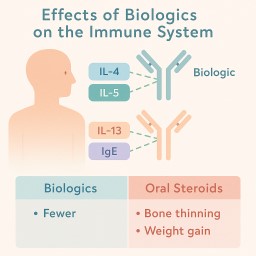
Biologics are targeted treatments made from living cells. They work by blocking parts of the immune system that cause inflammation — for example:
-
IL-4, IL-5, IL-13: linked to eosinophilic inflammation
-
IgE: linked to allergies and ABPA
They are not immunosuppressants like steroids or chemotherapy, but rather immune modulators.
💊 Long-Term Side Effects – What Do We Know?
👨⚕️ What research and experience show:
| Biologic | Used for | Long-term safety known? | Side effects most reported |
|---|---|---|---|
| Omalizumab (Xolair) | Allergic asthma, ABPA | 20+ years of use | Injection site reactions, headache, very rare anaphylaxis |
| Mepolizumab (Nucala) | Eosinophilic asthma, CPA | 10+ years | Fatigue, headache, shingles (rare), mild infections |
| Benralizumab (Fasenra) | Severe asthma, CPA | ~6–7 years | Headache, pharyngitis, injection site issues |
| Dupilumab (Dupixent) | Asthma, eczema, nasal polyps | 6–8 years | Eye dryness/redness, cold sores, joint pain (rare) |
| Tezepelumab (Tezspire) | Severe asthma | ~2 years | Sore throat, joint pain, injection site reactions |
⚠️ Possible Long-Term Concerns (but rare)
-
Infections: Some concern about slightly increased risk of herpes zoster (shingles) or respiratory viruses, but overall risk is very low compared to steroids.
-
Immunogenicity: Your body might develop antibodies to the drug over time, reducing its effect — this is more a loss of benefit, not a dangerous side effect.
-
Cancer risk: No consistent evidence linking asthma/ABPA biologics to cancer.
-
Unknowns: Because some biologics are new (e.g. tezepelumab), we don't yet have 20-year data — but so far the safety profile is reassuring.
🩺 Compared to Oral Steroids
| Treatment | Side Effects Over Time |
|---|---|
| Steroids (e.g. prednisolone) | Weight gain, diabetes, infections, bone thinning, cataracts, adrenal suppression |
| Biologics | Mostly minor – injection site pain, headache, mild infection risk, rare allergic reaction |
So in most cases, biologics reduce the need for steroids and therefore reduce long-term harm.
💬 Patient Experience
Most patients report:
-
Improved quality of life
-
Reduced asthma/ABPA attacks
-
Fewer hospital visits
-
Very few stop due to side effects
✅ Summary
| Question | Answer |
|---|---|
| Do biologics have long-term side effects? | Usually mild and rare; mostly injection reactions or mild infections |
| Are they safer than long-term steroids? | Yes, especially over years |
| Should I be worried? | Not usually — but always monitor with your team |
| How long have they been used? | 6–20+ years, depending on the biologic, with very good safety data |