

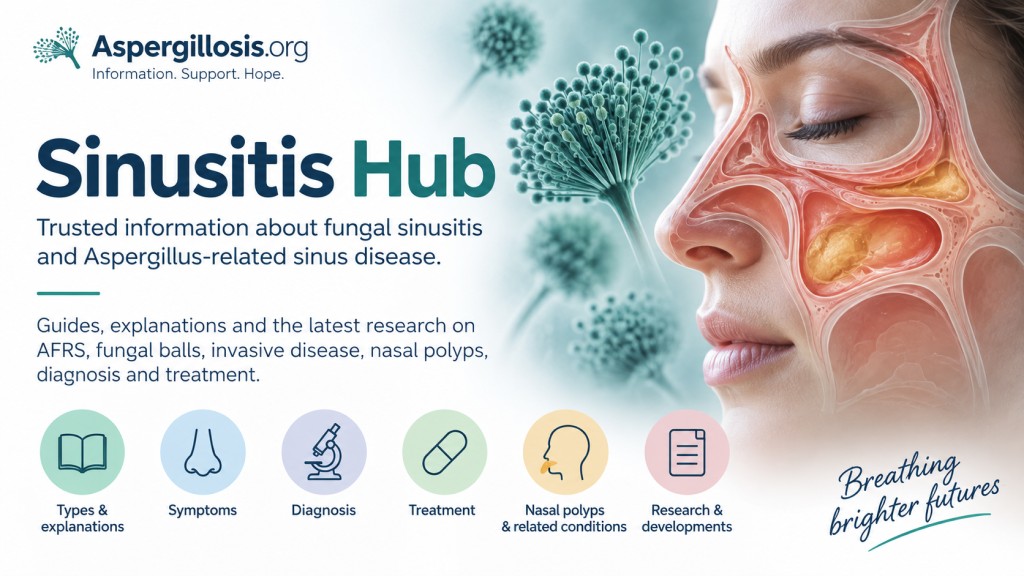
Fungal disease of the nose and sinuses can take several different forms. Some conditions are mainly allergic or inflammatory, while others involve fungal material growing within a sinus. Invasive fungal sinus disease is much less common but can be serious.
This hub brings together our main information about fungal rhinosinusitis, including allergic fungal rhinosinusitis (AFRS), fungal balls, invasive disease, nasal polyps, diagnosis and treatment.
New to fungal rhinosinusitis?
If you are new to the subject, begin with our main guide. It explains the different types of fungal sinus disease, common symptoms, how they are investigated and how treatment differs between them.
- Fungal Rhinosinusitis: Types, Symptoms, Diagnosis and Treatment
Our main patient and carer guide to allergic fungal rhinosinusitis (AFRS), fungal ball, fungal colonisation and invasive fungal rhinosinusitis.
More detailed information
For expert patients and non-specialist clinicians
Some readers may want more clinical detail about diagnosis, imaging, tissue invasion, microbiology and treatment.
- Aspergillus Sinusitis for Expert Patients and non-Specialist Clinicians
A more detailed clinical guide covering non-invasive and invasive Aspergillus sinus disease, investigations and treatment.
Allergic fungal rhinosinusitis (AFRS)
AFRS is a form of chronic rhinosinusitis with nasal polyps in which fungi are associated with a strong allergic and inflammatory response. Diagnosis usually depends on a combination of symptoms, imaging, endoscopy, allergy testing and examination of sinus material rather than one single test.
- Allergic Fungal Rhinosinusitis: How Diagnosis Is Changing
A closer look at evolving diagnostic criteria, newer tests and research aimed at recognising AFRS more accurately.
Nasal polyps, asthma and biologic treatment
Nasal polyps and asthma often involve overlapping inflammatory pathways. Some people with recurrent polyps, severe asthma or ABPA may therefore be considered for biological treatments that target specific parts of the immune response.
- Could One Biologic Treat Nasal Polyps, Asthma and ABPA?
An explanation of recurrent nasal polyps, type 2 inflammation and how treatments such as dupilumab may sometimes benefit more than one part of the airway.
Understanding the different types
The term fungal rhinosinusitis describes several different conditions rather than one single disease.
- Allergic fungal rhinosinusitis (AFRS) — an allergic and inflammatory condition, usually associated with nasal polyps and fungal sensitisation.
- Fungal ball — a collection of fungal material within a sinus without invasion of surrounding tissue.
- Saprophytic fungal colonisation — fungal growth on mucus or crusts, sometimes following sinus surgery.
- Invasive fungal rhinosinusitis — fungal growth into sinus tissue. This is much less common but may be serious and requires specialist treatment.
Read the full guide to the different types of fungal rhinosinusitis.
Symptoms and diagnosis
Symptoms can overlap with ordinary chronic rhinosinusitis and may include nasal blockage, thick mucus, post-nasal drip, reduced sense of smell, facial pressure, headaches and recurrent sinus problems.
Assessment may involve an ENT examination, nasal endoscopy, CT scanning, blood and allergy tests and, in some cases, laboratory examination of sinus material or tissue.
There is no single test that diagnoses every form of fungal rhinosinusitis, so results need to be interpreted together.
Treatment
Treatment depends on the type of sinus disease. It may involve:
- saline irrigation and nasal treatments;
- topical corticosteroids to control inflammation;
- endoscopic sinus surgery to remove obstructing material or polyps and improve drainage;
- biological medicines in selected people with severe inflammatory disease; or
- systemic antifungal treatment and urgent specialist care for invasive fungal disease.
Antifungal medicines are not needed for every type of fungal sinus disease. Treatment should be matched to the diagnosis.
When to seek medical advice
Speak to a healthcare professional if you have persistent or recurrent sinus symptoms, significant loss of smell, ongoing nasal blockage or facial pressure, particularly when symptoms have lasted for several weeks or are not responding to usual treatment.
Seek urgent medical assessment for rapidly worsening facial pain or swelling, visual disturbance, severe headache, neurological symptoms or rapidly progressive sinus symptoms, especially if you are significantly immunocompromised.
Related Hubs
Did this page help you?
Tell us in one minute