
Reviewed: 23 July 2026
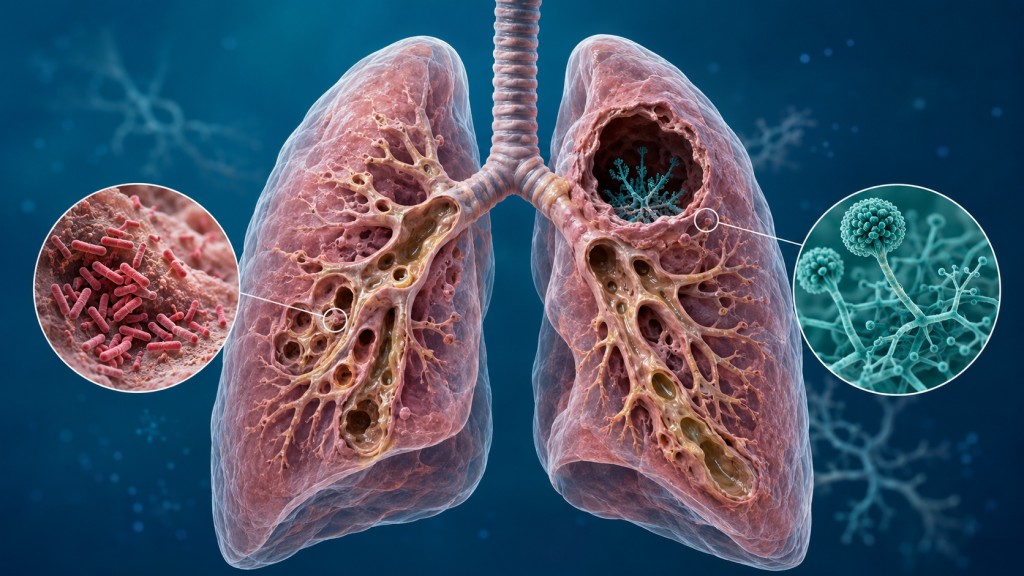
People with bronchiectasis and other chronic lung conditions may sometimes be diagnosed with both a nontuberculous mycobacterial infection and a form of pulmonary aspergillosis.
This overlap appears to be recognised more often than it once was. It raises understandable questions:
- Are NTM infections genuinely becoming more common?
- Does NTM make someone more vulnerable to aspergillosis?
- Can aspergillosis increase the risk of NTM?
- Could one of the test results represent colonisation rather than active disease?
- How can two complicated lung infections be treated at the same time?
The short answer is that NTM pulmonary disease is increasing in many parts of the world, and NTM and Aspergillus are being found together more frequently. However, this does not necessarily mean that one infection directly causes the other. Usually, they share the same opportunity: lungs that have already become vulnerable.
What is NTM?
Nontuberculous mycobacteria, usually shortened to NTM, are a large group of bacteria found naturally in soil, dust and water. They are related to the bacterium that causes tuberculosis, but NTM pulmonary disease is not tuberculosis.
Unlike tuberculosis, NTM infections are generally acquired from the environment rather than passed from one person to another. Person-to-person transmission has occasionally been documented in particular circumstances, especially involving some strains of Mycobacterium abscessus among people with cystic fibrosis, but this is not how most NTM lung disease is thought to develop.
Common disease-causing groups include:
- Mycobacterium avium complex, often called MAC;
- Mycobacterium abscessus;
- Mycobacterium kansasii;
- Mycobacterium xenopi.
Many people encounter NTM without becoming ill. Disease is more likely when the lungs have structural damage, mucus is not cleared effectively or immune defences are reduced.
Finding NTM does not always mean NTM pulmonary disease
NTM can occasionally be present in a respiratory sample without causing progressive disease. A diagnosis therefore cannot usually be made from one positive sputum result alone.
Clinicians bring together three types of evidence:
- Symptoms, such as persistent cough, sputum, fatigue, weight loss or breathlessness;
- CT changes, which may include bronchiectasis, small nodules, inflammation or lung cavities;
- Microbiology, usually repeated cultures growing the same clinically significant NTM species.
Even when the accepted diagnostic criteria are met, treatment may not begin immediately. Some people have slowly changing or stable disease and may initially be monitored. The possible benefits of treatment must be balanced against its length, complexity and side effects.
Aspergillus can also affect vulnerable lungs in different ways
Aspergillus is a mould found throughout the environment. Most people breathe in its spores every day without becoming ill.
In susceptible people, it can contribute to several different conditions, including:
- allergic bronchopulmonary aspergillosis (ABPA), an allergic and inflammatory response;
- Aspergillus bronchitis, involving persistent infection of the airways;
- chronic pulmonary aspergillosis (CPA), a slowly progressive infection that may cause cavities, pleural thickening or a fungal ball;
- invasive aspergillosis, primarily affecting people with substantial immune suppression or critical illness.
As with NTM, finding Aspergillus in sputum does not automatically establish which—if any—Aspergillus-related disease is present. Symptoms, CT appearances, cultures, Aspergillus IgG or other tests and the person’s underlying health all need to be considered together.
Are NTM infections becoming more common?
International guidelines and studies from several countries report that the incidence and prevalence of NTM pulmonary disease have increased, particularly among older people and those with bronchiectasis.
However, the trend is not identical in every country or every dataset. A UK primary-care study covering 2006 to 2016 found a decline in NTM disease managed in primary care, but its authors suggested that increasingly complex cases may have shifted into specialist hospital services.
Several factors probably contribute to the wider increase in recognition:
- more CT scanning and greater recognition of bronchiectasis;
- more frequent and improved laboratory testing of respiratory samples;
- better identification of individual NTM species;
- increased awareness among respiratory clinicians;
- an ageing population with more chronic structural lung disease;
- more people living for longer with conditions and treatments that affect immunity.
There may also be genuine changes in environmental exposure, climate and the organisms themselves, but these influences are still being investigated. The apparent increase is therefore likely to be a mixture of more disease, better detection and changes in the population at risk.
Why do NTM and aspergillosis occur together?
The most important explanation is that both organisms take advantage of similar weaknesses in the lungs.
1. Bronchiectasis and impaired mucus clearance
Healthy airways use mucus and tiny moving hairs called cilia to trap and remove inhaled organisms. In bronchiectasis, the airways are widened and damaged. Mucus can collect, providing an environment in which bacteria and fungi can persist.
Bronchiectasis can therefore be both a cause and a consequence of repeated infection. Once a cycle of airway damage, mucus retention, inflammation and infection has developed, several different organisms may appear over time.
2. Lung cavities
Some forms of NTM pulmonary disease cause cavities in the lungs. These abnormal spaces can subsequently provide somewhere for Aspergillus to grow.
This means that NTM disease may sometimes create structural conditions that increase the later risk of chronic pulmonary aspergillosis. Studies have repeatedly identified cavitary NTM disease as an important risk factor for CPA.
The relationship can also run in the other direction. A person may already have cavities, bronchiectasis or damaged airways from CPA, tuberculosis, COPD, sarcoidosis or another condition, leaving them vulnerable to NTM.
3. Shared underlying conditions
Both conditions are more likely in people with:
- bronchiectasis;
- COPD or emphysema;
- previous tuberculosis;
- cystic fibrosis;
- sarcoidosis or other causes of lung cavities;
- low body weight or poor nutritional status;
- immune suppression;
- long-term or repeated corticosteroid exposure.
These shared risk factors can make it difficult to say that one organism caused the other. Often, both are consequences of the same damaged lung environment.
4. Treatment and immune effects
Systemic corticosteroids suppress immune responses and have been associated with increased susceptibility to both NTM disease and aspergillosis. Inhaled corticosteroids may also contribute to infection risk, particularly at higher doses, although their benefits may remain important for people with asthma, ABPA or some forms of COPD.
This does not mean that prescribed steroids should be stopped. It means that the continuing indication and dose should be reviewed periodically, especially when someone has recurrent or unusual respiratory infections.
How common is the overlap?
There is no single reliable percentage that applies to every patient group. Published estimates vary because studies involve different countries, organisms, lung diseases, definitions and levels of specialist testing.
Recent large studies suggest that chronic pulmonary aspergillosis develops in a minority of people diagnosed with NTM pulmonary disease. A Japanese database study reported CPA in 2.29% of more than 11,000 people with NTM pulmonary disease. A separate multicentre Japanese study found CPA in 3.5% of 1,304 patients. Rates can be higher in selected groups with cavities, COPD, respiratory failure, previous tuberculosis or corticosteroid exposure.
Smaller specialist studies have sometimes reported considerably higher figures, but these populations are usually not representative of everyone with NTM.
A systematic review of published NTM–Aspergillus co-infection cases found that bronchiectasis and cavities were particularly common. However, collections of published cases tend to contain the most complicated and severe examples, so they cannot tell an individual patient what is likely to happen.
Why can the two conditions be difficult to recognise?
NTM pulmonary disease and chronic pulmonary aspergillosis can cause similar problems:
- chronic cough and sputum;
- fatigue;
- weight loss;
- breathlessness;
- coughing up blood;
- bronchiectasis, inflammation or cavities on CT scans.
If a person with known NTM disease becomes worse, it may be assumed that the NTM has progressed. Conversely, symptoms in someone with aspergillosis may be attributed entirely to the fungal disease.
Clinicians may need to reconsider the diagnosis when:
- symptoms worsen despite apparently appropriate treatment;
- new or enlarging cavities appear;
- a fungal ball or increasing pleural thickening develops;
- weight loss, fatigue or coughing up blood becomes more prominent;
- repeated samples identify another organism;
- the clinical course no longer fits the original diagnosis.
This does not mean that every patient with NTM requires repeated extensive fungal testing. It means that the possibility of coexisting disease should remain in mind, particularly in people with cavities or unexplained deterioration.
Why is treatment complicated?
NTM pulmonary disease commonly requires several antibiotics for many months. Chronic pulmonary aspergillosis is usually treated with an azole antifungal such as itraconazole, voriconazole, posaconazole or isavuconazole.
Important interactions can occur between these medicines.
In particular, rifampicin and rifabutin—drugs used in many NTM regimens—can greatly reduce the amount of azole antifungal in the body. This may make the antifungal ineffective. Azoles can also affect the levels or safety of other medicines, and both treatment regimens may cause liver, digestive, visual, neurological or other adverse effects.
When both diseases require treatment, specialists may need to decide:
- which condition is currently causing the greatest harm;
- whether both need treatment immediately;
- whether treatment should be simultaneous or sequential;
- whether an alternative NTM regimen is possible;
- how drug levels, liver tests, hearing, vision and heart rhythm should be monitored;
- how much treatment burden the person can reasonably manage.
These decisions usually benefit from input from respiratory, infectious-disease, microbiology and specialist pharmacy teams. Patients should not stop or alter either treatment without discussing it with the prescribing team.
What can patients do?
People living with bronchiectasis, NTM or aspergillosis can help their team by:
- providing sputum samples when requested;
- reporting new weight loss, coughing up blood or a sustained change in symptoms;
- keeping an up-to-date list of medicines and supplements;
- asking whether new medicines interact with existing antifungals or antibiotics;
- attending blood tests, drug-level monitoring and other safety checks;
- continuing an agreed airway-clearance routine;
- asking which organism the team currently believes is causing disease rather than simply being present.
Useful questions for an appointment include:
- Do my results show NTM in a sample, or do I meet the criteria for NTM pulmonary disease?
- Which NTM species has been identified, and was it found more than once?
- Is there evidence of active aspergillosis, or only exposure or colonisation?
- Have my CT scans changed over time?
- Which condition is thought to be causing my current symptoms?
- Do any of my medicines make treating both conditions more difficult?
The main message
NTM pulmonary disease is being diagnosed more frequently in many parts of the world, and its overlap with aspergillosis is increasingly recognised.
The relationship is not usually as simple as one infection directly causing the other. Bronchiectasis, cavities, impaired mucus clearance, immune changes and some treatments can create a shared vulnerability to both environmental organisms.
Finding either NTM or Aspergillus in a sample does not automatically prove active disease. The important task is to combine symptoms, repeated microbiology, blood tests and changes on CT—and then decide which condition, if either, needs treatment.
When both diseases are active, treatment can be challenging, but recognising the overlap allows specialist teams to plan monitoring, manage drug interactions and avoid attributing every change to a single organism.
Further information and evidence
- ATS/ERS/ESCMID/IDSA guideline: Treatment of NTM pulmonary disease
- Systematic review: NTM and Aspergillus lung co-infection
- Study: Risk and prognosis of aspergillosis complicating NTM pulmonary disease
- Multicentre study: NTM pulmonary disease with chronic pulmonary aspergillosis
- UK study: NTM disease managed in primary care
This information is intended to support, not replace, discussions with your healthcare team. Do not stop or change antibiotics, antifungal medicines or corticosteroids without advice from the relevant prescriber.

Did this page help you?
Tell us in one minute