Last reviewed: 19 October 2026
Author: Graham Atherton
Next scheduled review: October 2028
Key points
- Diagnosing aspergillosis can be difficult because symptoms and scan findings may resemble other lung conditions.
- Doctors use a combination of imaging, blood tests and laboratory investigations. No single test is suitable for every form of aspergillosis.
- PCR, fungal antigen tests and some rapid tests are already used in specialist laboratories.
- Newer approaches, including breath analysis, advanced sequencing and AI-assisted CT interpretation, may improve diagnosis in the future.
- Finding Aspergillus in a sample does not always mean it is causing disease.
Why is aspergillosis sometimes difficult to diagnose?
Aspergillus is a common fungus found in the environment. Most people breathe in its spores regularly without becoming ill.
However, some people develop lung disease associated with Aspergillus, particularly those with existing lung damage or weakened immune defences.
Symptoms such as cough, breathlessness, tiredness and weight loss can have many causes. Even a positive fungal test may be difficult to interpret because Aspergillus can sometimes be present in the airways without causing infection.
Doctors therefore consider the patient’s symptoms, medical history, CT scans and laboratory results together.
Different forms of aspergillosis need different tests
There is no single diagnostic pathway for every form of aspergillosis.
- Chronic pulmonary aspergillosis (CPA) develops over months or years, often in people with previously damaged lungs. Diagnosis commonly relies on characteristic CT changes, evidence implicating Aspergillus and the clinical history.
- Aspergilloma is a fungal ball, usually growing within an existing lung cavity.
- Aspergillus nodules may resemble other lung nodules, including cancer. Sometimes a tissue sample is needed to establish the diagnosis.
- Invasive aspergillosis generally occurs in people with significant immune impairment or other major risk factors and may progress rapidly.
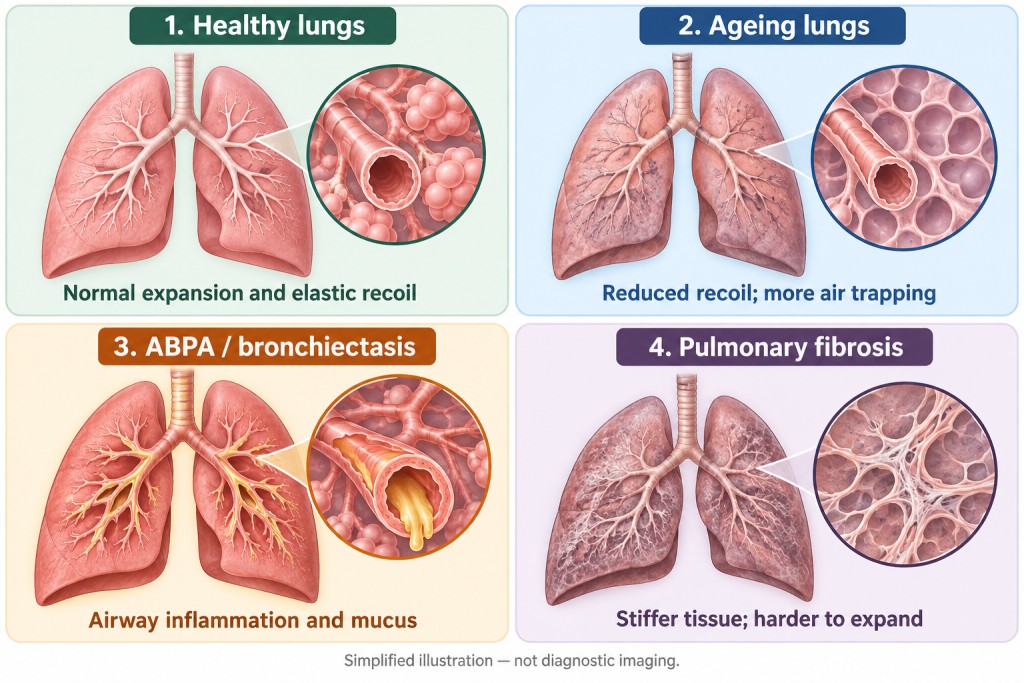
- Allergic bronchopulmonary aspergillosis (ABPA) is primarily an allergic response to Aspergillus. Tests such as Aspergillus-specific IgE, total IgE, eosinophils and CT imaging are particularly important.
- Aspergillus bronchitis is an airway infection rather than simply an allergic condition. Sputum testing may be especially relevant.
This article focuses mainly on tests that detect fungal infection or fungal material, rather than tests used specifically to diagnose allergy.
Tests already used in clinical practice
CT scans
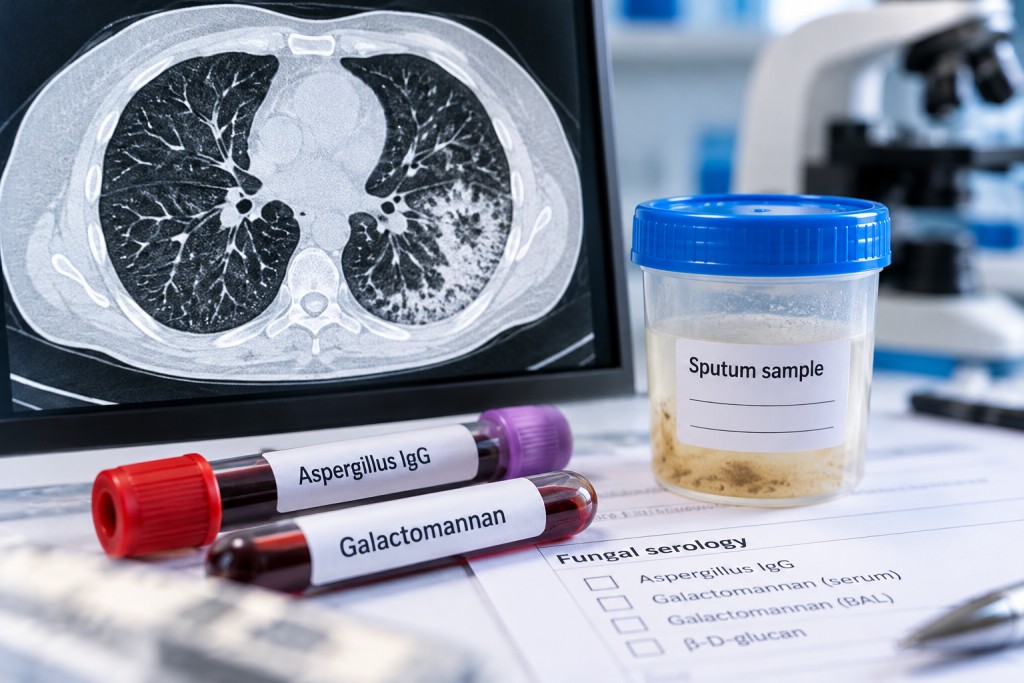
CT scans show changes in the structure of the lungs, including cavities, fungal balls, nodules, airway abnormalities and areas of inflammation.
They are central to diagnosing many forms of pulmonary aspergillosis.
Comparing scans taken months apart can be particularly helpful in chronic disease because it allows doctors to assess progression or improvement.
However, CT findings are not always specific to Aspergillus.
Aspergillus IgG antibody tests
Aspergillus-specific IgG is an important blood test when doctors suspect chronic pulmonary aspergillosis.
It detects antibodies produced by the immune system in response to the fungus.
A positive result supports the diagnosis in the right clinical circumstances, but does not prove active infection on its own. Some patients with CPA may also have negative results.
The interpretation depends on the assay used and the patient’s wider clinical picture.
Fungal culture
A sputum sample or fluid collected during bronchoscopy can be cultured in a laboratory to look for fungal growth.
Culture can identify Aspergillus species and may allow testing of their susceptibility to antifungal medicines.
Its main limitation is that the fungus may not grow even when infection is present. Conversely, a positive culture does not always prove that Aspergillus is responsible for the patient’s symptoms.
PCR: detecting fungal DNA
PCR stands for polymerase chain reaction. It is a laboratory technique that detects genetic material from an organism.
Aspergillus PCR may be performed on sputum, bronchoscopy fluid or tissue, depending on the clinical situation and laboratory.
PCR can be faster than culture and may detect fungal material when culture is negative.
However, detecting fungal DNA does not necessarily mean there is active infection. The test may also detect colonisation or fungal material that is not causing disease.
PCR results are therefore interpreted alongside imaging and other tests.
Fungal antigen tests
Antigens are substances associated with an organism that can be detected by laboratory tests.
Galactomannan
Galactomannan is a component of the Aspergillus fungal cell wall.
Testing for galactomannan is well established in the investigation of invasive aspergillosis, particularly in selected high-risk patients.
It may be measured in blood or bronchoalveolar lavage fluid obtained during bronchoscopy.
For chronic pulmonary aspergillosis, galactomannan testing of bronchoscopy fluid may sometimes be helpful, but blood testing is much less reliable.
A negative galactomannan result does not exclude every form of aspergillosis.
Beta-D-glucan
Beta-D-glucan is a component of the cell walls of several different fungi.
A positive blood test may provide supporting evidence for certain invasive fungal infections, but it is not specific to Aspergillus.
It cannot identify which fungus is responsible and is not routinely used to establish a diagnosis of chronic pulmonary aspergillosis.
Rapid fungal tests
Some fungal tests use a lateral-flow format, similar in appearance to a home pregnancy test.
These tests can detect particular fungal markers without requiring all the equipment used for conventional laboratory assays.
Certain lateral-flow tests are already commercially available and used in specialist diagnostic settings. Others remain under evaluation.
Their usefulness depends on the type of aspergillosis, the sample tested and the performance of the individual test.
Rapid testing is particularly attractive where access to specialist laboratories is limited, but a quick result is not automatically a definitive diagnosis.
Detecting resistance to antifungal medicines
Resistance to azole antifungal medicines is an important challenge, particularly in Aspergillus fumigatus.
Traditionally, laboratories investigate resistance by growing the fungus and testing its response to antifungal drugs.
Molecular tests can also identify certain genetic changes associated with resistance, including mutations involving the cyp51A gene.
Some specialist assays can detect these changes directly in clinical samples, potentially providing useful information when culture is negative.
However, not all resistance mechanisms are detectable by these tests. Conventional susceptibility testing remains important whenever a suitable isolate is available.
Earlier recognition of resistance may help clinicians choose more appropriate treatment.
Technologies being developed
Several promising approaches are being investigated, but they should not yet be regarded as routine diagnostic replacements.
Breath testing
Fungi and other microorganisms can produce volatile organic compounds (VOCs) — small chemical substances that may be detected in exhaled breath.
Researchers are investigating whether patterns of these compounds could help identify fungal lung infections.
Breath testing would be attractive because it is non-invasive and potentially quick.
However, the compounds detected may be influenced by other infections, medicines, diet and environmental exposures.
Further research is needed before breath testing can be relied upon to diagnose aspergillosis in routine care.
Advanced DNA sequencing
Traditional PCR usually looks for a particular organism or genetic target.
Advanced sequencing methods can examine a much wider range of genetic material within a sample.
These methods may help identify unusual fungi, mixed infections or organisms missed by more targeted tests.
Researchers are also studying the lung microbiome — the communities of microorganisms found in the respiratory system.
A major challenge is distinguishing organisms that are genuinely causing disease from those that are simply present.
Sequencing is also relatively expensive, and interpretation requires specialist expertise.
Artificial intelligence and CT imaging
Artificial intelligence (AI) systems can be trained to recognise patterns in medical images.
Researchers are exploring whether AI could help radiologists identify abnormalities, measure changes in lung cavities or monitor disease progression.
For chronic pulmonary aspergillosis, consistent measurement of changes over time could be particularly useful.
However, AI tools must be carefully validated across different patient groups and scanning systems.
They are not a substitute for specialist radiological and clinical assessment.
What might diagnosis look like in the future?
Rather than relying on one new test, future diagnosis may involve combining several types of information more effectively.
For example, a patient with suspected chronic pulmonary aspergillosis might have CT imaging, antibody testing and sputum investigations, with molecular or resistance testing added where appropriate.
Someone with suspected invasive aspergillosis may require a different combination of investigations, sometimes urgently.
The aim is not simply to perform more tests. It is to obtain the right information sooner, avoid unnecessary procedures and make treatment decisions with greater confidence.
Common questions
Why can aspergillosis take so long to diagnose?
Symptoms can resemble other respiratory illnesses, and no single test identifies every form of the disease.
Doctors may need to compare scans over time, repeat samples or exclude other explanations.
Does a positive Aspergillus PCR mean I have aspergillosis?
Not necessarily. PCR detects fungal DNA, which may be present without active infection.
The result needs to be considered alongside symptoms, scans and other investigations.
Can I have aspergillosis with a negative blood test?
Yes. The reliability of blood tests varies according to the form of aspergillosis and the patient’s immune response.
A negative result does not always exclude disease.
Can a blood test tell whether my Aspergillus is resistant to treatment?
Some molecular tests can identify particular resistance-associated mutations, but these are not suitable for every situation.
Your specialist laboratory may use a combination of molecular methods and culture-based susceptibility testing.
Are AI scans and breath tests available now?
They are primarily research and development approaches for this purpose. Their availability and clinical usefulness remain limited compared with established investigations.
What this means for patients
Diagnostic technology is improving, but the most important principle remains unchanged: aspergillosis is diagnosed by combining evidence, not relying on one test result.
If you are undergoing investigation, it is reasonable to ask your clinical team which form of aspergillosis they are considering, what each test is intended to show, and whether further investigations are needed.
Further information
For established information about tests and investigations, visit the Aspergillosis Diagnostics Hub.
This article is educational and does not replace advice from your treating clinical team.
References
- Denning DW, et al. Chronic pulmonary aspergillosis: rationale and clinical guidelines for diagnosis and management. European Respiratory Journal. 2016;47:45–68. https://doi.org/10.1183/13993003.00583-2015
- Ullmann AJ, et al. Diagnosis and management of Aspergillus diseases: executive summary of the 2017 ESCMID-ECMM-ERS guideline. Clinical Microbiology and Infection. 2018;24(Suppl 1):e1–e38. PubMed
- Pulmonary aspergillosis: diagnosis and treatment. European Respiratory Review. 2022. PubMed
- Fan Y, et al. Lateral-flow device for the diagnosis of invasive aspergillosis: a systematic review and diagnostic meta-analysis. BMC Infectious Diseases. 2025;25:388. https://doi.org/10.1186/s12879-025-10769-x

Did this page help you?
Tell us in one minute