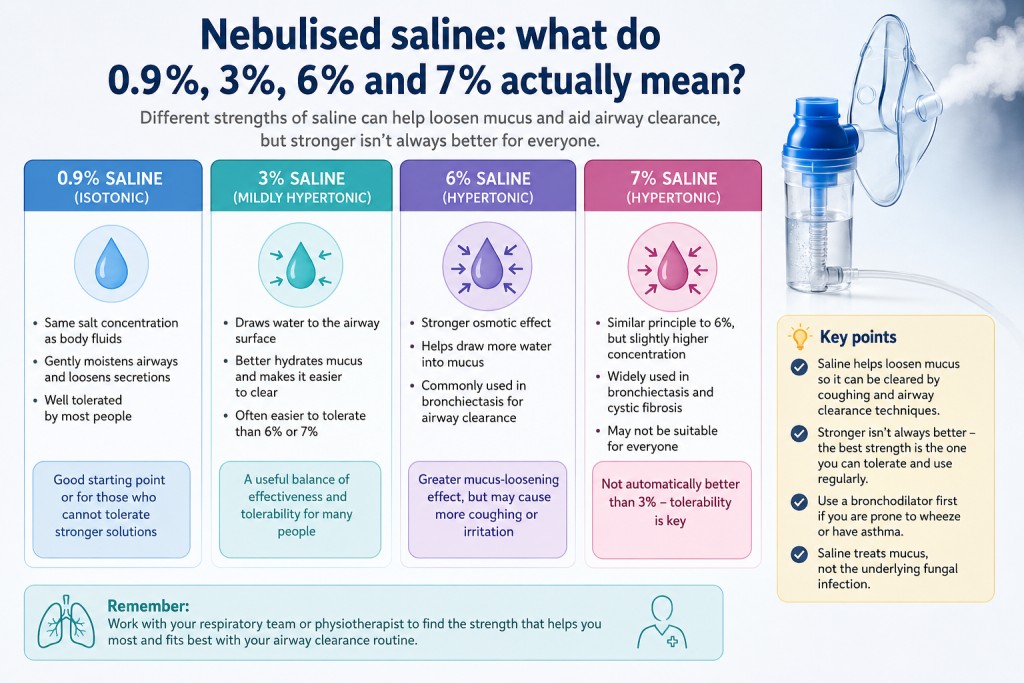
People with bronchiectasis and other long-term lung conditions are sometimes advised to inhale saline through a nebuliser to help with airway clearance. If you have been prescribed it, you may have noticed that saline comes in different strengths — commonly 0.9%, 3%, 6% or 7%.
So what do those numbers mean? Is stronger saline better? And why can one person comfortably use 7% saline while another finds even 3% makes them cough or wheeze?
The answer is that nebulised saline is not simply “salt water”. Its concentration changes how it interacts with the surface of the airways and with mucus.
Why use nebulised saline?
Healthy airways are lined by a thin layer of fluid. Tiny hair-like structures called cilia beat through this fluid, helping move mucus and trapped particles towards the throat, where they can be coughed up or swallowed.
In bronchiectasis, mucus can become unusually thick and difficult to clear. Damaged and widened airways can also allow mucus to accumulate, creating an environment in which bacteria and other microorganisms can persist.
Nebulised saline can help by adding water to the airway surface and making secretions easier to move and cough up. It is generally used alongside an airway-clearance technique rather than instead of one.
Current European bronchiectasis guidance suggests considering mucoactive treatments when airway-clearance techniques alone have not adequately controlled symptoms. Treatment should be individualised, taking account of tolerability and treatment burden.
What does the percentage mean?
The percentage tells you how much sodium chloride — ordinary salt — is dissolved in the sterile solution.
0.9% saline — isotonic or “normal” saline
A 0.9% sodium chloride solution has approximately the same salt concentration as body fluids, which is why it is described as isotonic.
When nebulised, it moistens the airways and can help loosen secretions. British Thoracic Society guidance suggests considering humidification with sterile water or normal saline to facilitate airway clearance.
Because it is relatively gentle on the airways, 0.9% saline may be useful for people who cannot tolerate stronger solutions.
3% saline — mildly hypertonic
Anything above 0.9% is described as hypertonic saline.
The higher salt concentration creates an osmotic effect that helps draw water towards the airway surface. This can increase the hydration of mucus and make it easier to move.
Three per cent saline therefore provides a stronger effect than normal saline while potentially being easier to tolerate than 6% or 7%.
It can be a useful compromise for someone who benefits from hypertonic saline but develops excessive coughing, chest tightness or wheezing with a higher concentration.
6% and 7% saline — hypertonic saline
Six and seven per cent saline have been studied as airway-clearance treatments in bronchiectasis and are commonly encountered in respiratory practice.
The principle is the same: the concentrated salt solution draws water towards the airway surface, helping hydrate thick secretions so that airway-clearance techniques and coughing can remove them more effectively.
British Thoracic Society guidance describes hypertonic saline as saline at 3% or above and suggests evaluating isotonic or hypertonic saline when airway clearance is inadequate, particularly where secretions are viscous or there is sputum plugging.
Does stronger mean better?
Not necessarily.
It is tempting to think:
0.9% → 3% → 6% → 7% = increasingly effective treatment.
Biologically, increasing the concentration can produce a greater osmotic effect. But what matters clinically is whether that translates into a useful improvement for the individual person.
The evidence is less clear-cut than might be expected.
Some relatively small studies have found improvements in sputum clearance, ease of expectoration, lung function or quality of life with hypertonic saline. However, other studies have found that normal saline also produces worthwhile benefits.
The British Thoracic Society concluded that hypertonic saline may improve sputum clearance and quality of life, but that it was uncertain how much additional benefit it provided over isotonic saline.
More recently, a systematic review and meta-analysis found that, overall, hypertonic saline produced results comparable with control treatment — which included isotonic saline in some studies — for outcomes including lung function and pulmonary exacerbations. The available evidence remains limited and further trials are needed.
So 7% is not automatically “better treatment” than 3%, and 3% is not automatically better than 0.9%.
The best concentration is the one that provides useful mucus clearance while remaining tolerable enough to use regularly.
Why does hypertonic saline make me cough?
Coughing is partly the point: mobilising mucus and making it easier to cough up is one reason saline is used.
But hypertonic saline can also irritate sensitive airways.
Some people experience:
- increased coughing
- wheezing
- chest tightness
- breathlessness
- throat irritation or an unpleasant salty taste.
This is particularly important for people who also have asthma or bronchial hyper-responsiveness.
For this reason, British Thoracic Society guidance recommends an airway-reactivity challenge when inhaled mucoactive treatment is first given. It also advises considering treatment with a bronchodilator beforehand in people at greater risk of bronchoconstriction, including those with asthma or very severe airflow obstruction.
This is one reason people should not simply decide for themselves to move from 3% to 7% saline because the higher number sounds more effective.
What if I cannot tolerate 7% saline?
This is an important point.
Being unable to tolerate a stronger saline solution does not mean airway-clearance treatment has failed.
A lower concentration may still provide useful benefit.
For example, someone might find that 7% saline causes considerable wheezing and coughing, whereas 3% saline loosens their sputum sufficiently for them to complete their airway-clearance routine comfortably.
Another person may do perfectly well with 0.9%.
In practice there is a balance between effectiveness, tolerability and treatment burden. This individualised approach is reflected in current bronchiectasis guidance.
A treatment that is theoretically more powerful but is so unpleasant that it is rarely used may be much less useful than a gentler treatment that can be incorporated reliably into everyday life.
Where does saline fit into airway clearance?
Nebulised saline is usually an adjunct to airway clearance, rather than a replacement for it.
Airway-clearance techniques can include:
- Active Cycle of Breathing Techniques (ACBT)
- huff coughing
- positive expiratory pressure (PEP)
- oscillating PEP devices
- positioning
- exercise.
The British Thoracic Society recommends that people with bronchiectasis are taught airway-clearance techniques by a respiratory physiotherapist.
Where several inhaled treatments are prescribed, the order can also matter. BTS physiotherapy guidance gives the general sequence:
bronchodilator → mucoactive treatment such as saline → airway clearance → nebulised antibiotic and/or inhaled steroid, where prescribed.
Individual treatment plans can differ, however, so people should follow the regimen recommended by their respiratory team or physiotherapist.
What does this have to do with aspergillosis?
Many people with aspergillosis also have structural or inflammatory airway disease.
For example, bronchiectasis commonly occurs alongside allergic bronchopulmonary aspergillosis (ABPA) and may also be present in people with chronic pulmonary aspergillosis (CPA) or other chronic lung conditions.
These people can produce substantial amounts of thick sputum and sometimes mucus plugs.
Nebulised saline may therefore form an important part of managing their airway secretions and bronchiectasis.
However, saline does not kill Aspergillus and is not an antifungal treatment.
It should be thought of as part of managing mucus and airway clearance rather than as treatment for the fungal infection or allergic response itself.
The important question isn’t always “Which strength is best?”
A better question may be:
“Which strength helps me clear my lungs effectively and is comfortable enough for me to keep using?”
For one person that may be 7%. For another it may be 6%, 3% or even 0.9%.
If nebulised saline causes significant wheezing, chest tightness or breathlessness, or if you are struggling to clear your sputum despite using it, discuss this with your respiratory physiotherapist or clinical team. They can review both the saline concentration and the rest of your airway-clearance technique.
Sometimes stepping down the concentration isn’t stepping down the quality of treatment at all — it is finding the treatment that works best for you.
Further reading
- British Thoracic Society guideline for bronchiectasis in adults
- British Thoracic Society bronchiectasis resources
- European Respiratory Society bronchiectasis guideline

Did this page help you?
Tell us in one minute