Being diagnosed with allergic bronchopulmonary aspergillosis (ABPA) can be frightening. Then you read about the medicines used to treat it – corticosteroids such as prednisolone and antifungal medicines such as itraconazole – and their lists of possible side effects can be frightening too.
It is quite reasonable to wonder: would I be better off taking nothing?
The answer isn’t simply “take every medicine you are offered”. ABPA varies considerably between people, and modern treatment is increasingly individualised. The aim is to control the disease while exposing you to as little treatment – and as few side effects – as reasonably possible.
Why is ABPA treated?
ABPA is not the same as an invasive fungal infection. In ABPA, Aspergillus growing in the airways triggers an excessive immune and inflammatory response.
This can cause worsening asthma, coughing, wheezing, mucus plugging and exacerbations. Repeated or poorly controlled inflammation can also contribute to permanent changes in the lungs, including bronchiectasis.
Treatment therefore has two main approaches:
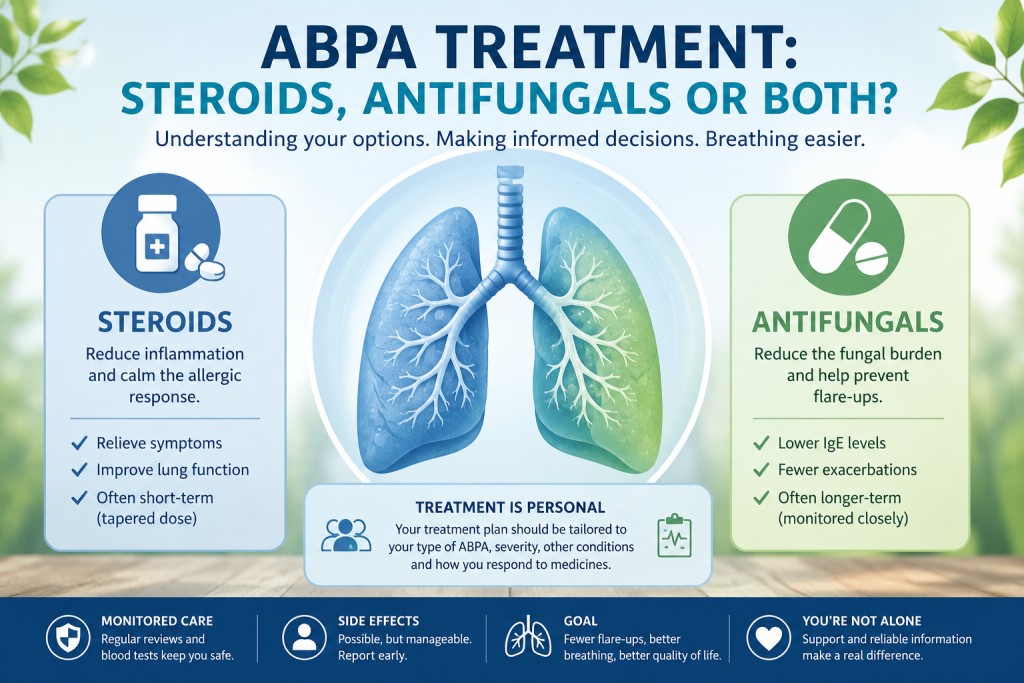
- Corticosteroids reduce the damaging allergic inflammation.
- Antifungal medicines reduce the amount of Aspergillus in the airways and therefore reduce one of the triggers for that inflammation.
But that does not mean everyone with ABPA automatically needs both.
Do I have to take prednisolone?
Not necessarily.
Oral corticosteroids such as prednisolone are very effective at suppressing the inflammation caused by active ABPA and have therefore been a mainstay of treatment for many years.
However, systemic steroids can cause significant side effects, particularly when used repeatedly or for prolonged periods. These can include changes in mood and sleep, increased appetite and weight gain, raised blood glucose, thinning of the bones and skin, increased susceptibility to infection and suppression of the body’s own production of cortisol.
Doctors therefore try to balance the benefits against these risks.
The 2024 international ISHAM guidelines recommend a low-to-moderate dose course of oral prednisolone, tapered and completed over several months, as one first-line option for acute ABPA.
But it is not the only first-line option.
Do I have to take an antifungal?
Again, not necessarily.
Itraconazole is another recommended first-line treatment for acute ABPA and may be particularly useful when systemic corticosteroids are contraindicated or undesirable.
Antifungals can cause side effects and interact with other medicines. Azoles such as itraconazole are processed by the liver and can occasionally cause liver problems.
That doesn’t mean that taking an azole will damage your liver.
Doctors can use blood tests to monitor liver function and, in some circumstances, measure the amount of antifungal medicine in the blood. Medication interactions also need to be checked carefully.
If one antifungal cannot be tolerated, that does not necessarily mean every antifungal will cause the same problem. Other treatment options may sometimes be considered by the specialist team.
Do I need steroids and an antifungal?
This is an important area where treatment thinking has changed.
For newly diagnosed acute ABPA, the 2024 ISHAM international guidelines recommend either:
- oral prednisolone, or
- oral itraconazole
as initial treatment.
They do not recommend routinely giving prednisolone and itraconazole together as first-line treatment for acute ABPA. Combination treatment has a more important role in people experiencing recurrent ABPA exacerbations.
There are exceptions, and your specialist may have good reasons for recommending a particular regimen based on your previous treatment, lung disease, scans, blood results, other illnesses and medications.
If you are concerned about being prescribed both medicines, it is reasonable to ask your specialist:
“Why have you recommended both treatments in my particular case?”
Does everyone diagnosed with ABPA need treatment?
No.
The 2024 international guidelines do not recommend routine systemic treatment for people with asymptomatic ABPA.
People with serological ABPA (ABPA-S), where there is no ABPA-associated bronchiectasis on CT, may also not require systemic treatment if their asthma is well controlled and they are not experiencing recurrent exacerbations.
This is another reason why somebody else’s experience of ABPA may not apply to you.
What happens if I don’t treat it?
This depends on your individual disease.
It is wrong to say that everybody with untreated aspergillosis will die. “Aspergillosis” describes several very different diseases.
However, active ABPA should not simply be ignored. Repeated inflammation and mucus plugging can damage the airways and contribute to bronchiectasis. Early identification and appropriate treatment are intended to control the disease and reduce that risk.
If fear of medication is making you consider refusing treatment, tell your doctor. There may be more than one reasonable treatment strategy to discuss.
What does “Stage 4 ABPA” mean?
You may encounter numbered ABPA stages on older websites, patient forums and medical papers.
These numbers can be misleading because they were not like cancer stages, where a higher number necessarily means more advanced disease.
In the previous ISHAM classification, for example, Stage 4 meant remission.
The 2024 international guidelines have moved away from numbered stages and instead describe five clinical states:
- acute ABPA
- response
- remission
- treatment-dependent ABPA
- advanced ABPA
So statements such as “Stage 4 aspergillosis is terminal” are incorrect.
It is also important to distinguish ABPA from chronic pulmonary aspergillosis (CPA), aspergilloma and invasive aspergillosis. They are different diseases with different treatments and outlooks.
What if the first treatment causes side effects?
Contact your clinical team.
Don’t assume that experiencing a side effect means you have only two choices: endure it or abandon treatment altogether.
Depending on the circumstances, clinicians may be able to alter the treatment, investigate whether the symptom really is caused by the medicine, or consider another approach.
For people with recurrent or treatment-dependent ABPA, specialist treatment options can also include longer-term azole therapy, nebulised amphotericin B and, in selected patients, biological medicines.
ABPA treatment is no longer simply a choice between “steroids or nothing”.
What about biological treatments for ABPA?
Biological medicines – often called biologics – are becoming increasingly important in the treatment of difficult-to-control asthma and ABPA.
These medicines target specific parts of the immune response involved in allergic and eosinophilic inflammation. They include omalizumab, mepolizumab, benralizumab, dupilumab and tezepelumab.
Biologics are not currently recommended as routine first-line treatment for a new episode of acute ABPA. Steroids and/or antifungal treatment remain the usual initial approaches.
However, biologics may be considered in some people with treatment-dependent or recurrent ABPA, particularly when severe asthma is also present or repeated courses of oral corticosteroids are causing problems.
One important potential advantage is their steroid-sparing effect: controlling the underlying allergic inflammation may allow some patients to reduce their exposure to systemic corticosteroids.
Omalizumab has the longest history of use in ABPA, but there is increasing experience with other biologics targeting different parts of the inflammatory pathway. Which, if any, is appropriate depends on the individual’s asthma, ABPA, blood results, previous treatments and other clinical factors.
Research in this area is developing rapidly, so the role of biologics in ABPA treatment is likely to continue evolving.
A particular warning about antifungals and sunlight
You may occasionally see claims that sitting in the sun or “heliotherapy” can help the inflammation associated with aspergillosis.
Sunlight is not a recognised treatment for ABPA.
There is an additional reason to be cautious if you take certain antifungals.
Voriconazole can cause significant photosensitivity. People taking it are advised to protect themselves from sunlight because prolonged treatment is also associated with an increased risk of phototoxic skin damage and squamous cell carcinoma.
Always check the advice for the particular medicine you have been prescribed.
Patient experiences are valuable – but they aren’t prescriptions
Patient support groups can be enormously helpful.
One person may tell you that itraconazole transformed their symptoms. Another may have stopped it because of side effects. Someone else may have taken corticosteroids for years, while another person has hardly needed them.
All of those experiences can be genuine.
But none tells you what will happen to you.
When reading patient discussions, it can help to separate:
“This is what happened to me.”
from:
“This is what you should do.”
The first can be extremely valuable. The second needs much more caution.
Questions to ask your doctor
If you have recently been diagnosed with ABPA and are worried about treatment, consider asking:
- How active or severe is my ABPA at the moment?
- What are we trying to achieve with this treatment?
- Why have you chosen this particular medicine for me?
- Do I need a steroid, an antifungal, or both?
- How long do you expect me to take it?
- What side effects should I report?
- What blood tests or other monitoring will I need?
- What happens if I cannot tolerate this treatment?
- How will we know whether it is working?
Understanding the purpose of treatment often makes the decision much less frightening.
The important message
A new diagnosis of ABPA does not mean that you are inevitably going to become seriously ill, nor does it mean that you must simply accept whatever side effects treatment causes.
ABPA is treatable, and there are now several approaches to managing it.
The aim is to find the treatment that controls the disease effectively while minimising its impact on the rest of your health.
If you are worried enough about a prescribed treatment that you are considering not starting it or stopping it, talk to your clinical team before making the change. There may be alternatives or adjustments that you have not yet discussed.
This information is intended to help people understand ABPA and its treatment. It does not replace individual advice from your doctor or specialist aspergillosis team.

Did this page help you?
Tell us in one minute