Media description:
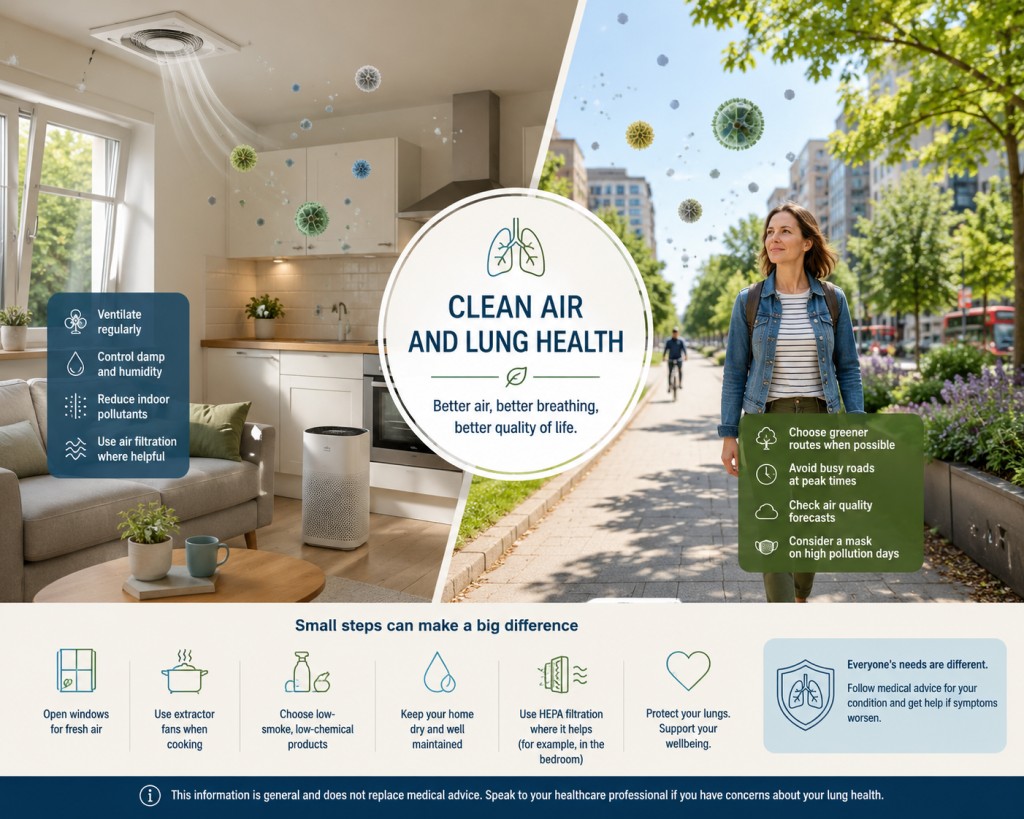
Illustration accompanying the Clean Air and Lung Health guide, showing indoor and outdoor sources of airborne particles and practical measures including ventilation, moisture control, reducing indoor pollutants, air filtration and choosing lower-pollution routes outdoors.
I’d keep “clean air and lung health” in the filename, title and alt text because it matches the article’s focus keyphrase, while the rest describes what is actually visible in the image.
Last reviewed: 17 August 2026
Key points
- Air quality can affect breathing symptoms, particularly in people with asthma, bronchiectasis, COPD and other chronic lung conditions.
- Important pollutants include fine particles, traffic and combustion gases, tobacco smoke, household chemicals, damp, mould and airborne allergens.
- People with aspergillosis do not need completely sterile or fungus-free air — that is neither realistic nor necessary.
- The most useful approach is usually to reduce important sources of pollution, control damp and moisture, ventilate appropriately and reduce exposure when outdoor air quality is poor.
- Air cleaners can sometimes help with airborne particles, but they do not fix damp, mould growth or the source of indoor pollution.
Why does clean air matter?
Every day we breathe thousands of litres of air into our lungs. Along with oxygen, that air contains particles, gases, allergens, fungal spores and other biological material.
For most people, ordinary environmental exposure causes no obvious problem. However, people with chronic respiratory conditions may be more sensitive to changes in air quality. Poor air quality can irritate the airways, increase inflammation and contribute to symptoms such as coughing, wheezing, chest tightness or breathlessness.
This is particularly relevant to people living with conditions such as asthma, bronchiectasis, chronic obstructive pulmonary disease (COPD) and aspergillosis.
Clean air does not mean air completely free from particles or microorganisms. The aim is to reduce avoidable exposure to pollutants and excessive concentrations of substances that may aggravate respiratory disease.
Indoor and outdoor air are connected
We often think of indoor and outdoor air pollution as separate problems, but they interact.
Outdoor pollutants enter buildings through doors, windows, ventilation systems and gaps in the building. At the same time, everyday activities inside the home can create additional pollutants.
Indoor sources can include:
- cooking, particularly combustion and frying
- gas appliances
- wood burners and open fires
- tobacco smoke
- candles and incense
- cleaning sprays and aerosols
- air fresheners and fragranced products
- paints, solvents and some furnishings
- damp and mould growth
NICE identifies people with existing respiratory conditions as particularly vulnerable to poor indoor air quality and advises reducing pollutant sources and using appropriate ventilation.
See the NICE guidance on indoor air quality at home.
Particulate matter
Particulate matter (PM) consists of tiny solid particles and liquid droplets suspended in the air.
You may see references to PM10 and PM2.5. The number refers approximately to the maximum diameter of the particles in micrometres. PM2.5 is particularly important because these very small particles can penetrate deep into the lungs.
Sources include:
- road traffic
- industrial emissions
- wood and solid-fuel burning
- wildfires
- cooking
- smoking
- candles and other combustion
People with existing lung disease may notice increased respiratory symptoms during periods of poor outdoor air quality.
For practical advice about pollution forecasts, air-quality indices and reducing exposure, see our Outdoor Air Pollution and Aspergillosis guide.
Damp, mould and fungal spores
Fungi are a natural part of our environment. Fungal spores are present in outdoor and indoor air, and completely avoiding them is impossible.
Problems are more likely when buildings develop persistent damp or visible mould growth. Moisture allows fungi to grow on walls, ceilings, furnishings and other materials, potentially increasing exposure to fungal spores and fragments.
Damp housing is also associated with respiratory symptoms independently of any single fungal species.
For people with aspergillosis, the sensible objective is therefore not to attempt to eliminate every fungal spore. It is to avoid unusually high or prolonged exposure and to deal with significant damp and mould growth.
NICE recommends tackling the source of damp, repairing water damage, controlling condensation and ensuring appropriate ventilation rather than simply treating visible mould as a surface-cleaning problem.
What about Aspergillus outdoors?
Aspergillus spores are naturally present in the environment. Other fungi, including Cladosporium and Alternaria, can also contribute substantially to airborne fungal-spore levels.
Spore concentrations vary with season, weather, vegetation and local environmental conditions.
A 2026 systematic review of airborne fungal spores found evidence linking higher fungal-spore concentrations with respiratory symptoms in sensitised populations, although relatively few studies directly linked environmental measurements with health outcomes. Read the systematic review.
This does not mean that every increase in outdoor fungal spores causes aspergillosis. Different Aspergillus-related diseases arise from a combination of exposure, underlying lung disease, immune responses and other individual risk factors.
Ventilation: useful, but context matters
Ventilation helps remove moisture and pollutants generated inside a building.
Useful measures can include:
- using kitchen extractor fans while cooking
- using bathroom extraction during and after bathing or showering
- keeping trickle vents open where appropriate
- opening windows when conditions allow
- avoiding prolonged indoor drying of wet clothes without adequate ventilation
However, simply saying “open the windows” is not always good advice.
If outdoor pollution is temporarily high — for example because of heavy traffic, smoke or a pollution episode — opening windows may increase indoor pollution. Buildings beside busy roads may also require a different ventilation strategy from homes in cleaner locations.
The objective is therefore appropriate ventilation, not maximum ventilation at all times.
Cooking and combustion
Cooking can produce substantial amounts of particulate matter, particularly frying and high-temperature cooking. Gas cooking can also release nitrogen dioxide and other combustion products.
Using an extractor hood that vents outdoors, where available, can reduce exposure.
Other combustion sources such as tobacco smoke, open fires, wood burners, candles and incense can also add particles and gases to indoor air.
People with sensitive airways may find that reducing these sources improves symptoms.
Cleaning products, sprays and fragrances
Some household products release volatile organic compounds (VOCs) or aerosols that can irritate sensitive airways.
Strong smells do not necessarily mean that something is dangerous, and an odour-free product is not automatically harmless. However, people with asthma or other reactive airway disease may notice symptoms after using sprays, aerosols, fragrances or strong cleaning products.
If a product repeatedly triggers coughing, wheezing or chest tightness, consider using a simpler non-spray alternative and ventilating the area appropriately.
NICE specifically advises people whose asthma is triggered by household sprays, air fresheners or aerosols to avoid them where possible and use non-spray alternatives.
Do air purifiers help?
Portable air cleaners fitted with an appropriate particle filter, commonly a HEPA filter, can reduce concentrations of airborne particles in a room.
They may be useful in some circumstances, particularly where outdoor particles or airborne allergens are a concern.
However, an air purifier has important limitations.
It cannot:
- repair a leak
- remove damp from a building
- prevent condensation caused by inadequate heating or ventilation
- remove mould growing inside walls or other building materials
- replace adequate kitchen or bathroom extraction
If there is an identifiable source of pollution, removing or controlling the source is usually more important than trying to filter the resulting pollution afterwards.
Should people with aspergillosis wear a mask outdoors?
Most people with aspergillosis do not need to wear a mask whenever they go outside.
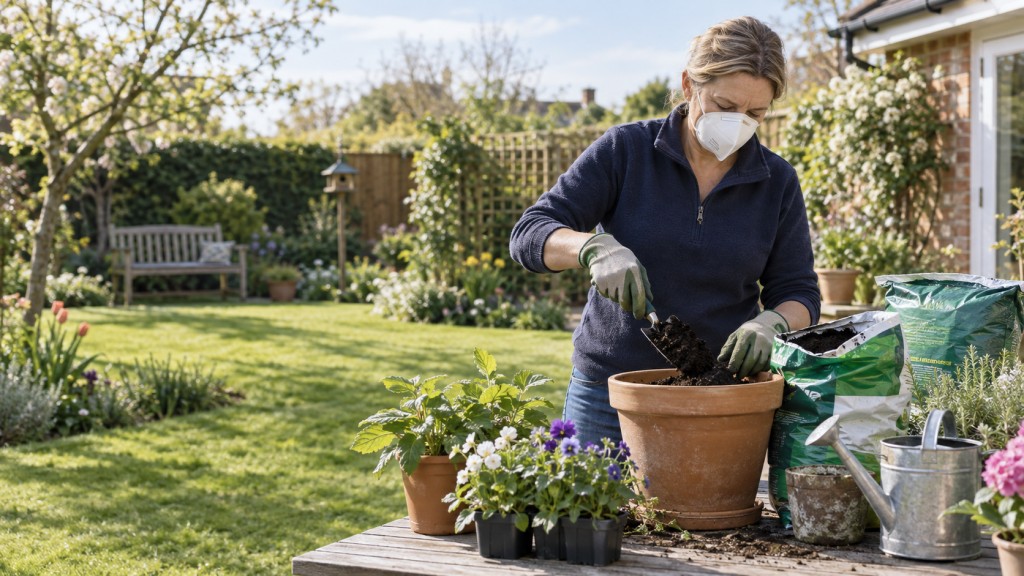
However, respiratory protection may be sensible during activities that can generate unusually high concentrations of dust or fungal material, such as:
- handling compost
- turning compost heaps
- clearing large amounts of decaying vegetation
- working in very dusty environments
- entering buildings with extensive mould contamination
- some construction or renovation activities
The appropriate level of precaution depends on the individual’s condition and immune status.
Avoiding air pollution should not mean avoiding life
It is possible to become understandably anxious about fungal spores, pollution and environmental exposure after being diagnosed with aspergillosis.
But trying to eliminate all exposure is impossible and can unnecessarily restrict daily life.
Outdoor activity, exercise, social contact and spending time in nature can all be important for physical and mental wellbeing.
A more useful approach is to identify high or avoidable exposures and reduce those, rather than treating ordinary air as dangerous.
Practical steps for cleaner air
- Keep your home dry and deal promptly with leaks and water damage.
- Use kitchen and bathroom extraction where available.
- Ventilate appropriately when cooking, showering or drying clothes.
- Avoid smoking and second-hand tobacco smoke.
- Reduce combustion sources such as candles and open fires if they aggravate symptoms.
- Use non-spray cleaning products if aerosols trigger your airways.
- Check outdoor air-quality information when pollution is high or when your breathing is unusually sensitive.
- Consider particle filtration where there is a clear reason for it, but do not use an air purifier as a substitute for fixing damp or pollution sources.
- Avoid unnecessarily high fungal exposure from activities such as handling mouldy material or disturbing compost.
- Continue normal activities when conditions are reasonable rather than attempting to avoid all environmental exposure.
When should I seek medical advice?
Environmental conditions can affect symptoms, but worsening breathlessness, wheezing, coughing or sputum should not automatically be attributed to air quality.
Contact your healthcare team if symptoms are persistent, significantly worse than usual or accompanied by other signs of illness.
People with asthma should follow their asthma action plan and seek urgent medical help for severe breathing difficulty or symptoms that are not responding to their usual treatment.
Further information
- Outdoor Air Pollution and Aspergillosis
- Reducing Aspergillus Exposure and Environmental Risk
- NICE: Indoor air quality at home
References
- National Institute for Health and Care Excellence (NICE). Indoor air quality at home (NG149). NICE guidance.
- Jiménez-Uribe DA, Acevedo-Barrios R, Rubiano-Labrador C, et al. Relationship of airborne fungal spores to epidemiological data on respiratory disease: a systematic review. Aerobiologia. 2026;42:11. Full article.
Audience: Patients, carers and non-specialist healthcare professionals
Last reviewed: 17 August 2026

Did this page help you?
Tell us in one minute