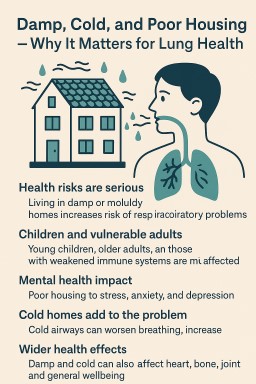
Damp, Cold, and Poor Housing – Why It Matters for Lung Health
This briefing from the House of Commons Library (2025) looks at how poor housing conditions—especially damp, mould, and cold homes—affect health and what’s being done about it in the UK.
Main Points
-
Health risks are serious
Living in damp or mouldy homes increases the risk of respiratory problems, particularly for people with existing lung disease like aspergillosis, asthma, COPD, or bronchiectasis. -
Children and vulnerable adults
Young children, older adults, and people with weakened immune systems are most affected. Damp and mould can trigger flare-ups, worsen breathing symptoms, and increase infection risk. -
Mental health impact
Poor housing is linked to stress, anxiety, and depression. Worrying about your home can also worsen physical symptoms, especially if you avoid using rooms with mould or limit heating to save costs. -
Cold homes add to the problem
Cold airways can make breathing more difficult, weaken the immune system, and increase the chance of winter infections. -
Wider health effects
Damp and cold can also affect heart health, bone/joint pain, and overall wellbeing.
What’s Being Done
-
Legal responsibilities: Landlords must keep homes safe and fit to live in under UK law. This includes dealing with serious damp and mould.
-
Government programmes:
-
Funding for improving insulation and heating in social housing.
-
Advice services for tenants.
-
Local councils can take action if landlords fail to address hazards.
-
-
Public health guidance now recognises the link between housing and chronic illness, with stronger advice for early intervention.
What This Means for Aspergillosis Patients
-
Stay alert to symptoms: If your cough, breathlessness, or fatigue worsen at home, check for damp, mould, or poor heating.
-
Act early: Report problems to your landlord or council quickly—prolonged exposure can worsen lung damage.
-
Medical link is recognised: You are more likely to be taken seriously now, as official guidance acknowledges the health risks.
-
Keep records: Photos, symptom diaries, and GP notes can support housing complaints.
For full details see https://commonslibrary.parliament.uk/research-briefings/cdp-2025-0096/
📘 What is CPA? (Chronic Pulmonary Aspergillosis)
Patient handout for A&E staff who are not aware of aspergillosis.
What is CPA?
CPA is a chronic fungal infection of the lungs caused by Aspergillus, most often in people who already have damaged lungs from conditions like tuberculosis, COPD, lung cancer, or sarcoidosis.
Unlike ABPA, CPA is a true infection, not an allergic reaction. It is not contagious but can slowly destroy lung tissue if not treated.
Symptoms
-
Chronic cough, often with mucus
-
Coughing up blood (haemoptysis)
-
Fatigue, low-grade fever
-
Unexplained weight loss
-
Breathlessness
-
Recurrent chest infections not responding to antibiotics
Diagnosis
-
CT scan of the chest showing cavities, nodules, or fungus balls (aspergillomas)
-
Aspergillus IgG antibody (usually raised)
-
Positive sputum PCR or culture for Aspergillus
-
Exclude TB and malignancy
Treatment
-
Long-term antifungal therapy (e.g. itraconazole, voriconazole, posaconazole)
-
Monitor blood levels and liver function
-
Surgery or embolisation if severe bleeding occurs
-
Supportive care: oxygen, nutrition, physiotherapy
Key Points for A&E:
✅ CPA is a progressive fungal infection, not a typical bacterial pneumonia
✅ May present with haemoptysis, respiratory distress, or systemic illness
✅ Review current antifungal treatment and potential drug interactions
✅ Consider urgent chest CT and specialist referral if patient is unwell
📍 For specialist support:
National Aspergillosis Centre (NAC)
🏥 Wythenshawe Hospital, Manchester University NHS Foundation Trust
🌐 NAC homepage on MFT website https://mft.nhs.uk/wythenshawe/services/infectious-diseases/national-aspergillosis-centre/
🌐 www.aspergillosis.org
📞 Daytime contact: 0161 291 2891 or 0161 291 4362
📞 Urgent out-of-hours: Call Wythenshawe switchboard on 0161 998 7070
📢 Ask for the on-call Infectious Diseases Consultant
📘 What is ABPA? (Allergic Bronchopulmonary Aspergillosis)
Patient handout for A&E staff who ask what aspergillosis is.
What is ABPA?
ABPA is an allergic lung condition caused by the immune system overreacting to the fungus Aspergillus. It mainly affects people with asthma or cystic fibrosis.
When Aspergillus spores are inhaled, most people clear them without issue. In ABPA, the immune system sees these spores as dangerous and mounts a strong inflammatory response. This leads to asthma-like symptoms, mucus plugging, and can result in permanent lung damage (bronchiectasis) if left untreated.
Symptoms
-
Worsening breathlessness
-
Wheezing, chest tightness
-
Coughing up thick, often brown mucus
-
Fever, fatigue, or feeling generally unwell
-
Unintentional weight loss (advanced cases)
Diagnosis
-
History of asthma or cystic fibrosis
-
High IgE levels and positive Aspergillus-specific IgE
-
Eosinophilia (raised white blood cells)
-
Sputum culture or PCR positive for Aspergillus
-
Chest imaging showing mucus plugging or bronchiectasis
Treatment
-
Oral corticosteroids (e.g. prednisolone) to reduce inflammation
-
Antifungal medication (e.g. itraconazole) to lower fungal burden
-
Biologic therapies (e.g. omalizumab or benralizumab) in some patients
-
Regular monitoring by respiratory or infectious diseases specialists
Key Points for A&E:
✅ ABPA is an allergic lung disease, not a classical infection
✅ Can present with severe asthma, mucus plugging, or type 2 respiratory failure
✅ Requires early recognition and often systemic steroids and antifungal therapy
✅ Take bloods (IgE, eosinophils, CRP), consider chest imaging, and review oxygen status
📍 For specialist support:
National Aspergillosis Centre (NAC)
🏥 Wythenshawe Hospital, Manchester University NHS Foundation Trust
🌐 NAC homepage on MFT website https://mft.nhs.uk/wythenshawe/services/infectious-diseases/national-aspergillosis-centre/
🌐 www.aspergillosis.org
📞 Daytime contact: 0161 291 2891 or 0161 291 4362
📞 Urgent out-of-hours: Call Wythenshawe switchboard on 0161 998 7070
📢 Ask for the on-call Infectious Diseases Consultant
🤐 Why It's Important Not to Share Your Clinical Trial Experience — Until It’s Over
If you have chronic pulmonary aspergillosis (CPA), you may be invited to take part in a clinical trial for a new antifungal medication like rezafungin. That’s exciting — and could help improve treatment for many people in future.
Naturally, people want to support each other by sharing experiences, especially in online support groups. But when it comes to clinical trials, there’s a really important reason why we shouldn’t talk about how we’re feeling while we’re still in the trial.
Here’s why.
🧪 What Are Clinical Trials For?
Clinical trials help doctors and researchers answer important questions like:
-
Does this new treatment work?
-
Is it better than the current treatment?
-
What side effects might it cause?
To get accurate answers, the trial needs to be fair and unbiased — meaning that personal expectations and outside influences shouldn’t affect how people report their symptoms or progress.
📣 The Problem With Sharing During a Trial
If you’re taking part in a trial and say something like:
“I feel great — this new drug is working for me!”
or
“This is making me feel worse than ever — don’t join!”
...other people may change how they think and feel based on your comment.
This is called bias. It can:
-
Make others expect the same good (or bad) result
-
Affect how people rate their own symptoms
-
Cause people to drop out or not join at all
-
Make the trial results less accurate or even unusable
Even well-meaning comments can damage the study, especially if the trial is small (like most CPA studies are).
🕵️♀️ What If It’s a Blinded Trial?
Some trials are "blinded", meaning you don’t know whether you're getting the new treatment or a standard one (or placebo).
But if people start guessing or posting:
“I’m sure I’m on the real drug — I feel amazing!”
...then other people might also guess, or feel disappointed — which again, affects how results are reported.
🚦When Is It Safe to Share?
💬 After the trial is over and the results are published, you can talk freely about your experience.
In fact, patient voices are vital at that stage — they help others understand what it’s like to be part of a trial and whether new treatments are helpful in real life.
💡 What You Can Say During the Trial
You can still help raise awareness without compromising the study. For example:
-
✅ “I’m taking part in a CPA trial – ask your doctor if you might be eligible.”
-
✅ “There’s a study on a new antifungal — here’s the link to the official trial page: clinicaltrials.gov/study/NCT06794554”
-
✅ “I’m proud to be contributing to research — happy to share my experience once the trial ends.”
Just don’t talk about how the treatment is affecting you until the trial is complete.
🙏 Why This Matters
By keeping quiet during the trial, you're:
-
Protecting the integrity of the study
-
Helping future patients get trustworthy answers
-
Supporting the research team who need clear, unbiased data
You’re not just taking part in a trial — you’re helping build evidence that others will depend on for years to come.
🧭 Summary
| ✅ Do | ❌ Don’t |
|---|---|
| Tell people a trial exists | Share how the treatment is affecting you |
| Encourage others to talk to their doctor | Post guesses about which drug you’re on |
| Wait until the trial ends to share experiences | Influence others to join based on your results |
If you're ever unsure, ask your clinical trial team or group moderator — they'll be glad to help. Your role in research is important, and your silence now is a powerful act of support for science, fairness, and future care.
Other forms of Aspergillosis: 🔬 Acute Invasive Aspergillus Sinusitis (AIAFS)
⚠️ A rare and severe fungal sinus infection — seen almost exclusively in people with severely weakened immune systems
🧾 What is it?
Acute Invasive Aspergillus Sinusitis (AIAFS) is a rapidly progressing fungal infection of the sinuses, caused by Aspergillus species (typically A. fumigatus). It leads to tissue invasion, destruction, and potentially fatal complications if not treated urgently.
🛡️ Who is at Risk of Acute Invasive Aspergillus Sinusitis?
Acute Invasive Aspergillus Sinusitis (AIAFS) is very rare, and affects people who are significantly immunocompromised — meaning their immune systems are unable to control even common environmental fungi.
However, “immunocompromised” is not always black-and-white. There are different degrees of vulnerability, and it's important to understand who is at greatest risk.
🔴 High-risk (severe immunosuppression)
These individuals are at the greatest risk for AIAFS:
-
Profound neutropenia (especially <500 neutrophils/μL for >10 days)
-
Acute leukaemia or stem cell transplantation
-
Solid organ transplant recipients on strong immunosuppressive regimens
-
High-dose corticosteroids (e.g. ≥20 mg prednisolone/day for ≥2 weeks)
-
Uncontrolled HIV/AIDS with low CD4 counts (<200)
-
Diabetic ketoacidosis or severe metabolic acidosis
🟠 Intermediate-risk (chronic or moderate immunosuppression)
Patients in this category may not be at risk of AIAFS, but may still be more vulnerable to chronic or allergic forms of aspergillosis or other infections:
-
Long-term oral corticosteroids at lower doses (e.g. <10 mg/day)
-
Biologic therapies for asthma (e.g. anti-IL-5, anti-IgE), which may subtly modulate immunity
-
Genetic susceptibility (e.g. subtle immune pathway deficiencies identified in CPA or ABPA)
-
COPD, bronchiectasis or severe asthma with impaired local defence
-
Malnutrition or poorly controlled diabetes
These patients are not typically at risk of invasive sinus aspergillosis, but may experience worsening of fungal conditions or atypical presentations of infection.
🟢 Low-risk (normal immune function)
People with normal immune function — even those with:
-
Allergic rhinitis
-
Chronic rhinosinusitis
-
Mild asthma or occasional infections
…are not at risk of developing AIAFS. Everyday exposure to Aspergillus spores is harmless to most people.
💬 Key Clarification:
Having aspergillosis does not automatically mean you are at risk of invasive sinus infection.
Many patients with CPA, ABPA, or SAFS are immunologically “fragile,” but not severely immunocompromised.
AIAFS typically only occurs in people with a combination of immune suppression and a very specific set of risks — especially when white blood cell function is severely impaired.
📋 Symptoms and Signs (typically <4 weeks onset)
-
Fever that does not respond to antibiotics
-
Facial pain or pressure, often severe and one-sided
-
Nasal congestion, discharge (often bloody or blackish)
-
Dark scabs (eschar) on the nasal mucosa or palate
-
Eye swelling, visual changes, or cranial nerve symptoms (if spread to the orbit or brain)
-
Altered mental state, seizures (in advanced cases)
🧪 Diagnosis
AIAFS is diagnosed based on:
-
Clinical suspicion in a high-risk patient
-
Endoscopic examination with biopsy and histology (showing hyphal invasion of tissue)
-
CT/MRI imaging to assess spread (bone, orbit, brain)
-
Culture and molecular testing of sinus material
-
Aspergillus PCR or galactomannan testing may help, but are not definitive alone
💊 Treatment Approach
Treatment must begin urgently, ideally within hours of suspicion.
1. Systemic antifungal therapy
-
First-line: Voriconazole or Isavuconazole
-
Alternatives: Liposomal Amphotericin B
-
Combination therapy may be considered in some cases
-
Therapeutic drug monitoring is essential (especially for voriconazole)
2. Surgical debridement
-
Prompt and aggressive endoscopic surgery is critical
-
Repeat procedures may be needed to remove necrotic tissue
3. Immunological support
-
Reversal of neutropenia if possible (e.g. G-CSF)
-
Reduction or withdrawal of immunosuppressive drugs
-
Management of underlying condition (e.g. glycaemic control in diabetes)
📈 Prognosis
-
Mortality is high (>50%) if not recognised and treated early
-
With rapid antifungal therapy and surgery, survival improves significantly
-
Regular monitoring, follow-up imaging, and immune recovery are crucial to long-term outcomes
🧠 Key Points to Remember
✅ This is a medical emergency, but
✅ It is extremely rare, and
✅ Almost exclusively affects those with profound immune suppression
✅ Not a risk to the general public or people with typical sinus infections
📣 Summary for Patient Awareness
Acute Invasive Aspergillus Sinusitis is very rare.
It is a fast-moving sinus infection caused by a fungus called Aspergillus, but it only happens in people with very weak immune systems, like those having chemotherapy or organ transplants.
It needs urgent treatment with antifungal medicine and sometimes surgery.
If your immune system is normal, this infection is not a risk to you.
Patient Guide: Understanding Aspergillus-Related Chronic Pulmonary Disease
Based on new international guidance (2024)
What is Aspergillus and Why Is It Important?
Aspergillus is a common type of fungus found in the environment. Most people breathe it in every day without any problem. However, if you have a lung condition or a weakened immune system, Aspergillus can cause serious problems. It can:
- Trigger allergic reactions in the lungs
- Infect damaged lung tissue
- Worsen symptoms like coughing, wheezing, or breathlessness
Until recently, doctors treated each type of aspergillus-related lung disease as a separate condition. But new guidance recognises that many patients may have more than one form or sit on a spectrum.
What Conditions Are Included?
The term "aspergillus-related chronic pulmonary disease" covers a range of conditions:
| Condition | What it means |
|---|---|
| ABPA (Allergic Bronchopulmonary Aspergillosis) | An allergic reaction to Aspergillus, usually in asthma or cystic fibrosis patients |
| CPA (Chronic Pulmonary Aspergillosis) | A slow-developing fungal infection, often in people with pre-existing lung damage |
| Aspergillus bronchitis | A fungal infection in the airways, often in people with bronchiectasis |
| Overlap syndromes | Some people show features of more than one of the above |
What Are the Symptoms?
Symptoms can vary, but common signs include:
- Persistent cough (sometimes with mucus or blood)
- Wheezing or breathlessness
- Fatigue and low energy
- Weight loss or loss of appetite
- Repeated chest infections
If you experience these symptoms and have an underlying lung condition, it’s important to ask whether Aspergillus might be involved.
How Is It Diagnosed?
Doctors now use a combination of tests to get a clearer picture:
- Chest CT scan – to look for signs of lung damage or fungal balls
- Sputum samples – to check for the presence of Aspergillus
- Blood tests – to detect allergic antibodies (IgE), immune responses (IgG), or fungal antigens
- Bronchoscopy (sometimes) – to collect samples directly from the lungs
These tests help doctors decide whether it’s an allergic reaction, an infection, or both.
How Is It Treated?
Treatment depends on your symptoms and test results. The aim is to:
- Reduce inflammation
- Clear fungal infection
- Prevent further lung damage
Common treatment options include:
| Treatment | Purpose |
| Steroids (e.g. prednisolone) | Reduce allergic inflammation (especially in ABPA) |
| Antifungal drugs (e.g. itraconazole, voriconazole) | Treat fungal infection and reduce fungal burden |
| Biologic therapies (e.g. omalizumab, dupilumab) | Used in difficult-to-treat allergic cases |
| Nebulised antibiotics | If other infections (like Pseudomonas) are also present |
| Surgery (rarely) | To remove fungal balls or damaged tissue in severe CPA |
What Has Changed in the 2024 Guidance?
- Doctors are now encouraged to look for overlapping features, not just one diagnosis.
- More emphasis is placed on early detection and preventing lung decline.
- Guidelines promote the use of multidisciplinary teams (MDTs) for complex cases.
- Newer treatments, including biologics, are being recommended more often.
- Patients with symptoms but unclear diagnoses should be re-evaluated regularly.
What Can You Do as a Patient?
- Know your diagnosis – Ask your team whether your current label still fits your symptoms
- Track your symptoms – Keep a log of cough, breathlessness, fatigue, and infections
- Ask about specialist referral – For example, to a National Aspergillosis Centre
- Stay informed – Visit aspergillosis.org for up-to-date guidance
- Take medications as prescribed and report any side effects promptly
Support and Information
- Patient support groups can help you connect with others
- Pulmonary rehabilitation and breathing therapy can improve quality of life
- Annual reviews and regular scans can help spot problems early
For more information, leaflets, and help getting the right care, visit: aspergillosis.org
You don’t have to manage this alone.
Understanding the Different Types of Chronic Pulmonary Aspergillosis (CPA)
CPA is a long-term lung condition caused by a common fungus called Aspergillus. It usually affects people who already have lung damage — from infections like tuberculosis (TB), conditions like COPD or asthma, or diseases such as sarcoidosis.
There are five main types of CPA. Knowing which one you have can help guide your treatment and follow-up.
🟠 1. Chronic Cavitary Pulmonary Aspergillosis (CCPA)
Most common form
-
Caused by Aspergillus growing in one or more cavities in the lungs
-
Cavities may slowly get larger or thicker
-
Often develops in people with previous lung disease
Symptoms:
-
Long-term cough
-
Fatigue and weight loss
-
Breathlessness
-
Sometimes mild or moderate coughing up blood
Treatment: Long-term antifungal tablets (e.g. itraconazole or voriconazole)
⚠️ 2. Chronic Fibrosing Pulmonary Aspergillosis (CFPA)
Advanced stage of CPA
-
Happens when long-term infection causes lung scarring (fibrosis)
-
Lungs become stiff, making breathing harder
Symptoms:
-
Worsening breathlessness
-
Low oxygen levels
-
Severe fatigue
Treatment: Focuses on antifungals, symptom relief, and oxygen if needed
🟢 3. Simple Aspergilloma
A single fungal ball in a lung cavity
-
A round ball of fungus (aspergilloma) forms in an existing lung cavity
-
Often found during scans done for other reasons
-
Some people have no symptoms at all
Main risk: Coughing up blood (sometimes serious)
Treatment:
-
Monitoring if mild
-
Surgery or embolisation if bleeding occurs
🔴 4. Subacute Invasive Aspergillosis (SAIA or CNPA)
Faster-moving form of CPA
-
Occurs over weeks to months
-
Often seen in people with weaker immune systems (e.g. due to diabetes, steroids, or alcohol dependence)
-
Infection starts to invade deeper lung tissue
Symptoms:
-
Fever
-
Worsening breathlessness
-
Severe weight loss
Treatment: Prompt antifungal treatment and close medical monitoring
🟡 5. Aspergillus Nodules
Small lumps caused by Aspergillus
-
These are solid nodules in the lungs, often found by chance on a CT scan
-
They may be mistaken for cancer at first
-
Often cause no symptoms
Treatment:
-
Usually watch and wait
-
Sometimes surgery or biopsy if uncertain
🩺 Why Knowing Your CPA Type Matters
Understanding your CPA type helps your medical team:
-
Choose the best treatment for you
-
Monitor for bleeding or lung damage
-
Decide when to repeat scans or adjust medication
💬 Questions to Ask Your Doctor
-
Which type of CPA do I have?
-
Will I need long-term antifungal treatment?
-
How often should I have scans or blood tests?
-
What should I do if I cough up blood?
🧘 Final Note
CPA is a chronic condition, but many people manage it well with the right treatment and regular check-ups. You are not alone — support and information are available.
Allergic Bronchopulmonary Aspergillosis (ABPA) Without Asthma: A Hidden Reality
Most people – including many doctors – associate Allergic Bronchopulmonary Aspergillosis (ABPA) almost exclusively with asthma or cystic fibrosis. In fact, the current diagnostic criteria for ABPA often assume the presence of asthma as a prerequisite. But what happens when a patient has all the features of ABPA… without ever having had asthma?
This article explores the possibility – and growing recognition – of ABPA without asthma.
🔍 What Is ABPA?
ABPA is an allergic (hypersensitivity) reaction to the fungus Aspergillus fumigatus, which can colonise the lungs and cause:
-
Severe allergic inflammation
-
Damage to lung tissue (bronchiectasis)
-
High levels of IgE (often >1000 IU/mL)
-
Positive skin tests or blood tests for Aspergillus
Traditionally, ABPA is diagnosed in people with asthma or cystic fibrosis, where the airways are already vulnerable.
❗But Can ABPA Occur Without Asthma?
Yes. Though uncommon, there are confirmed cases where ABPA occurs in people who:
-
Do not have asthma
-
Have no wheeze, breathlessness or variability in symptoms
-
Show no reversibility on a bronchodilator test
-
May not respond to inhaled corticosteroids
This presentation is now increasingly recognised – particularly:
-
After viral infections like COVID-19
-
In people exposed to environmental moulds
-
In those with no personal or family history of asthma
🧪 Diagnostic Clues
Patients with ABPA but no asthma typically still show:
-
Very high total IgE levels
-
Positive Aspergillus-specific IgE and IgG
-
Radiological changes like central bronchiectasis
-
Sometimes eosinophilia in blood
But they do not show:
-
Classic asthma symptoms (e.g. wheeze, reversible breathlessness)
-
Improvement with bronchodilators
-
Variable peak flow readings
🧬 How Might This Happen?
There are a few theories:
-
Some people have a strong allergic immune response (IgE-driven) to Aspergillus alone, even without underlying asthma
-
COVID-19 and other infections may prime the immune system or damage airways enough to allow fungal colonisation
-
Not all bronchial hypersensitivity is asthma — the airway inflammation in ABPA is unique and not always “asthmatic” in pattern
✅ What Tests Can Help Confirm or Rule Out Asthma?
For patients who have ABPA but no clear asthma symptoms:
-
Bronchodilator reversibility test → May be negative
-
Methacholine or histamine challenge test → Gold standard for confirming asthma
-
FeNO test → Measures eosinophilic airway inflammation (may be high in both ABPA and asthma)
-
Peak flow monitoring → Often stable in ABPA without asthma
These tests can help clarify the diagnosis and prevent mislabeling patients as asthmatic when they are not.
🧭 Why Does It Matter?
Correct diagnosis matters because:
-
Not all ABPA patients benefit from inhaled corticosteroids or asthma drugs
-
Treatment should be tailored — e.g. antifungals and oral steroids for ABPA, but not unnecessary asthma medications
-
Misdiagnosis may delay the right treatment and overburden patients
🩺 A Call to Clinicians
If a patient has high IgE, bronchiectasis, and strong Aspergillus sensitisation — but no clinical asthma — consider ABPA without asthma.
Request confirmatory tests before labeling someone asthmatic for life. In these rare cases, asthma criteria do not fully apply — but the patient still needs support for ABPA.
🧾 Summary
| Feature | ABPA With Asthma | ABPA Without Asthma |
|---|---|---|
| Wheeze/breathlessness | Common | May be absent |
| Bronchodilator response | Often positive | Usually negative |
| Total IgE | High | High |
| Aspergillus IgE/IgG | Positive | Positive |
| Imaging (HRCT) | Bronchiectasis | Bronchiectasis |
🙋 What Can Patients Do?
If you’ve been diagnosed with ABPA but don’t believe you have asthma:
-
Ask your doctor about further testing to confirm or rule out asthma
-
Keep a record of your symptoms, peak flow (if used), and medication response
-
Discuss your IgE levels, CT scan results, and whether other diagnoses (e.g. chronic pulmonary aspergillosis) might apply
Adrenal Insufficiency in Aspergillosis: Important Risks for Patients and GPs

🫁 Who is at Risk?
People with aspergillosis — especially ABPA (Allergic Bronchopulmonary Aspergillosis) and CPA (Chronic Pulmonary Aspergillosis) — are often treated with:
- Steroids (inhaled or oral, such as fluticasone or prednisolone)
- Azole antifungal medications (like itraconazole, voriconazole, posaconazole)
Both of these can affect the adrenal glands, though azole antifungals only do so indirectly in combination with a steroid medication. When used together, or when steroids are used on their own for long periods of time at a high dose, they can significantly increase the risk of a serious condition called adrenal insufficiency (AI) — when the body can’t produce enough cortisol to respond to stress or illness.
💊 Why Azole Antifungals Make This Worse
Azoles (itraconazole, voriconazole, posaconazole) block liver enzymes (CYP3A4) that normally break down inhaled or oral steroids. As a result:
- Even inhaled steroids (like fluticasone or budesonide) can build up in the body
This can lead to systemic steroid effects, including:
- Adrenal suppression
- Cushing’s-like symptoms (weight gain, moon face, skin thinning)
- Higher risk of adrenal crisis if steroids are stopped too fast or during illness
This is especially well documented with fluticasone + itraconazole — a known high-risk combination.
🚨 What is Adrenal Insufficiency?
Adrenal insufficiency means your adrenal glands cannot produce enough cortisol, the hormone your body needs to:
- Regulate blood pressure and sugar
- Respond to infections and illness
- Maintain energy, mood, and salt balance
Without cortisol, even a minor illness can become life-threatening — this is called an adrenal crisis.
🔍 Warning Signs of Adrenal Suppression
- Fatigue and muscle weakness
- Low mood or confusion
- Weight loss or loss of appetite
- Dizziness when standing (low blood pressure)
- Nausea, abdominal pain
- Skin changes (e.g. thin skin, stretch marks, bruising)
- Cushingoid appearance (round face, fat on upper back)
- During stress (infection, surgery, trauma), people may:
- Vomit or collapse
- Become drowsy or disoriented
- Experience dangerously low blood pressure or blood sugar
🛡️ What GPs and Patients Should Do
For GPs:
- Be alert to the interaction between inhaled corticosteroids and azoles
- If a patient is using inhaled fluticasone or budesonide and starts azoles:
- Consider switching to a non-CYP3A4-metabolised inhaler (e.g. beclometasone)
- Monitor for signs of adrenal suppression or Cushing’s
- If adrenal insufficiency is suspected:
- Arrange morning cortisol testing
- Consider Short Synacthen Test (SST)
- Educate patients on sick day rules and ensure:
- A steroid emergency card is provided
- An adrenal crisis plan is in place
- Emergency hydrocortisone is prescribed if needed
For Patients:
Tell your GP or specialist if you are on:
-
- Azoles (like itraconazole, posaconazole)
- Any form of steroids (inhaled, nasal, oral, injected)
- Never stop steroids suddenly — they may need to be reduced slowly
- Report symptoms like fatigue, nausea, or dizziness
- Ask about a sick day plan — you may need to double your steroid dose during illness
- If you become very unwell, tell emergency services you are at risk of adrenal crisis
💬 Summary
Adrenal insufficiency is a real and under-recognised risk in aspergillosis — especially when azole antifungals are used alongside inhaled or oral steroids. Patients and GPs should work together to prevent and manage this serious complication.
🌿 Tezepelumab (Tezspire) and ABPA: What You Need to Know
If you’ve been living with ABPA and find your symptoms keep coming back despite steroids and antifungal treatment, your consultant may suggest a biologic (monoclonal antibody). One of the newer options being offered to some patients in the UK is Tezepelumab, brand name Tezspire.
💡 What is Tezepelumab?
Tezepelumab is a biologic injection that targets a molecule called TSLP (thymic stromal lymphopoietin). TSLP is an early trigger in the chain reaction that leads to inflammation in the lungs. By blocking it, Tezepelumab can calm multiple allergic and eosinophilic pathways, which makes it different from most other biologics that only block one type of inflammation.
✅ Who Might Be Offered Tezepelumab?
Tezepelumab is approved by NICE for use in the NHS in people aged 12+ with severe asthma, especially those who:
-
Are on high-dose inhaled steroids and still struggling
-
Have had 3+ asthma flare-ups in the last year, or
-
Need to take regular oral steroids
If you have both ABPA and severe asthma, you might be offered Tezepelumab—even though it isn’t specifically licensed for ABPA.
🔍 How Does It Compare to Other Biologics?
Here’s a quick comparison:
| Biologic Name | Target | NHS Use | Needs High IgE or Eosinophils? |
|---|---|---|---|
| Omalizumab | IgE | Severe allergic asthma | ✅ Yes – High IgE needed |
| Mepolizumab | IL-5 | Eosinophilic asthma | ✅ Yes – High eosinophils needed |
| Benralizumab | IL-5 receptor | Eosinophilic asthma | ✅ Yes |
| Dupilumab | IL-4/13 | Allergic asthma | ❌ No, but usually allergy-type |
| Tezepelumab | TSLP (upstream) | Severe asthma (NICE-approved) | ❌ No – works across all types |
🧠 Why this matters: If your IgE or eosinophil levels aren’t high, Tezepelumab may still work for you—even when other biologics aren't suitable.
💷 Is Tezepelumab Expensive?
Yes—but it's funded on the NHS for patients who meet NICE criteria.
-
List price: ~£1,265 per injection (monthly)
-
NHS pays less through a confidential discount agreement
-
It’s not necessarily cheaper than other biologics, but it offers wider eligibility and broad activity
⚖️ Is It Better Than Other Biologics?
It depends. Some patients respond well to older biologics like omalizumab or mepolizumab, especially if their ABPA overlaps with allergy or eosinophilic asthma. But Tezepelumab may be a better fit if:
-
You don’t qualify for the others (e.g. your IgE is too low)
-
You’ve tried other biologics and they didn’t help enough
-
Your ABPA overlaps with hard-to-control asthma
While Tezepelumab isn’t licensed specifically for ABPA, its upstream targeting may help reduce flare-ups in those with overlapping conditions.
💉 Side Effects
Most people tolerate Tezepelumab well. Possible side effects include:
-
Injection site reactions (redness, swelling)
-
Headache or sore throat
-
Allergic reaction (rare)
It's given by subcutaneous injection once a month, often at hospital initially, but home administration may be an option later on.
👩⚕️ What to Ask Your Consultant
-
Why are you recommending this biologic for me?
-
Will it help with both my ABPA and asthma?
-
How soon should I expect results?
-
Can I stop steroids if this works?
Keeping a symptom diary and reporting back is really useful to your team.
🧾 Summary
| Question | Tezepelumab (Tezspire) Answer |
|---|---|
| Licensed for ABPA? | ❌ No, but used off-label when asthma overlaps |
| Approved for NHS use? | ✅ Yes – via NICE for severe asthma |
| IgE or eosinophils needed? | ❌ No |
| Dose/frequency | Monthly injection |
| Broad anti-inflammatory effect? | ✅ Yes – acts early in the pathway |
Tezepelumab is opening new doors for people with ABPA and severe asthma who’ve struggled with flare-ups, steroid side effects, or biologics that didn’t work. It’s not for everyone, but it’s worth a conversation with your specialist.