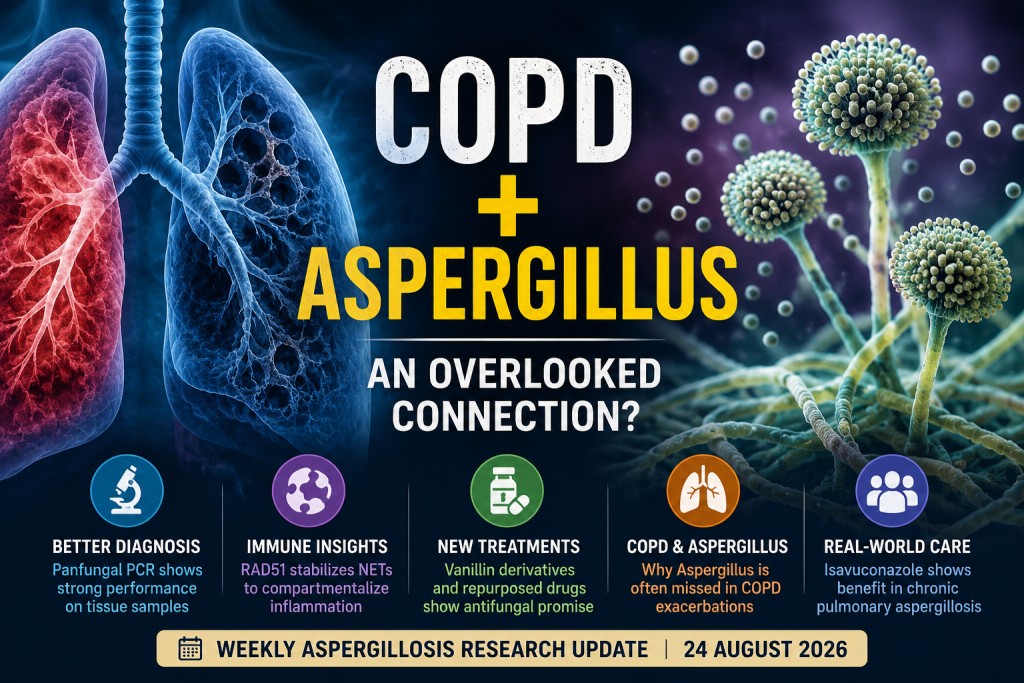
This week’s research spans chronic obstructive pulmonary disease (COPD), fungal diagnostics, neutrophil biology and several potential antifungal strategies.
Particularly notable are a major review of the relationship between COPD and Aspergillus, a meta-analysis supporting panfungal PCR on tissue samples, and new work in Science exploring how neutrophil extracellular traps may contain inflammation during aspergillosis.
COPD and Aspergillus: an increasingly important combination
Denning DW, Bertuzzi M, Chotirmall SH, et al.
COPD and Aspergillus—a complex interaction of global health importance.
Lancet Infectious Diseases. Published 18 August 2026.
This major review brings together growing evidence that Aspergillus is an important and probably under-recognised problem in people living with COPD.
People with COPD may experience several different interactions with Aspergillus, ranging from airway colonisation and sensitisation through to chronic pulmonary aspergillosis (CPA) and invasive pulmonary aspergillosis.
The authors highlight several factors that may increase susceptibility, including damaged airways, repeated exacerbations, corticosteroid exposure, respiratory viral infections and environmental exposure to fungal spores.
The review also argues that fungal disease may sometimes be missed in patients whose deterioration is assumed to be another bacterial COPD exacerbation.
Improved investigation may therefore include fungal culture, Aspergillus PCR and, where clinically appropriate, tests such as Aspergillus IgG or antigen detection.
Why this matters: COPD is extremely common worldwide. Even if only a relatively small proportion of people with COPD develop clinically important aspergillosis, the potential number of affected patients is substantial. Better recognition could prevent repeated courses of inappropriate treatment and identify CPA or invasive disease earlier.
Panfungal PCR improves detection of invasive fungal disease in tissue
Filippidis P, El Khoury C, Cruciani M, et al.
Diagnostic performance of panfungal PCR on tissue specimens for the diagnosis of invasive fungal diseases: a systematic review and meta-analysis of the Fungal PCR Initiative (FPCRI).
Journal of Clinical Microbiology. Published 21 August 2026.
Diagnosing invasive fungal disease from tissue can be difficult. Conventional fungal culture is specific when positive but often lacks sensitivity, particularly when patients have already received antifungal treatment.
This systematic review and meta-analysis examined 28 studies evaluating panfungal PCR assays performed on tissue samples.
Panfungal PCR targets genetic sequences shared across many fungi and then identifies the fungus using sequencing. This means it can detect organisms even when clinicians did not know which fungus to look for beforehand.
The researchers found good overall diagnostic performance. Sensitivity was higher in fresh or frozen tissue than in formalin-fixed paraffin-embedded (FFPE) samples, although PCR remained useful in FFPE material.
In direct comparisons, panfungal PCR was substantially more sensitive than fungal culture.
Why this matters: Tissue biopsies are precious samples and may be difficult or risky to obtain. Adding molecular testing can increase the chance of obtaining a fungal diagnosis from tissue that would otherwise remain culture-negative.
This is particularly important for invasive aspergillosis and other invasive fungal infections where identifying the responsible organism can directly affect treatment.
How neutrophil extracellular traps may keep inflammation contained
Tsansizi LI, Guan SY, Aramburu IV, et al.
RAD51 stabilizes neutrophil extracellular traps to compartmentalize inflammation.
Science. Published 20 August 2026.
Neutrophils are among the immune system’s first responders to fungal infection. One way they attack microorganisms is by releasing neutrophil extracellular traps (NETs): webs of DNA and antimicrobial proteins that can trap microbes.
This study identifies the DNA-repair protein RAD51 as an important structural component helping NETs form stable, branched networks.
In a mouse model of pulmonary aspergillosis, disrupting RAD51 reduced local containment of NET-associated inflammation. Material escaped more readily into the circulation and was associated with increased inflammatory signalling, including IL-6 and type-2 inflammatory responses.
The researchers also found associations between circulating DNA, IL-6 and eotaxin in people with aspergillosis.
Why this matters: NETs are often discussed as potentially damaging inflammatory structures. This research suggests the picture is more complicated: their architecture may also help keep inflammatory material confined to the site of infection.
Understanding how this balance works could eventually help researchers separate protective antifungal immunity from harmful inflammation.
Existing medicines repurposed to weaken fungal metabolism
Song Z, Zhao C, Wang Q, et al.
Repurposing FDA-Approved Drugs to Inhibit Fungal PPTases for Broad-Spectrum Synergy.
Advanced Science. Published 21 August 2026.
Researchers have identified fungal phosphopantetheinyl transferases (PPTases) as a potential new antifungal target.
PPTases are involved in activating enzymes needed for the production of several fungal metabolites, including molecules that contribute to virulence and fungal survival.
Rather than developing entirely new drugs from scratch, the researchers screened medicines that are already approved for other diseases and identified compounds capable of interfering with fungal PPTases.
Two drugs, tepotinib and eltrombopag, showed antifungal activity and enhanced the activity of existing antifungal treatment in experimental models. The compounds also reduced fungal burden and inflammation in a mouse model of pulmonary aspergillosis.
Why this matters: Repurposing existing medicines can sometimes accelerate drug development because much is already known about their pharmacology and safety.
However, this remains preclinical research. These medicines are not approved treatments for aspergillosis and patients should not attempt to use them for fungal disease.
Isavuconazole in aspergilloma and chronic cavitary pulmonary aspergillosis
Deviaene M, Dumoulin E, Somayaji R, et al.
Isavuconazole as an adjunctive antifungal in the multimodal management of pulmonary aspergilloma and chronic cavitary pulmonary aspergillosis: a single-centre case series.
Respiratory Medicine Case Reports. 2026;63:102486.
This single-centre case series describes the use of isavuconazole as part of the management of people with pulmonary aspergilloma and chronic cavitary pulmonary aspergillosis (CCPA).
CPA treatment often requires a combination of approaches. These may include long-term antifungal therapy, management of underlying lung disease and, in selected patients, surgery or other interventions.
Isavuconazole is one of several azole antifungals available to specialist teams and may be particularly useful in patients who cannot tolerate other azoles or where drug interactions and adverse effects make alternative treatment difficult.
Why this matters: This is only a small observational case series and cannot establish that isavuconazole is superior to other antifungals. However, it adds useful real-world evidence about its role in difficult-to-manage CPA and aspergilloma.
Our patient information page on isavuconazole has recently been updated to reflect current UK monitoring recommendations.
Read: Isavuconazole in Aspergillosis
Vanillin derivatives show experimental activity against Aspergillus fumigatus
Flores Maldonado OE, De Anda-Mora K, Jiménez-Barrientos JG, et al.
Vanillin derivatives as antifungal agents against Aspergillus fumigatus: in vitro activity, in vivo efficacy, and mechanistic insights.
Canadian Journal of Microbiology. Published 19 August 2026.
Researchers investigated vanillin and chemically related compounds for activity against Aspergillus fumigatus.
Several compounds inhibited fungal growth in laboratory experiments. The researchers also observed effects on fungal adhesion, biofilm formation and ergosterol, an important component of the fungal cell membrane.
One derivative, o-vanillin, also showed activity in an experimental model of aspergillosis.
Why this matters: New antifungal chemical structures are urgently needed as resistance to existing drugs increases.
However, these findings should not be interpreted as evidence that vanilla, vanilla extract or dietary vanillin can treat aspergillosis. The research concerns experimental antifungal compounds studied under controlled laboratory conditions.
What stands out this week?
Three themes emerge from this week’s research.
- Better recognition: the COPD review reinforces how frequently fungal disease may be overlooked in patients with chronic lung disease.
- Better diagnosis: panfungal PCR is becoming an increasingly important way of identifying fungi when tissue cultures are negative.
- New treatment strategies: researchers continue to explore both new molecular targets and ways of extending the usefulness of existing antifungal drugs.
The RAD51 study also reminds us that successful treatment of aspergillosis is not only about killing the fungus. Understanding how the immune system contains infection without causing excessive inflammation remains an important part of developing better treatments.
This weekly research update summarises recently published scientific papers for general information. Laboratory and animal research is included to show where the field may be heading, but experimental findings should not be interpreted as treatments available to patients. Treatment decisions should always be discussed with an appropriate clinical team.

Did this page help you?
Tell us in one minute