

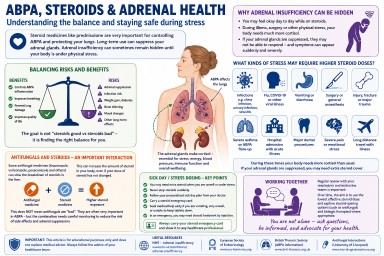
Infographic explaining adrenal suppression, cortisol, ACTH, steroid side effects and antifungal interactions in patients with ABPA and aspergillosis.

Understanding Steroids, Cortisol, ACTH and Adrenal Suppression in Aspergillosis

Infographic explaining adrenal suppression, cortisol, ACTH, steroid side effects and antifungal interactions in patients with ABPA and aspergillosis.
Educational infographic showing how steroids and antifungal medicines can affect adrenal function and cortisol production in patients with ABPA, severe asthma and aspergillosis.

For people with Allergic Bronchopulmonary Aspergillosis (ABPA), severe asthma and other forms of aspergillosis, steroid treatment can be both extremely helpful and medically complicated.

Many patients are prescribed corticosteroids such as prednisolone or methylprednisolone to control inflammation, improve breathing and reduce the risk of lung damage. These medicines can be very effective. However, repeated or long-term steroid treatment can also affect the body’s natural hormone system, especially the adrenal glands.

Some patients are told:

  • “Your cortisol is low.”
  • “Your ACTH level is abnormal.”
  • “You may have adrenal suppression.”
  • “This may be steroid withdrawal.”
  • “The blood tests are difficult to interpret.”

This can be worrying and confusing, especially when symptoms are severe but the explanation is not straightforward.

This article explains why adrenal problems can occur in some people with aspergillosis and severe asthma, why blood tests such as cortisol and ACTH can be difficult to interpret, and why steroid treatment sometimes involves a careful balance between benefit and risk.


Key points summary

  • Steroid medicines can reduce the body’s own natural cortisol production.
  • This is called adrenal suppression or adrenal insufficiency.
  • Symptoms may overlap with aspergillosis, asthma, infection, fatigue or steroid withdrawal.
  • Blood tests such as cortisol and ACTH can be difficult to interpret.
  • Inhaled steroids and antifungal medicines can also influence steroid effects.
  • Long-term prednisolone is generally avoided where possible, but it may still be necessary for some patients.
  • Patients should not stop or reduce steroids suddenly without medical advice.
  • Severe symptoms such as collapse, vomiting, dehydration, confusion or severe weakness require urgent medical advice.

Contents

  1. What do the adrenal glands do?
  2. What are cortisol and ACTH?
  3. Why are steroids used in ABPA and aspergillosis?
  4. Are steroids only meant for short-term use?
  5. How steroids affect the body’s natural hormone system
  6. What is adrenal suppression?
  7. Why symptoms can be difficult to recognise
  8. Why blood tests can become confusing
  9. The role of inhaled steroids
  10. Antifungal medicines and steroid interactions
  11. Steroid withdrawal versus adrenal insufficiency
  12. What kinds of stress may require higher steroid doses?
  13. When should patients seek urgent medical advice?
  14. Frequently asked questions
  15. Final thoughts

What do the adrenal glands do?

The adrenal glands are small glands that sit above the kidneys. They produce several important hormones, including cortisol.

Cortisol helps the body:

  • respond to stress,
  • maintain blood pressure,
  • regulate energy levels,
  • support immune function,
  • and cope with illness or infection.

The body carefully controls cortisol levels through a hormone signalling system involving the brain, the pituitary gland and the adrenal glands.


What are cortisol and ACTH?

ACTH stands for adrenocorticotropic hormone.

The pituitary gland in the brain releases ACTH to tell the adrenal glands to produce cortisol.

This system normally works as a feedback loop:

  • When cortisol is low, ACTH usually rises.
  • When cortisol is high, ACTH usually falls.

Cortisol levels naturally change during the day and are usually highest in the early morning. This is one reason why many cortisol blood tests are taken around 9am.


Why are steroids used in ABPA and aspergillosis?

In Allergic Bronchopulmonary Aspergillosis (ABPA) and some severe asthma conditions, the immune system reacts strongly to Aspergillus fungi.

This can cause:

  • airway inflammation,
  • wheezing,
  • coughing,
  • mucus plugging,
  • breathlessness,
  • worsening lung function,
  • and repeated flare-ups.

Steroids such as prednisolone are often used because they reduce inflammation quickly and effectively.

Some patients may need:

  • short courses during flare-ups,
  • repeated courses,
  • long-term low-dose treatment,
  • inhaled steroid therapy,
  • antifungal treatment,
  • or biologic medicines to reduce the need for oral steroids.

For many patients, steroids are not optional or casual medicines. They may be essential treatments used to control serious inflammation and protect lung function.


Are steroids only meant for short-term use?

Patients sometimes hear that prednisolone was “only designed for short-term use”. This is understandable, because modern medical practice tries to avoid long-term steroid treatment where possible.

Long-term oral corticosteroids can cause significant side effects, including:

  • adrenal suppression,
  • diabetes or worsening blood sugar control,
  • osteoporosis and fracture risk,
  • increased infection risk,
  • cataracts or glaucoma,
  • muscle weakness,
  • skin thinning and bruising,
  • weight gain,
  • sleep disturbance,
  • and mood or mental health effects.

For this reason, doctors usually aim to use steroids at the lowest effective dose for the shortest safe time.

However, it is also important not to oversimplify this message. Some people with ABPA, severe asthma or other inflammatory lung conditions do need longer-term steroid treatment because the disease itself can be dangerous if not controlled.

In some patients, the risk of uncontrolled lung inflammation may outweigh the risks of steroid treatment, at least for a period of time.

Modern care increasingly tries to reduce steroid exposure by using other approaches where appropriate, such as:

  • antifungal treatment,
  • biologic medicines for severe asthma or ABPA-type inflammation,
  • careful monitoring of lung function and blood tests,
  • gradual steroid tapering,
  • bone protection where needed,
  • diabetes monitoring,
  • and regular review of whether the steroid dose can be reduced.

The key message is not that patients have done anything wrong by needing steroids. The key message is that long-term steroid treatment deserves careful monitoring, honest discussion and regular review.

Patient reassurance: If you have needed prednisolone for ABPA or severe asthma, this does not mean you have failed or made a poor choice. It usually means your medical team has been trying to control a potentially serious inflammatory condition. The aim is to balance benefit and risk as safely as possible.

Balancing risks and benefits

One of the hardest parts of long-term steroid treatment is that two important things can be true at the same time:

  • steroids can cause serious side effects,
  • and steroids can also prevent serious lung damage and dangerous flare-ups.

Patients sometimes feel guilty, frustrated or frightened when they hear about the risks of prednisolone. Others may feel judged for “still being on steroids”.

However, many people with ABPA or severe asthma did not choose steroids lightly. Steroids are often prescribed because uncontrolled inflammation itself can damage the lungs, worsen bronchiectasis, increase hospital admissions and significantly reduce quality of life.

Modern respiratory care increasingly tries to reduce steroid exposure where possible using:

  • antifungal therapy,
  • biologic medicines,
  • careful monitoring,
  • gradual tapering plans,
  • and better recognition of steroid side effects.

But for some patients, steroids may still remain an important part of treatment, even if the goal is eventually to reduce the dose.

The most helpful approach is usually not “steroids are good” or “steroids are bad”, but rather:

  • What dose is truly needed?
  • Can the dose be safely reduced?
  • Are side effects being monitored properly?
  • Are there alternative treatments available?
  • And is the patient being listened to when symptoms change?

This balanced approach is increasingly recognised as one of the most important parts of caring for people with severe asthma and aspergillosis.


How steroids affect the body’s natural hormone system

Steroid medicines act in ways that are similar to natural cortisol.

When the body senses steroid medication in the bloodstream, it may reduce its own ACTH production. Over time, this can mean:

  • ACTH falls,
  • the adrenal glands become less active,
  • and natural cortisol production decreases.

Doctors sometimes describe this as the adrenal glands “going to sleep”.

This is called:

  • adrenal suppression,
  • steroid-induced adrenal insufficiency,
  • or hypothalamic-pituitary-adrenal axis suppression.

What is adrenal suppression?

Adrenal suppression means the body may not produce enough cortisol when it is needed.

This can become especially important during:

  • infection,
  • surgery,
  • injury,
  • severe stress,
  • or rapid steroid reduction.

Some patients develop symptoms gradually. Others notice problems when trying to reduce steroid doses.

Because cortisol is part of the body’s stress response, people with adrenal insufficiency may need specific medical advice about what to do during illness, vomiting, surgery or severe infection.


Why symptoms can be difficult to recognise

Symptoms of adrenal suppression can overlap with many other conditions common in people with aspergillosis, ABPA or severe asthma.

Possible symptoms include:

  • profound tiredness,
  • weakness,
  • dizziness,
  • sweating,
  • shakiness,
  • nausea,
  • muscle aches,
  • low mood,
  • brain fog,
  • reduced exercise tolerance,
  • poor recovery after illness,
  • or feeling suddenly much worse after reducing steroids.

These symptoms may also occur with:

  • an ABPA flare,
  • asthma worsening,
  • lung infection,
  • chronic illness,
  • poor sleep,
  • anxiety,
  • or steroid withdrawal.

This overlap is one reason why patients can feel frustrated or uncertain. Symptoms are real, even when the cause is difficult to pin down.


Why blood tests can become confusing

Many patients expect blood tests to give clear answers, but cortisol and ACTH results are often complicated.

Several things can affect results:

  • time of day,
  • recent steroid use,
  • the type of steroid used,
  • inhaled steroid dose,
  • recent dose reductions,
  • illness or stress,
  • laboratory methods,
  • and antifungal medicines.

Typical patterns

In classic steroid-induced adrenal suppression:

  • cortisol is low,
  • and ACTH is low or “inappropriately normal”.

This happens because steroid medication suppresses ACTH production.

However, real-life cases are not always straightforward. Some patients may have recently reduced steroids, missed doses, changed steroid type, used high-dose inhaled steroids, or taken antifungal medicines that alter steroid metabolism.

In some situations, endocrinologists may need repeated testing or dynamic tests such as a Synacthen test to understand whether the adrenal glands can respond properly.

It is important that patients do not try to interpret cortisol or ACTH results in isolation. The result needs to be understood alongside symptoms, medication history, timing of the sample and the clinical situation.


The role of inhaled steroids

Many people assume inhaled steroids only affect the lungs.

Inhaled steroids usually have fewer whole-body effects than long-term oral steroids, but high doses can sometimes contribute to adrenal suppression, especially when combined with:

  • long-term or repeated oral steroid courses,
  • azole antifungal medicines,
  • other medicines that affect steroid metabolism,
  • or individual differences in how medicines are processed.

This does not mean inhaled steroids are unsafe or should be stopped suddenly. For many people with asthma or ABPA, inhaled steroids are an important part of keeping airway inflammation under control.

It does mean that total steroid exposure should be reviewed carefully, especially in patients with symptoms suggestive of adrenal suppression.


Antifungal medicines and steroid interactions

This is an especially important issue in aspergillosis.

Antifungal medicines such as:

  • itraconazole,
  • voriconazole,
  • posaconazole,
  • and isavuconazole

can interact with other medicines, including corticosteroids.

Some azole antifungals slow the breakdown of steroids in the liver. This can increase the body’s exposure to steroid medication, meaning that even doses which initially appear moderate may sometimes behave more like higher doses inside the body.

This interaction may increase the risk of:

  • adrenal suppression,
  • Cushing-like side effects,
  • weight gain,
  • skin thinning,
  • easy bruising,
  • high blood sugar,
  • muscle weakness,
  • or hormonal imbalance.

The interaction can be particularly important in patients taking:

  • oral prednisolone or methylprednisolone,
  • high-dose inhaled steroids,
  • multiple steroid preparations together,
  • or repeated steroid courses over time.

Some patients tolerate steroid treatment reasonably well for long periods before antifungal medicines are added. Endocrine problems may then become more noticeable later, especially during:

  • infection,
  • surgery,
  • vomiting or diarrhoea,
  • major physical stress,
  • rapid steroid reduction,
  • or severe asthma or ABPA flare-ups.

This can feel as though adrenal insufficiency has appeared “suddenly” or “out of nowhere”, when in reality the adrenal glands may have been partially suppressed for some time.


Why adrenal insufficiency may only become obvious during illness or stress

Some patients with steroid-related adrenal suppression cope reasonably well during normal day-to-day life, especially while still taking regular steroids. However, the problem may become much more noticeable when the body faces significant physical stress.

Under normal circumstances, the body rapidly increases cortisol production during severe illness or injury. If the adrenal glands cannot respond properly, symptoms may suddenly become much more severe.

Patients sometimes describe:

  • “crashing” during an infection,
  • extreme exhaustion,
  • severe weakness,
  • dizziness or collapse,
  • poor recovery after illness,
  • or feeling suddenly unable to cope physically.

This does not mean every severe illness in an ABPA patient is caused by adrenal insufficiency. Infections, inflammation and lung disease themselves are often the major problem. However, adrenal suppression can sometimes contribute to deterioration and may only reveal itself during periods of stress or acute illness.

This is one reason why some patients are given “sick day rules”, emergency steroid cards or advice about temporary steroid dose increases during illness.

Importantly, this does not mean antifungal medicines are “bad” or should be avoided. In many patients, antifungal treatment significantly improves ABPA control and may eventually help reduce steroid exposure overall. The important message is that these combinations require awareness, monitoring and careful medical supervision.

Patients should never stop antifungal or steroid medicines suddenly without medical advice.


Steroid withdrawal versus adrenal insufficiency

Steroid withdrawal and adrenal insufficiency can feel very similar.

Steroid withdrawal

When steroid doses are reduced, the body may take time to adjust. Patients can temporarily feel unwell even if the adrenal glands are slowly recovering.

Adrenal insufficiency

Adrenal insufficiency means the body cannot produce enough cortisol to meet its needs.

Symptoms may overlap considerably. Recovery can sometimes take weeks or months, and in some patients longer.

For many patients, one of the hardest parts is that they may “look well” externally while feeling exhausted internally.

It is important that symptoms are not dismissed simply because they are difficult to measure.


What kinds of stress may require higher steroid doses?

Patients who have adrenal insufficiency or significant adrenal suppression may sometimes be advised to temporarily increase steroid doses during periods of physical stress. This is often called following “sick day rules”.

The body normally produces extra cortisol during stress, illness or injury. If the adrenal glands cannot respond properly, extra steroid medication may sometimes be needed to prevent serious illness.

Examples of situations that may place significant stress on the body include:

  • high fever or significant infection,
  • chest infection or pneumonia,
  • vomiting or diarrhoea,
  • COVID-19 or influenza,
  • major dental treatment or surgery,
  • fractures or significant injury,
  • general anaesthetic procedures,
  • severe asthma attacks or ABPA flare-ups,
  • hospital admission with acute illness,
  • or severe physical exhaustion associated with illness.

The exact advice varies between patients depending on:

  • whether adrenal insufficiency has been formally diagnosed,
  • the steroid dose currently being taken,
  • how suppressed the adrenal glands are thought to be,
  • other medical conditions,
  • and guidance from endocrine or respiratory specialists.

Some patients are provided with:

  • specific “sick day rules”,
  • an emergency steroid card,
  • medical alert jewellery,
  • or emergency hydrocortisone injection kits.

Patients should only adjust steroid doses according to the advice provided by their medical team. If severe vomiting, collapse, confusion, inability to keep medication down or major deterioration occurs, urgent medical advice is needed.


When should patients seek urgent medical advice?

Patients should seek urgent medical help if they experience:

  • collapse,
  • fainting,
  • severe vomiting,
  • inability to keep steroid medication down,
  • severe dehydration,
  • confusion,
  • severe weakness,
  • very low blood pressure,
  • or sudden major deterioration during illness.

These symptoms can occasionally indicate adrenal crisis, which is a medical emergency.

Patients who have been told they are at risk of adrenal insufficiency should follow the emergency and “sick day” advice given by their endocrine or respiratory team.


Frequently asked questions

Does everyone taking steroids develop adrenal suppression?

No. Risk depends on factors such as dose, duration, repeated courses, inhaled steroid dose, other medicines and individual sensitivity.

Can adrenal function recover?

Yes. Many patients gradually recover adrenal function over time, although recovery speed varies.

Are inhaled steroids safer than tablets?

Inhaled steroids usually have fewer whole-body effects than long-term oral steroids, but high doses can still contribute to adrenal suppression in some patients, especially when combined with certain antifungal medicines.

Why do I feel worse when reducing steroids?

This can happen for several reasons. The underlying lung disease may flare, the body may be adjusting to lower steroid levels, or cortisol production may not yet have recovered.

Does needing long-term prednisolone mean something has gone wrong?

Not necessarily. Long-term prednisolone is usually avoided where possible because of side effects, but some patients need it to control serious inflammation. The aim is regular review, careful monitoring and dose reduction when it is safe.

Should I stop steroids because of this risk?

No patient should stop prescribed steroids suddenly unless specifically advised by their medical team. Sudden withdrawal can be dangerous, especially if the body’s own cortisol production is suppressed.


Final thoughts

Adrenal suppression and steroid-related hormone problems are recognised complications of corticosteroid treatment.

For patients with aspergillosis, ABPA and severe asthma, the situation can become especially complex because:

  • steroid treatment may be medically necessary,
  • symptoms overlap with many other conditions,
  • antifungal medicines may interact with steroids,
  • inhaled steroids may add to total steroid exposure,
  • and blood tests are not always straightforward.

Patients sometimes feel frustrated because their symptoms are difficult to explain or measure clearly. However, these experiences are recognised by clinicians and researchers, and steroid-related adrenal problems are increasingly acknowledged as important and sometimes under-recognised.

The goal is not to create fear of steroids. The goal is to use them carefully, monitor them properly, reduce them when possible, and support patients through the difficult process of balancing disease control with treatment side effects.


Suggested internal links


References and further reading


When was this article last reviewed?

Last reviewed: May 2026


Author and review information

Prepared for patient education and support purposes.

This article is intended for general educational use and should not replace personalised medical advice from a healthcare professional.


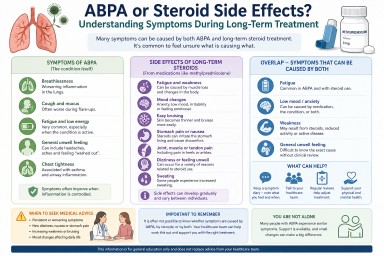
Infographic comparing symptoms of ABPA and long-term steroid side effects, including fatigue, mood changes, weakness and overlapping symptoms.

ABPA or Steroid Side Effects? Understanding Symptoms During Long-Term Treatment

Infographic comparing symptoms of ABPA and long-term steroid side effects, including fatigue, mood changes, weakness and overlapping symptoms.
Many symptoms such as fatigue, weakness, and low mood can be caused by both ABPA and long-term steroid treatment, making it difficult to tell the difference without clinical review.

Last reviewed: April 2026

Many people living with Allergic Bronchopulmonary Aspergillosis (ABPA) who take long-term steroids find it difficult to tell whether their symptoms are caused by the condition or the treatment.

Symptoms in ABPA can come from both the condition and long-term steroid treatment. Fatigue, weakness, mood changes, and general unwellness are common to both, making it difficult to identify a single cause without clinical review.

This is especially true for people taking corticosteroids such as methylprednisolone or prednisolone.

Infographic comparing symptoms of ABPA and long-term steroid side effects including fatigue, mood changes and weakness
Many symptoms such as fatigue, weakness, and low mood can be caused by both ABPA and long-term steroid treatment, making it difficult to tell the difference without clinical review.

---

Key Points

  • ABPA and steroid treatment can cause overlapping symptoms.
  • Fatigue, low mood, and general unwellness can come from either the condition or medication.
  • Long-term corticosteroid use can cause additional side effects.
  • It is common to feel unsure what is causing symptoms.
  • Ongoing or worsening symptoms should be discussed with your healthcare team.

---

Why is it hard to tell the difference?

ABPA is an immune-driven lung condition that causes inflammation. Treatment often includes corticosteroids such as methylprednisolone or prednisolone, which reduce inflammation but can also affect many systems in the body.

This means that:

  • The disease itself can cause symptoms
  • The treatment can also cause symptoms

As a result, people often experience a combination of both.

---

Symptoms caused by ABPA

ABPA commonly affects the lungs but can also cause more general symptoms.

  • Fatigue and low energy
  • Breathlessness
  • Cough and mucus production
  • Chest tightness
  • General feeling of being unwell

Fatigue can be particularly prominent, especially during flare-ups.

---

Side effects of long-term steroids

Corticosteroids such as methylprednisolone are highly effective treatments, but long-term use can lead to a range of side effects.

  • Fatigue and weakness (including muscle loss)
  • Mood changes (anxiety, low mood, irritability)
  • Easy bruising (skin becomes thinner)
  • Stomach irritation or pain
  • Dizziness or feeling unwell
  • Sweating
  • Bone or joint discomfort

Learn more about treatment approaches in aspergillosis treatment options.

---

Where symptoms overlap

Some symptoms can be caused by both ABPA and steroid treatment, making them difficult to interpret.

Symptom Possible cause
Fatigue ABPA inflammation or steroid effects
Low mood / anxiety Medication effects or impact of chronic illness
Weakness Muscle loss from steroids or reduced activity
General unwell feeling Both

This overlap is one of the most challenging aspects of long-term management.

🔎 Not sure what’s causing your symptoms?
Many people with ABPA feel exactly the same—this overlap is one of the most common challenges during long-term treatment.

---

Understanding specific symptoms

Some symptoms are more commonly linked to treatment effects:

  • Easy bruising – often related to steroid use
  • Heel or ankle pain – may relate to tendon or joint effects
  • Stomach pain – can be linked to steroid irritation

Other symptoms, such as fatigue, dizziness, and nausea, may have multiple possible causes.

Because of this, it is often not possible to attribute symptoms to a single cause without clinical review.

---

When to seek medical advice

You should contact your healthcare team if you experience:

  • Persistent or worsening fatigue
  • New dizziness or nausea
  • Ongoing stomach pain
  • Increasing weakness
  • Mood changes affecting daily life

These symptoms do not necessarily indicate a serious problem, but they may mean that treatment or support needs to be reviewed.

---

Summary

In ABPA, symptoms such as fatigue, weakness, and low mood can arise from both the condition and its treatment. Long-term steroid use can add additional effects, making it difficult to distinguish between causes.

If symptoms are persistent or worsening, it is important to discuss them with your healthcare team so that appropriate adjustments or support can be considered.

---

Further Reading

---

Author & Review

Prepared for aspergillosis.org to support patient understanding. Content reflects current clinical knowledge and patient-reported experience.

Disclaimer

This information is for general education only and does not replace advice from your healthcare team.


Hydrocortisone Injection Changes in the UK: What It Means for Aspergillosis Patients

Last reviewed: March 2026
Audience: Patients, carers, and non-specialist healthcare professionals

Key points

  • A ready-to-use hydrocortisone injection (liquid solution) is no longer available in the UK.
  • Patients are now usually given a hydrocortisone injection that must be mixed before use.
  • The medication itself is unchanged, but preparation is more complex.
  • This may feel more difficult during an emergency, especially if someone is unwell or distressed.
  • Training and preparation can help reduce delays.
  • Always seek urgent medical help in a suspected emergency.

Table of contents

Overview

Hydrocortisone is a steroid hormone used as cortisol replacement in people whose bodies cannot produce enough cortisol, a condition known as adrenal insufficiency.

Some patients with aspergillosis may be affected by this change because:

  • long-term steroid use can suppress the body’s natural cortisol production
  • adrenal function may be reduced during or after treatment
  • some patients may already have adrenal insufficiency or need emergency steroid cover

In emergencies, hydrocortisone injections can be life-saving.

Why hydrocortisone matters in aspergillosis

Patients with aspergillosis may encounter adrenal-related issues for several reasons. For example, some people with allergic bronchopulmonary aspergillosis (ABPA) have needed prolonged courses of steroid treatment. Over time, this can reduce the body’s own cortisol production.

There can also be concerns about drug interactions, especially where antifungal medicines and steroid medicines affect the way the body handles hormones. Not every aspergillosis patient will be affected, but for some people this is an important part of their wider treatment plan.

If cortisol levels are too low during illness, injury, vomiting, or other physical stress, this can lead to an adrenal crisis, which is a medical emergency.

What has changed in the UK

Previously, some patients were supplied with a ready-made liquid hydrocortisone injection. This was already in solution and could be given more quickly.

This ready-to-use product is no longer available in the UK.

Most patients who need emergency hydrocortisone injection are now supplied with a preparation that includes:

  • a vial containing hydrocortisone powder
  • a liquid for mixing
  • a syringe and needle for drawing up and giving the injection

The medicine itself is still hydrocortisone and remains standard treatment. What has changed is the practical process: it now needs to be prepared before it can be injected.

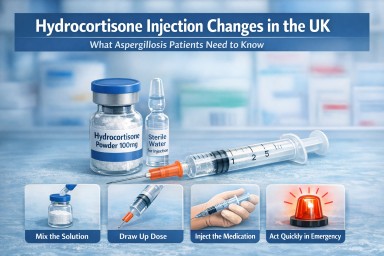
Diagram: preparing hydrocortisone injection

Preparing a hydrocortisone injection (Video) : https://www.youtube.com/watch?v=NXXB3w1ADcI

What this means in practice

For many patients, this change is manageable with training and practice. However, it does change the experience of using emergency medication.

Compared with a ready-made solution, there are now more steps involved. In a calm situation, that may not seem significant. In an emergency, it can feel much harder.

This is especially relevant if the person is:

  • very unwell
  • vomiting
  • dizzy or confused
  • trying to guide a family member or carer through the process

For some patients, this could potentially cause a delay in giving the injection. That does not mean the current treatment is ineffective or unsafe, but it does mean that confidence, familiarity, and training matter even more.

Potential concerns and risks

1. More steps may mean more delay

The current injection usually has to be mixed before use. That means opening the kit, preparing the medicine, drawing it up, and then giving the injection. In an emergency, even a short delay may feel important.

2. Stress makes practical tasks harder

Patients and carers are often being asked to act quickly during a frightening situation. Even people who have previously been shown what to do may lose confidence if they rarely need to use the injection.

3. Training may vary

Not everyone receives the same level of teaching or refresher support. Some people may feel very confident. Others may feel unsure, especially if their kit has changed.

4. Aspergillosis patients may already be managing a lot

Some patients are already coping with breathlessness, fatigue, infections, multiple medicines, and complex follow-up. Adding a more complicated emergency injection process can feel like an extra burden.

It is important to keep this concern in proportion. Many patients and carers do use mixed hydrocortisone kits successfully. The key issue is not that the medicine no longer works, but that the loss of a ready-made formulation may make emergency use less straightforward.

Practical steps for patients and carers

If you have been prescribed emergency hydrocortisone, it may help to:

  • check that you know exactly which product you have been given
  • ask for a demonstration of how to prepare and inject it
  • ask for a refresher if you are not confident
  • make sure family members, carers, or trusted friends also know what to do
  • keep the emergency kit somewhere accessible and check expiry dates regularly
  • carry any steroid emergency information you have been given, such as a steroid card

These steps cannot remove all risk, but they may reduce hesitation and confusion if the injection is ever needed urgently.

Common questions

Has hydrocortisone been withdrawn completely?

No. Hydrocortisone is still widely used. The main issue is that a ready-to-use liquid injectable form is no longer available in the UK.

Is the current injection less effective?

No. The medicine remains hydrocortisone. The change is in the formulation and the preparation steps, not in the intended effect of treatment.

Why does this matter so much?

In an emergency, simple treatments are often easier to use correctly and quickly. A preparation that needs mixing may be more difficult for some patients or carers under pressure.

Does this affect every aspergillosis patient?

No. This is mainly relevant to people who have adrenal insufficiency, adrenal suppression, or a clear plan from their clinical team to keep emergency hydrocortisone available.

Should patients be worried?

Patients should not panic, but it is reasonable to recognise this as a practical concern. If you rely on emergency hydrocortisone, it is sensible to make sure you understand your current kit and feel as confident as possible using it.

When to seek medical help

Seek urgent medical help if there are symptoms suggesting a possible adrenal emergency, especially if there is:

  • severe weakness
  • collapse or near-collapse
  • confusion or marked drowsiness
  • vomiting or inability to keep medicines down
  • sudden severe illness or infection

If an emergency hydrocortisone injection has been prescribed, follow the instructions given by your clinical team and seek urgent medical care immediately.

References


Author and review information

Prepared for: aspergillosis.org

Purpose: General information for patients, carers, and non-specialist healthcare professionals

Important note: This article is intended for general education and should not replace individual medical advice from your own clinical team.


Does when I eat cause fat gain if I have adrenal insufficiency?

Many people with adrenal insufficiency worry that eating at the “wrong time” — especially later in the day — will automatically cause weight gain or “steroid belly”.
This is understandable, but it’s important to separate myths from what actually happens in the body.

https://cdn.media.amplience.net/i/dexcom/stelo-bg-levels-graph?fmt=auto&qlt=default&w=2000
https://www.zrtlab.com/media/3286/1-normal-cortisol-curve-2024.png?height=267&mode=max&width=357

What doctors mean by “glucose response”

When clinicians or researchers talk about glucose response, they mean:

How your blood sugar rises and falls after eating

It does not mean that sugar is instantly being turned into fat.

A rise in blood glucose after eating is normal and happens in everyone.


Does eating later in the day automatically turn food into fat?

No.

Fat gain does not happen because of a single meal or snack — or because you ate at a particular time.

In most people:

  • Carbohydrates are first used for energy

  • Extra glucose is stored as glycogen in muscles and liver

  • Only repeated excess intake over time contributes to fat gain

Eating in the evening does not automatically cause fat storage.


Where insulin fits in (without the fear)

Eating raises blood glucose, which triggers insulin.

Insulin:

  • Helps move glucose into cells

  • Replenishes energy stores

  • Temporarily pauses fat burning

This pause is normal and reversible.
Insulin does not automatically create body fat.

Fat gain happens when:

  • Total calorie intake is consistently higher than needs

  • Steroid replacement is higher than required

  • This pattern continues over weeks or months


Why people with adrenal insufficiency feel confused about this

With adrenal insufficiency:

  • Cortisol replacement is taken in doses, not continuously

  • Symptoms, stress, poor sleep, or illness can affect appetite and energy

  • Some people are prone to low blood sugar, especially later in the day

Because of this:

  • Rigid food timing rules can make symptoms worse

  • Skipping meals or avoiding evening snacks can increase fatigue, dizziness, or night-time symptoms


A safer way to think about meal timing

Instead of strict rules, think in patterns:

  • Some people feel best with:

    • Larger meals earlier in the day

    • Lighter evenings

  • Others need:

    • A small evening snack

    • Protein or fat to keep blood sugar stable overnight

Both can be correct.

What matters most is:

  • How you feel

  • Whether your energy is stable

  • Whether sleep and symptoms improve


What usually matters more than timing

For people with adrenal insufficiency, weight changes are most often related to:

  • Total daily steroid dose

  • Repeated or prolonged stress dosing

  • Reduced activity due to illness or fatigue

  • Menopause, ageing, or other medical conditions

Food timing plays a much smaller role.


Key reassurance

If a food timing rule makes you feel worse, it is not the right rule for you.

  • A single glucose rise does not cause fat gain

  • Eating later does not automatically lead to weight gain

  • Safety, symptom control, and adequate steroid replacement come first


Please remember

Never change steroid dose or meal patterns intended to prevent hypoglycaemia without medical advice.
Underdosing steroids is far more dangerous than eating at the “wrong” time.


Take-home message

Focus on stability, nourishment, and feeling well — not fear of timing.


🌡️ Understanding Body Temperature in Aspergillosis: Why Your Fever May Look Different

Many people living with aspergillosis—including allergic bronchopulmonary aspergillosis (ABPA), chronic pulmonary aspergillosis (CPA), severe asthma with fungal sensitisation (SAFS) and Aspergillus bronchitis—notice that their body temperature behaves differently from what doctors call “normal.”

This is especially common in people who are:

  • On long-term steroids

  • Tapering steroids

  • Living with adrenal insufficiency

  • Older adults

  • On biologics

  • Managing chronic lung disease

This guide explains why your temperature may run lower, why fevers can appear smaller or absent, and how to safely manage this.


🔶 1. Many aspergillosis patients have a lower baseline temperature

Although “37.0°C” is often quoted, most patients actually sit anywhere between 35.5–36.5°C.
Reasons include:

✔ Long-term steroids

Prednisolone, methylprednisolone, hydrocortisone, and even high-dose inhaled steroids can blunt the immune response and lower your resting temperature.

✔ Adrenal insufficiency

If your adrenal glands are suppressed, your body’s ability to raise temperature is reduced.
You may get no fever at all, even with infections.

✔ Chronic lung disease

Living with ABPA, CPA or bronchiectasis can change how your body regulates heat.

✔ Biologic treatments

Some biologics influence inflammatory signalling and may soften fever responses.

✔ Age

Older adults naturally have:

  • Lower metabolism

  • Lower baseline temperature

  • Reduced ability to generate fever (“immune senescence”)

Many older aspergillosis patients sit around 35.7–36.2°C when completely well.


🔶 2. Fever is a rise from your normal — not a single number

For someone with a naturally low temperature, a fever may look very different.

A useful rule:

A fever = a rise of 1°C above your personal baseline,
even if the thermometer is below 38°C.

Example

  • Your baseline = 35.8°C

  • Your fever may begin at 36.8–37.0°C

You may feel shivery, hot, exhausted or “flu-ish” long before hitting 38°C.


🔶 3. Why fevers are often “muted” in aspergillosis

✔ Steroids

Reduce the body’s ability to trigger a strong fever.

✔ Adrenal insufficiency

Greatly reduces your ability to raise temperature; infections may show as fatigue, dizziness, nausea or sudden weakness instead.

✔ Age

Older adults may have:

  • No fever

  • A tiny rise

  • Confusion or breathlessness as the only sign of infection

✔ Chronic disease

Your temperature regulation system may simply behave differently because of long-term inflammation.


🔶 4. What YOU can do to manage this safely

Know your personal baseline

Measure your temperature twice daily for 5–7 days when well.
Record the average — this is your true normal.

Treat a 1°C rise as your own fever

Don’t wait for the thermometer to reach 38°C.

Watch symptoms more than the number

Seek medical advice if you notice:

  • Feeling feverish or shivery

  • Breathing worsening

  • New chest or flank pain

  • Sudden exhaustion

  • Increased heart rate

  • Confusion, dizziness or “not right”

  • New cough or change in sputum

These can indicate infection even without a high temperature.

Keep a symptom + temperature chart

Especially if you:

  • Are on steroids

  • Have adrenal insufficiency

  • Are tapering

  • Are on biologics

  • Have recurrent infections

Even simple notes help clinicians hugely.

Tell every clinician your temperature baseline

Not all doctors will know your usual pattern, so tell them:

“My normal temperature is around X°C.
I don’t get high fevers because of chronic illness/steroids/adrenal suppression.
A small rise is significant for me.”

This is important in GP appointments, A&E, respiratory clinics and hospital admissions.


🔶 5. Extra precautions if you have adrenal insufficiency

People with steroid-induced adrenal suppression must be especially careful:

  • A small temperature rise + feeling unwell may mean you need stress-dose steroids

  • Vomiting, dizziness, intense fatigue or confusion are warning signs

  • Always follow your adrenal emergency plan

  • Always carry your Steroid Emergency Card and hydrocortisone emergency injection if prescribed


🔶 6. Do doctors understand this?

Most clinicians understand the general rules:

  • Older adults often do not mount high fevers

  • Steroids blunt fever

  • Adrenal insufficiency changes the febrile response

  • Infection may present atypically

However, few clinicians know your personal baseline unless you tell them.

Sharing your own numbers helps them interpret your symptoms safely and accurately.


🟩 Summary for Aspergillosis Patients

  • Many people with aspergillosis have a naturally lower temperature.

  • Steroids, adrenal insufficiency and age can all reduce your ability to produce a fever.

  • A rise of 1°C above YOUR normal may be your fever.

  • Focus on overall symptoms, not just the thermometer.

  • Tell every clinician your baseline temperature.

  • Take extra care if you have adrenal insufficiency.


**Adrenal Insufficiency & Steroid Tapering:

A Complete Patient Guide**

People taking long-term steroids (prednisolone, methylprednisolone, hydrocortisone, dexamethasone) can develop adrenal insufficiency because their adrenal glands “go to sleep” and stop making cortisol.
During tapering, the body must slowly “wake up” again — and this needs careful monitoring.

This guide explains the symptoms, tests, warning signs, and emergency precautions to keep you safe.


⭐ 1. Why adrenal insufficiency happens

Long-term steroid use suppresses the HPA axis (hypothalamus–pituitary–adrenal system).
When daily steroid doses are reduced, your body must produce more of its own cortisol. This takes time.

If the steroid reduction is too quick, or the body is under stress, low cortisol symptoms appear.


⭐ 2. Symptoms to watch for during steroid tapering

These are early signs that your body may not be keeping up with the reduction.

Early, mild symptoms

  • Fatigue / sudden exhaustion

  • Muscle weakness

  • Dizziness when standing

  • Nausea or reduced appetite

  • Flu-like aching

  • Low mood, anxiety, irritability

  • Brain fog

  • Feeling unusually cold

  • Worsening joint or muscle pain

These often improve if the taper is slowed or paused.


⭐ 3. More serious symptoms of low cortisol

These symptoms suggest steroid levels are too low and the taper needs urgent review:

  • Vomiting

  • Persistent dizziness

  • Very low blood pressure

  • Severe fatigue (unable to function normally)

  • Salt cravings

  • Ongoing nausea preventing eating

  • Faintness or near-collapse

These require medical advice (same day).


⭐ 4. Emergency symptoms — possible adrenal crisis

Call 999 or go to A&E immediately if you develop:

  • Severe vomiting or diarrhoea

  • Collapse or inability to stand

  • Severe dehydration

  • Confusion

  • Sudden severe abdominal or back pain

  • Pale, clammy skin

  • Rapid breathing

  • Loss of consciousness

This is a medical emergency.
Patients normally receive 100 mg hydrocortisone IM/IV, but patients allergic to hydrocortisone require a pre-agreed emergency alternative — your endocrinologist must document this clearly.


⭐ 5. Symptoms that mean you may need a temporary “stress dose” of steroids

Your cortisol requirement increases during physical stress.
If you have adrenal suppression, your body cannot produce this extra cortisol.

You may need a temporary increase in dose if you have:

✔ Illness

  • Fever

  • Chest infection

  • Flu-like illness

  • COVID

  • Urinary infection

  • Gastroenteritis

  • Diarrhoea

  • Persistent nausea

✔ Physical stress

  • Injury

  • Significant fall

  • Severe pain

  • Dental surgery

  • Medical or surgical procedures

✔ Emotional stress

  • Bereavement

  • Panic attacks

  • Trauma

If vomiting prevents taking steroids → seek emergency help immediately.


⭐ 6. Tests used to monitor adrenal function during tapering

Doctors rely on a combination of symptoms and laboratory tests.


Morning cortisol (8–9 am)

A key test to assess recovery.

Typical interpretation:

  • > 400–500 nmol/L → likely normal function

  • 150–350 nmol/L → recovering / borderline

  • < 100 nmol/L → adrenal insufficiency

(Exact thresholds vary.)


ACTH level

Shows whether the pituitary is trying to stimulate the adrenals.

  • Low ACTH → still suppressed

  • High ACTH → trying to wake adrenals

  • Normal ACTH + low cortisol → gland slow to respond


Short Synacthen Test (SST)

Gold standard.
A small ACTH injection tests whether your adrenal glands can produce cortisol.

Used when:

  • taper reaches low doses

  • symptoms appear

  • deciding if steroids can be stopped


Electrolytes (U&Es)

Low cortisol may cause:

  • Low sodium

  • High potassium (less common in steroid-induced insufficiency)


Blood pressure monitoring

Low cortisol → low BP, dizziness, faintness.


Glucose levels

Low-normal glucose and shakiness may occur during withdrawal.


Clinical symptom review

Symptoms are sometimes more sensitive than tests.

Doctors track:

  • fatigue

  • appetite

  • dizziness

  • illness triggers

  • salt cravings

  • mental state

  • recovery after small dose increases


⭐ 7. How tapering decisions are made

Tapering depends on:

  • how long steroids have been taken

  • current dose

  • symptoms

  • test results

  • presence of illness

  • rate at which symptoms develop

  • allergy restrictions (pred/hydrocortisone allergy requires specialist handling)

General principles (not schedules):

  1. Higher doses can reduce more quickly.

  2. Taper slows dramatically near physiological levels
    (~4–6 mg pred-equivalent).

  3. If symptoms appear → pause, slightly increase, or slow taper.

  4. SST is used near the end to confirm recovery.


⭐ 8. When to contact your medical team

Same day advice needed

  • worsening dizziness

  • persistent nausea

  • new vomiting

  • symptoms appear with each taper step

  • fainting

  • new severe fatigue

  • any infection (urinary, chest, flu)

Urgent / A&E

  • collapse

  • severe vomiting/diarrhoea

  • confusion

  • severe abdominal pain

  • unable to take oral steroids

  • suspected adrenal crisis


⭐ 9. What patients should do to stay safe

  • Carry a Steroid Emergency Card at all times

  • Keep emergency instructions from your endocrinologist

  • Know your Sick Day Rules

  • Ensure A&E or ambulance crews know about corticosteroid allergy

  • Keep a written record of tapering plan

  • Never stop steroids suddenly

  • Be cautious during illness

  • Know your emergency steroid plan (alternative if allergic to hydrocortisone)


⭐ Final reassurance

Adrenal insufficiency during tapering is common, manageable, and often reversible.
By monitoring symptoms, using regular blood tests, and following specialist guidance, tapering can be done safely.

You are not alone — your endocrine team will guide every step, especially if allergies (to prednisolone or hydrocortisone) make your case more complex.

With careful observation and a clear emergency plan, serious complications are rare and preventable.


🌿 Your Immune System, Biologics, and Steroids: What’s Suppressed — and What Stays Strong

A clear, reassuring guide for people living with ABPA, CPA, asthma, SAFS, or bronchiectasis

Treatments for aspergillosis-related conditions often involve steroids, and more recently, biologics.
Many patients understandably wonder:

  • What do these medicines suppress?

  • Do they affect my ability to fight infection?

  • Why are biologics considered safer than long-term steroids?

  • Which parts of my immune system stay strong?

This guide explains the full picture in simple terms.


🧬 1. Understanding Your Immune System: The Three Layers

Your immune system has three major lines of defence.


A. Barriers — the first line

These stop pathogens entering in the first place:

  • Skin

  • Mucus in airways

  • Cilia sweeping mucus out

  • Tears, saliva, stomach acid

  • Healthy bacteria (microbiome)

👉 Biologics do NOT affect barriers.
👉 Steroids can weaken skin and airway lining if used long-term.


B. Innate immunity — fast responders

These act within minutes or hours.

Key cells:

  • Neutrophils → main killers of Aspergillus

  • Macrophages → engulf spores

  • Dendritic cells → show pathogens to T-cells

  • NK cells → kill virus-infected cells

Sensors:

  • Dectin-1 → recognises fungal walls

  • TLRs

  • Complement proteins

👉 Biologics do NOT weaken these.
👉 Steroids weaken several key functions, especially neutrophils and macrophages.


C. Adaptive immunity — targeted, long-term defence

Slower but specialised.

T-cells:

  • Th1 → fight bacteria/viruses

  • Th17 → major antifungal fighters

  • Th2 → allergic pathways (IgE, eosinophils)

  • Tregs → calm inflammation

B-cells & antibodies:

  • IgG / IgA / IgM → normal infection defence

  • IgE → allergy and ABPA pathway

👉 Biologics only suppress Th2/IgE pathways.
👉 Steroids suppress many T-cell and B-cell functions, not just allergy.


🎯 2. What Biologics Suppress (Targeted & Selective)

Biologics used in ABPA and difficult asthma (omalizumab, mepolizumab, benralizumab, dupilumab, tezepelumab) only turn down allergic inflammation, not infection-fighting immunity.

🔻 A. They suppress:

  • IgE

  • Eosinophils

  • IL-4 / IL-5 / IL-13

  • Type-2 allergic inflammation

  • Mucus hypersecretion (IL-13)

  • TSLP airway alarm signalling

🛡️ B. They do NOT suppress:

  • Neutrophils

  • Macrophages

  • Th1 immunity

  • Th17 antifungal pathways

  • T-cell killing function

  • Antibiotic/cell-mediated defences

  • Complement

  • Dectin-1 fungal recognition

This is why biologics do NOT increase fungal infection risk.


🔥 3. What Oral Steroids Suppress (Broad & Non-Specific)

Oral steroids like prednisolone reduce inflammation everywhere — including places you need for infection defence.

A. They suppress key immune cells

  • Neutrophils → move slower, kill less effectively

  • Macrophages → reduced pathogen killing

  • T-cells → weaker antiviral/antifungal defence

  • B-cells → reduced antibody production

B. They suppress important cytokines

  • IL-1, IL-2, IL-6

  • TNF-α

  • Interferons

  • IL-12, IL-23 (Th1/Th17 pathways)

These are essential for fighting viruses, bacteria, and fungi.

C. They weaken antigen presentation

Dendritic cells and macrophages become less effective at “showing” pathogens to T-cells.

D. They weaken barriers

  • Thinner skin

  • Thinner airway lining

  • Slower wound healing

This increases infection risk.

E. They reduce eosinophils and IgE (similar to biologics)

But they do this alongside suppressing many healthy parts of your immune system.


🛡️ 4. What Remains Intact on Each Treatment

✔ On biologics (strongest preserved immunity):

  • Neutrophil antifungal killing

  • Macrophage function

  • Th1 & Th17 immunity

  • Antibodies (IgG, IgA, IgM)

  • Complement

  • Mucus & cilia defences

  • NK cell antiviral defence

  • Fever & inflammation responses

⚠️ On steroids (weaker preserved immunity):

  • Complement

  • Some antibody production

  • Basic barrier function (though thinner)

Many infection-fighting cells work less effectively.


🫁 5. Why Biologics Are Safer Long-Term for ABPA/SAFS

Because biologics:

  • target only a tiny portion of immunity

  • do not increase fungal growth

  • do not raise infection risk

  • reduce inflammation without broad suppression

  • help avoid long-term steroid complications

Steroids:

  • increase infection risk

  • can worsen fungal colonisation

  • damage lung structure over time

  • cause weight gain, bone thinning, adrenal issues

  • must be used short-term only when essential


🌈 6. Summary Table

Immune Feature Biologics Steroids
IgE suppression
Eosinophil suppression
Neutrophils Unaffected Suppressed
Macrophages Unaffected Suppressed
Th1/Th17 antifungal pathways Unaffected Suppressed
Viral defence Unaffected Suppressed
Barrier integrity Unaffected Weakened
Infection risk No increase Increased
Long-term safety High Low

🌟 7. One-Sentence Takeaway

Biologics turn down the allergic part of immunity (IgE, IL-4, IL-5, IL-13, eosinophils), while steroids suppress many of the infection-fighting parts as well — which is why biologics are much safer long-term.


Inhaled Steroids and ABPA: Do They Help or Should They Be Avoided?

Many people living with allergic bronchopulmonary aspergillosis (ABPA) also use inhaled steroid inhalers such as Symbicort, Fostair, Seretide or Clenil. It’s common to feel confused about whether these inhalers help, whether they should be continued, or whether they could cause harm.

This guide explains what inhaled steroids do, what they don’t do, and how they fit into the treatment of ABPA, asthma, and bronchiectasis.


1. Understanding the basics

What are inhaled steroids?

Inhaled corticosteroids (ICS) are medications breathed directly into the lungs to reduce airway inflammation, especially in asthma. Combination inhalers (e.g., Symbicort, Fostair) contain a steroid + a long-acting bronchodilator.

What they don’t do

Inhaled steroids do not treat ABPA itself.
ABPA is caused by an immune over-reaction to Aspergillus in the lungs. This reaction sits too deep in the airways for inhaled steroids to reach, and the inflammation is too strong for inhaled doses to control.

This is why ABPA flares are treated with:

  • Oral steroids, or

  • Biologics, such as mepolizumab, benralizumab, dupilumab or omalizumab.


2. Why inhaled steroids are still useful for many ABPA patients

Although inhaled steroids don’t treat ABPA directly, most people with ABPA also have asthma.
In asthma:

  • the airways are twitchy

  • inflamed

  • narrow easily

  • and respond well to inhaled steroids

If your symptoms include wheeze, chest tightness, breathlessness that varies from day to day, or a good response to your reliever inhaler, there is a strong chance that asthma is part of your condition.

In those cases, inhaled steroids can be very helpful in keeping the asthma component under control.


3. When inhaled steroids may offer little benefit

Some patients with ABPA have:

  • minimal asthma

  • mainly bronchiectasis

  • or are fully controlled on a biologic

In these situations, inhaled steroids might not provide much additional benefit and occasionally can increase the risk of airway infections, especially in people with significant bronchiectasis.

This is why doctors sometimes sound vague: the answer genuinely depends on your individual mix of ABPA, asthma, and bronchiectasis.


4. How biologics change the picture

Biologics used for ABPA and asthma (e.g., benralizumab, mepolizumab, dupilumab) reduce airway inflammation far more effectively than inhaled steroids. Once a patient is stable on a biologic, many specialists will slowly reduce the inhaled steroid dose if asthma symptoms remain well-controlled.

This does not happen quickly — it is done gradually and only if your breathing tests and symptoms stay stable.


5. Why there is no simple “yes” or “no” answer

Doctors often hesitate to give a straight answer because inhaled steroids can be:

  • Essential for asthma

  • Optional for mild asthma

  • Less useful if ABPA is the main issue

  • Potentially overused in some bronchiectasis patients

  • Safely reduced in people doing well on biologics

Your treatment has to sit in the right place on that spectrum.


6. Questions that can help you get a clear answer from your own team

Many patients say they receive vague responses. These direct questions can help:

✔ “Am I using this inhaler for my asthma, or for my ABPA?”

(If it’s for ABPA, that usually signals a misunderstanding.)

✔ “Do you think my asthma is active, and is the dose of inhaled steroid still appropriate?”

This invites your clinician to be specific.

✔ “If I stay stable on my biologic, could we review the inhaled steroid dose in the future?”

This aligns with typical specialist practice.


7. The bottom line

  • Inhaled steroids do not treat ABPA itself.

  • They are helpful if you also have asthma — which many ABPA patients do.

  • They may be less useful if asthma is mild or absent, especially in pure bronchiectasis.

  • When patients stabilise on biologics, inhaled steroid doses are often reviewed and sometimes reduced.

  • The best approach is individual: the right treatment mix varies from patient to patient.

If you’re unsure what role your inhaler is playing, it’s absolutely reasonable to ask your specialist to explain exactly why you’re on it and whether the dose is still right for you.


🌿 Will My Body Start Making Cortisol Again After Long-Term Prednisolone?

Many people with Allergic Bronchopulmonary Aspergillosis (ABPA) take prednisolone (a corticosteroid) for long periods to control inflammation and prevent flare-ups.
A common concern is whether the body will ever start producing its own natural steroid hormone, cortisol, again after so many years of treatment.


💡 Why Cortisol Matters

Cortisol is a vital hormone made by your adrenal glands.
It helps your body manage stress, maintain healthy blood pressure, control inflammation, and balance energy levels.
Your brain normally regulates this through the HPA axis (Hypothalamus–Pituitary–Adrenal axis).

When you take prednisolone, your body senses there’s already enough steroid circulating, so your brain switches off the signal that tells the adrenals to make cortisol.
Over time, the adrenal glands can “go to sleep”.


⏳ After Long-Term Prednisolone Use

If you’ve taken prednisolone for months or years, your adrenal glands may not restart immediately — and sometimes not completely.
Recovery depends on several factors:

Factor How It Affects Recovery
Length of treatment The longer you’ve been on steroids, the slower recovery tends to be
Average daily dose Higher doses suppress the adrenal glands more strongly
Tapering speed A gradual, careful reduction helps the adrenals “wake up” again
Individual differences Some people recover in months, others may need lifelong steroid replacement (hydrocortisone tablets)

📅 What to Expect

  • After short courses (a few weeks), cortisol production usually returns quickly.

  • After many months or years, recovery can take months or even years.

  • Some people never regain full adrenal function and need lifelong replacement therapy.

Your specialist will usually assume your adrenal glands are suppressed until tests prove otherwise.


⚠️ Why Adrenal Suppression Is a Safety Concern

If your adrenal glands are not producing cortisol and you suddenly stop prednisolone, or become ill, have an accident, or need surgery, your body can’t produce the extra steroid it needs to handle stress.
This can cause a serious medical emergency called adrenal crisis, which may lead to low blood pressure, collapse, or shock if untreated.

That’s why it’s vital to:

  • Carry a Steroid Emergency Card or Medical Alert bracelet at all times

  • Tell healthcare staff (doctors, dentists, pharmacists, A&E teams) that you’re on or recently stopped steroids

  • Never miss a dose and never stop suddenly without medical advice

  • Use “stress-dose” steroids during illness, surgery, or injury as advised by your doctor

These simple precautions can be life-saving if your body can’t make enough cortisol during stress.


💨 What About Inhaled Steroids?

Many people with ABPA or asthma also use inhaled corticosteroids (such as fluticasone, budesonide, or beclometasone) in combination inhalers like Seretide, Symbicort, or Fostair.
These medicines mainly act in the lungs and only a small amount enters the bloodstream — but at high doses or with long-term use, they can still partly suppress the adrenal glands, especially when combined with oral steroids or certain antifungal medications.

Adrenal suppression is more likely if:

  • You use high-dose inhaled steroids for many months or years (e.g. fluticasone >500 µg/day)

  • You also take oral steroids (even at low doses)

  • You’re on antifungal medicines such as itraconazole, voriconazole, or posaconazole, which slow steroid breakdown

  • You are particularly sensitive to steroid effects

If suppression occurs, you might feel unusually tired, dizzy, or weak — especially when unwell or under stress.

Your doctor may test your morning cortisol or do a Synacthen test if there’s any concern.
In some cases, patients on high-dose inhaled therapy are also advised to carry a steroid card for safety, just like those on oral steroids.

The good news is that inhaled steroids are much safer than long-term oral prednisolone, and the risk of serious adrenal problems remains low when used correctly.


🧪 How Doctors Check for Recovery

Your respiratory or endocrine team may arrange:

  • Morning cortisol blood test (before your usual dose)

  • ACTH stimulation test (Synacthen test) – to see how well your adrenal glands respond

These tests help guide your doctors in determining whether your body is producing enough cortisol naturally or if you require a maintenance or replacement dose.


💊 Why Some Patients Move from Prednisolone to Hydrocortisone

If you’ve been on long-term prednisolone and your body is no longer making enough cortisol, your doctor may switch you to hydrocortisone.
Hydrocortisone is almost identical to the natural cortisol your body should produce.

Feature Prednisolone Hydrocortisone
Strength 4–5 times stronger than cortisol Matches the body’s natural cortisol
Duration of action Long-acting (12–36 hours) Short-acting (6–8 hours)
Typical use Controls inflammation during flares Replaces missing cortisol when adrenals are suppressed

Hydrocortisone is used as replacement therapy, not as an anti-inflammatory drug.
It’s given when your adrenal glands are “asleep” after long-term steroid use — or permanently if they no longer recover.

Doctors may switch to hydrocortisone if:

  • Tests show adrenal suppression (low morning cortisol or poor Synacthen test results)

  • You’ve finished tapering off prednisolone, but still feel unwell or fatigued

  • You have symptoms of adrenal insufficiency, such as dizziness, nausea, or low blood pressure

  • You need more precise stress dosing during illness or surgery

Hydrocortisone more closely mimics the body’s natural rhythm, usually taken two or three times a day, with an increased dose during illness or stress.

If you’re on hydrocortisone:

  • Carry a Steroid Emergency Card and make sure it’s visible to healthcare staff.

  • Never stop suddenly.

  • Increase (“double”) your dose when you’re ill or having surgery, as advised by your doctor.

  • Seek urgent medical help if you vomit and can’t keep tablets down — you may need an injection.

For many ABPA patients, hydrocortisone is temporary, helping to support the body until natural cortisol production recovers.
In others, especially after many years of prednisolone, it may become a lifelong replacement, which is safe and well managed under specialist supervision.


💉 The Future: Reducing Dependence on Prednisolone

The good news is that newer treatments called biologics are changing how ABPA is managed.
Biologics such as mepolizumab, benralizumab, dupilumab, and omalizumab target specific immune pathways involved in ABPA rather than suppressing the whole immune system.

For many patients, biologics:

  • Reduce or replace the need for long-term steroids

  • Lower the risk of adrenal suppression

  • Control symptoms more precisely, with fewer side effects

This means more people with ABPA may, in the future, safely taper off prednisolone and give their adrenal glands a chance to recover — always under close medical supervision.


🌤️ In Summary

After many years on prednisolone for ABPA, some people’s adrenal glands do recover, while others remain partially or fully dependent on replacement steroids.
Recovery is slow, varies between individuals, and must be guided by your specialist.
Be aware that both oral and inhaled steroids can suppress the adrenals if used long-term or at high doses.
Carrying a steroid emergency card and knowing what to do in an emergency is essential for safety — especially while your adrenals are still “waking up.”
With newer treatments like biologics and careful follow-up, the goal is to reduce steroid dependence and protect your long-term health.


🌦️ Understanding Corticosteroid Mood Swings

Alison shared something that will resonate with many of us:

“Recognising that prednisone mood swings are very unpredictable is a good reminder as I feel like I am up and down so much of late. Yesterday’s swap to half hydrocortisone and half prednisone probably took a bit of adjusting too. Better day today though — I even got out to pick up my campervan that had been in for service. Felt really good to be driving it again and as the weather improves, I live in hope that I might get to use it this year!” 😊🤔


💭 Why mood can change on corticosteroids

Steroid medicines such as prednisone, prednisolone, and hydrocortisone affect many systems in the body — including brain chemistry.
When levels go up or down (for example when changing dose or type), it’s common to feel:

  • Irritable or anxious one day, low or tired the next

  • More emotional than usual — tears or frustration come quickly

  • Sleep disturbance, vivid dreams, or early waking

  • Short bursts of energy or restlessness, followed by a “crash”

These changes don’t mean you’re “losing control” — they reflect how sensitive the brain is to shifts in cortisol, the hormone steroids replace or supplement.


⚖️ Why switching between steroids can feel bumpy

Prednisone and hydrocortisone are both corticosteroids but have different potencies and timings:

Steroid Approx. equivalent dose (anti-inflammatory) Typical duration of action
Hydrocortisone 20 mg ≈ 5 mg prednisolone Short-acting (6–8 hours)
Prednisone/Prednisolone 5 mg Longer-acting (12–36 hours)

When switching or mixing them, the body’s rhythm of cortisol can temporarily feel off — like jet lag for your stress hormones. It often settles after a few days.


🌞 Tips that may help

  • Keep a simple mood or energy diary — it helps you and your clinician see patterns.

  • Take doses at consistent times, usually in the morning, unless advised otherwise.

  • Build in gentle activity or time outdoors — small wins, like Alison’s campervan trip, really lift mood.

  • Avoid caffeine or alcohol spikes if feeling restless or irritable.

  • Tell your clinician if mood swings are severe or prolonged — dose adjustment or slower tapering may help.


💬 In Alison’s words

“Better day today.”
Sometimes that’s the victory — one step, one better day, one bit of normality returning.

