Aspergillosis and the benefits of gentle exercise – a patient’s perspective

[et_pb_section fb_built="1" admin_label="section" _builder_version="4.16" global_colors_info="{}" theme_builder_area="post_content" custom_padding="5px||5px||true|false"][et_pb_row admin_label="row" _builder_version="4.16" background_size="initial" background_position="top_left" background_repeat="repeat" global_colors_info="{}" theme_builder_area="post_content"][et_pb_column type="4_4" _builder_version="4.16" custom_padding="|||" global_colors_info="{}" custom_padding__hover="|||" theme_builder_area="post_content"][et_pb_text admin_label="Text" _builder_version="4.16" background_size="initial" background_position="top_left" background_repeat="repeat" global_colors_info="{}" theme_builder_area="post_content"]

Cecilia Williams suffers from aspergillosis in the form of an aspergilloma and Chronic Pulmonary Aspergillosis (CPA). In this post, Cecilia talks about how a light but regular exercise regime has helped improve her health and wellbeing.


I downloaded the exercise guide (available here) in September this year. My oxygen levels had been dreadful, and I wanted to do some form of at-home pulmonary rehabilitation. I was surprised that the exercises in the programme were to be undertaken daily, as previous pulmonary programmes at the hospital were only three times a week. However, this programme was a lot simpler.

I do a stretching routine for a few minutes before the exercises, and I have now introduced 2.5kg weights, but I would do them without weights when I first started. I started at the lowest number of reps for the seated and standing exercises and have gradually increased to the recommended sets. I take my time to do the exercises as I can get breathless, and the time it takes depends on the kind of day I’m having. I break the 30-minute step into two; one first thing in the morning and one after lunch. If I go for a walk outside, I just do the other exercises and no step routine. I make a conscious effort to concentrate on my breathing as indicated on the chart. I use the breathing techniques recommended by Phil (National Aspergillosis Centre Specialist Physiotherapist, video available here), which has been my go-to for getting my breathing back to normal.

When I started this programme, my oxygen saturation levels were poor. I was breathless for long periods, and I would suffer all day with terrible nasal congestion and postnasal drip - I was forever steaming with menthol crystals. Incorporating the exercises and breathing techniques into my daily routine (first thing in the morning in my bedroom with the windows open) has had a profound effect. My congestion clears easier without steaming. I can take deeper breaths and hold my breath for longer. I have noticed the time it takes for me to recover from episodes of low oxygen levels and breathlessness has also improved. I do all the exercises on the table; the balance ones are essential, and with time and practice, I am improving - though I haven’t started doing them with my eyes closed – I am not there yet! I hope that writing my account of the benefits even the lightest of exercise programmes has gives others confidence and encouragement to undertake an at-home exercise programme.


If you want to know more about exercising with aspergillosis, our Specialist Physiotherapist Phil Langdon has a talk available via our YouTube channel here. 
[/et_pb_text][/et_pb_column][/et_pb_row][/et_pb_section]


National Aspergillosis Centre (NAC) Patient & Carer Support meeting: July 2021

[et_pb_section admin_label="section"]
[et_pb_row admin_label="row"]
[et_pb_column type="4_4"][et_pb_text admin_label="Text"]Our support meetings are informal and designed to provide participants to chat, to ask questions and to listen to some expert opinions on a variety of subjects related to aspergillosis in some way - you can often ask questions too. No-one need go away without their questions having an answer from the NAC team.

This month we had a talk from University of Manchester & Manchester Fungal Infection group (MFIG) researcher Jorge Amich Elias on his research into new ways to treat aspergillosis - this one even has a medication ready to go!

View full Video here

We also had an informative talk on the important subject of Power of Attorney from NAC team member Lauren Amphlett.

See a collection of our meetings going back several years here[/et_pb_text][/et_pb_column]
[/et_pb_row]
[/et_pb_section]


Palliative Care - Not What You Might Think

[et_pb_section fb_built="1" admin_label="section" _builder_version="4.16" global_colors_info="{}" theme_builder_area="post_content"][et_pb_row admin_label="row" _builder_version="4.16" background_size="initial" background_position="top_left" background_repeat="repeat" global_colors_info="{}" theme_builder_area="post_content" custom_margin="0px|auto|0px|auto|true|false"][et_pb_column type="4_4" _builder_version="4.16" custom_padding="|||" global_colors_info="{}" custom_padding__hover="|||" theme_builder_area="post_content"][et_pb_text admin_label="Text" _builder_version="4.16" background_size="initial" background_position="top_left" background_repeat="repeat" global_colors_info="{}" theme_builder_area="post_content"]
Chronically ill people are occasionally asked to consider entering a period of receiving palliative care. Traditionally palliative care was equated with end of life care, so if you are offered palliative care it can be a daunting prospect and it is entirely natural to think that your healthcare workers are preparing you for the final stages of your illness. That is not the case.

End-of-life care usually revolves around making what time you have left as comfortable at possible. Increasingly palliative care does much more than that - the NHS information page on End-of-life care includes the following exerpt:

End of life care includes palliative care. If you have an illness that cannot be cured, palliative care makes you as comfortable as possible, by managing your pain and other distressing symptoms. It also involves psychological, social and spiritual support for you and your family or carers. This is called a holistic approach, because it deals with you as a "whole" person, not just your illness or symptoms.

Palliative care is not just for the end of life – you may receive palliative care earlier in your illness, while you are still receiving other therapies to treat your condition.

When we have spoken about palliative care to our patient groups here are some of the comments:

Palliative care can be very helpful. One individual I have worked with was very weak when we first met a few years ago after a very active life. He could barely speak. He was referred to a local palliative care team at a hospice where they were able to offer a variety of activities, holistic treatments and socialisation. He is now much better and a very chatty man, moving with a much better quality of life.

 they introduce calm and certainty into a situation where neither are usually present.

I can’t recommend being referred to palliative care enough. Please don’t assume palliative care and end of life care is the same.

Palliative care is delivered by a range of medical professionals so you can make enquiries via your GP or hospital specialist. It can be delivered in a number of settings - in a couple of examples we heard about recently a local hospice provided support to achieve personal goals to live well - for the patient and their carer and family. It made a huge difference to the lives of the people concerned.

Hospice UK
[/et_pb_text][et_pb_video src="https://youtu.be/b42BZxdWWqQ" _builder_version="4.19.1" _module_preset="default" theme_builder_area="post_content" hover_enabled="0" sticky_enabled="0"][/et_pb_video][/et_pb_column][/et_pb_row][/et_pb_section]


Aspergillosis Patient & Carer Support

[et_pb_section fb_built="1" admin_label="section" _builder_version="4.16" global_colors_info="{}" theme_builder_area="post_content"][et_pb_row admin_label="row" _builder_version="4.16" background_size="initial" background_position="top_left" background_repeat="repeat" global_colors_info="{}" theme_builder_area="post_content"][et_pb_column type="4_4" _builder_version="4.16" custom_padding="|||" global_colors_info="{}" custom_padding__hover="|||" theme_builder_area="post_content"][et_pb_text admin_label="Text" _builder_version="4.16" background_size="initial" background_position="top_left" background_repeat="repeat" global_colors_info="{}" theme_builder_area="post_content"]

Many hands symbolising people coming together and caring and coming together to help each other with their aspergillosis.

Here at the National Aspergillosis Centre, we understand the importance of providing support and pride ourselves on bringing those affected by aspergillosis together.

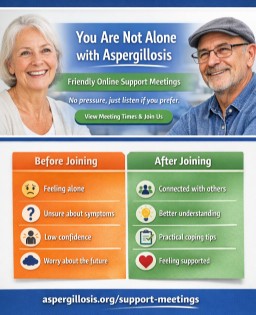
Through our social media channels, our virtual weekly support group and monthly patient meetings, we provide accessible platforms where people can ask questions, share their experiences of life with aspergillosis, and express their emotions and frustrations - with people who understand first-hand. Our members regularly share anecdotal advice and are an endless source of support and encouragement. The NAC team are always on hand to provide information, signpost to resources, and at each monthly meeting, we present on topics relevant to aspergillosis.

We have a weekly zoom support group that meets every Tuesday at 2pm, Thursday at 10am and a more formal monthly meeting on the first Friday of every month 1-3pm. Everyone is welcome. The meetings are closed captioned, and you don't have to be a NAC patient - in fact, you don't even need to be in the UK - we welcome people from all over the world!

Alison Heckler is from New Zealand, and she has Allergic Bronchopulmonary Aspergillosis (ABPA). Alison was kind enough to tell us why, most weeks, she stays up way past her bedtime to join our weekly support meeting.

I joined the Aspergillosis Support Group when I was first diagnosed with aspergillosis. I was given zero information, so I was looking for a credible source of information. I was somewhat ill at the time, and one group member assured me that once my medication levels were right, I would get some level of life back.


Everyone was so encouraging while still being realistic and honest about the complexities of the condition.

Graham and others from the NAC team could answer questions from a knowledgeable, professional perspective, plus provide information on new research and developments.


I don’t know anyone in NZ who has Aspergillosis, so it’s nice to have a group of friends who will pick up on where I am at (health-wise), who don’t need explanations and have encouraging things to say.  They care from a position of relating and understanding that “looking well” doesn’t necessarily mean that I am.

It also helps, when I’m feeling particularly frustrated, to recognise that others are dealing with even more issues and puts things back in perspective.


Because the group is essentially British, the discussion often focuses on the NHS, but even that helps keep me in perspective. There is information to be gleaned. NZ has a similar Public Health System, and my current medical team seems to understand ABPA. For all its faults, I am very appreciative of what we have, especially when I have some understanding of systems in other countries.


I like the virtual meetings on Zoom because I am communicating with real people; it is not just an anonymous written feed.  We can joke and laugh together and share a little bit of our lives.  The slightly more directed conversations, often prompted by someone’s question, are informative and useful.  This then compliments the valuable articles posted on the support pages and website.

For more details and information on how to join our meetings, follow the link below:

https://aspergillosis.org/support/6226-2/ 


You can find us on Social Media:

[/et_pb_text][/et_pb_column][/et_pb_row][/et_pb_section]


National Aspergillosis Centre (NAC) Patient & Carer Support meeting: June 2021

[et_pb_section fb_built="1" admin_label="section" _builder_version="4.16" global_colors_info="{}" theme_builder_area="post_content"][et_pb_row admin_label="row" _builder_version="4.16" background_size="initial" background_position="top_left" background_repeat="repeat" custom_margin="9px|auto|50px|auto|false|false" global_colors_info="{}" theme_builder_area="post_content"][et_pb_column type="4_4" _builder_version="4.16" custom_padding="|||" global_colors_info="{}" custom_padding__hover="|||" theme_builder_area="post_content"][et_pb_text admin_label="Text" _builder_version="4.16" background_size="initial" background_position="top_left" background_repeat="repeat" global_colors_info="{}" theme_builder_area="post_content"]
Our support meetings are informal and designed to provide participants to chat, to ask questions and to listen to some expert opinions on a variety of subjects related to aspergillosis in some way - you can often ask questions too. No one need go away without their questions having an answer from the NAC team.

This month we had a talk from National Aspergillosis Centre Team's Graham Atherton with an update on the COVID pandemic and its implications for aspergillosis patients in the UK, Beth Bradshaw of NAC talks about lung function tests and Chris Harris gives us our weekly exercises for 10 mins.

View full Video here
[/et_pb_text][/et_pb_column][/et_pb_row][/et_pb_section]