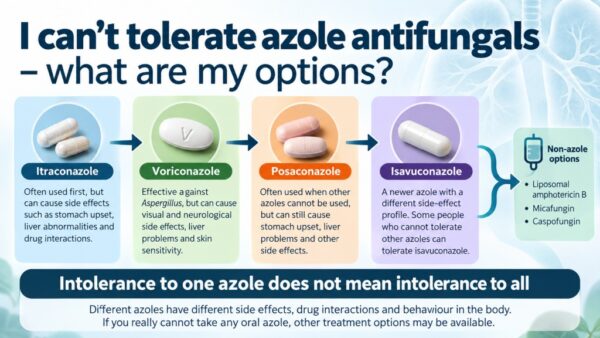
Azole antifungal medicines are among the most important treatments for aspergillosis. They include itraconazole, voriconazole, posaconazole and isavuconazole.
Some people, however, experience significant side effects and eventually say, “I can’t take azoles.”
For a small number of patients this may indeed be the case. But having problems with one azole does not necessarily mean that you will be unable to take another. The different azoles have different side-effect profiles, drug interactions and behaviour in the body.
What does “azole intolerance” mean?
People use the term in several different ways.
It may mean that a medicine caused unpleasant but potentially manageable side effects, such as nausea, headache or fatigue. In other cases there may be a significant medical problem such as liver toxicity, a severe skin reaction, neurological symptoms, heart-related effects or a serious drug interaction.
Occasionally a person has tried several different azoles and developed significant problems with each. These patients can be genuinely difficult to treat and need specialist assessment.
The important question is therefore not simply “Are you intolerant to azoles?”, but:
Which azoles have you taken, what happened with each one, and were drug levels and other possible causes investigated?
The azoles are not identical
The main mould-active oral azoles used in aspergillosis are:
Itraconazole – commonly used as a first treatment, particularly for chronic pulmonary aspergillosis (CPA) and allergic bronchopulmonary aspergillosis (ABPA). Gastrointestinal problems, liver abnormalities, drug interactions and cardiac effects can occur.
Voriconazole – effective against Aspergillus, but can cause visual disturbances, neurological symptoms, liver abnormalities and significant photosensitivity and skin problems, particularly during prolonged treatment.
Posaconazole – often used when itraconazole or voriconazole cannot be used or have failed. It can still cause adverse effects, including gastrointestinal and liver problems.
Isavuconazole – a newer azole with a somewhat different side-effect and drug-interaction profile. Some people who have been unable to tolerate other azoles can tolerate isavuconazole.
For example, research from the National Aspergillosis Centre (NAC) found that some people with CPA who had previously been intolerant of other triazoles were able to tolerate standard-dose isavuconazole.
So a previous bad experience with itraconazole or voriconazole should not automatically be interpreted as meaning that every azole will produce the same reaction.
What does the evidence show?
Azole side effects are common enough to be an important part of long-term aspergillosis care.
- A systematic review of treatments for chronic pulmonary aspergillosis found adverse effects in approximately 25% of itraconazole-treated patients and 36% of voriconazole-treated patients. Treatment discontinuation because of adverse effects was also common in the studies included in the review.
- In a National Aspergillosis Centre comparison, adverse events were reported in 60% of patients taking isavuconazole compared with 86% taking voriconazole.
- Importantly, 25% of patients receiving isavuconazole who had previously been intolerant of other triazoles were able to tolerate standard-dose isavuconazole.
- NAC research has also shown that some patients receiving long-term isavuconazole can maintain satisfactory drug concentrations at a reduced dose, which may help some people continue treatment.
The key point: intolerance of one azole does not reliably predict intolerance of another.
Could the dose be part of the problem?
Sometimes.
People absorb and metabolise azole medicines very differently. Two people taking exactly the same dose can have very different concentrations of the drug in their blood.
This is particularly important with medicines such as itraconazole and voriconazole.
Therapeutic drug monitoring (TDM) measures the amount of antifungal medicine in the blood. It can help establish whether the concentration is:
- too low to be effective;
- within the intended range; or
- high enough to increase the risk of toxicity.
This means that apparent “intolerance” can sometimes be related to excessive drug exposure rather than an absolute inability to take the medicine.
Dose adjustment can occasionally make treatment tolerable.
Research from the National Aspergillosis Centre has also shown that some people receiving long-term isavuconazole maintained satisfactory drug concentrations on a reduced dose and were able to continue treatment.
Dose changes should only be made by the clinical team supervising antifungal treatment.
Drug interactions matter too
Azole antifungals interact with many other medicines because of the way they affect enzymes involved in drug metabolism.
Sometimes symptoms attributed to the antifungal may actually be caused or worsened by an interaction that increases the concentration of the azole or another medicine.
This is particularly important for people taking several medicines.
Before deciding that an azole is intolerable, the clinical team may therefore review:
- other prescription medicines;
- inhaled medicines;
- over-the-counter medicines;
- supplements;
- antifungal blood levels;
- liver function;
- kidney function where relevant; and
- ECG or other monitoring where appropriate.
What if I really cannot tolerate any oral azole?
This does happen.
For people with CPA who cannot take oral triazoles, other antifungal treatments may sometimes be considered. These include intravenous medicines such as liposomal amphotericin B and the echinocandins micafungin or caspofungin.
These treatments are not simple substitutes for an oral azole. They usually require intravenous administration and have their own limitations and potential toxicities. Amphotericin B, for example, requires careful monitoring because of potential effects including kidney toxicity.
The appropriate alternative also depends greatly on which form of aspergillosis is being treated. Treatment decisions for CPA, ABPA and invasive aspergillosis are not interchangeable.
“Allergic to azoles” is not necessarily the same as “intolerant”
It is useful to distinguish a true drug allergy or hypersensitivity reaction from other adverse effects.
Someone who experienced nausea on itraconazole, for example, has a very different clinical problem from someone who experienced a serious hypersensitivity reaction.
If you have previously been told that you are “allergic to azoles”, your specialist team may want to establish exactly which medicine caused the reaction and what happened before deciding whether another azole can safely be considered.
Questions worth asking your specialist team
If azole treatment has been difficult, useful questions include:
- Which azoles have I actually tried?
- What side effects did each one cause?
- Were my antifungal blood levels measured?
- Could the dose have been too high?
- Could another medicine have interacted with the antifungal?
- Have my liver tests or ECG shown evidence of toxicity?
- Would another azole have a sufficiently different side-effect profile to consider?
- Is isavuconazole appropriate in my situation?
- If I genuinely cannot take oral azoles, what non-azole treatments are available for my particular type of aspergillosis?
The important message
Do not stop an antifungal medicine or alter the dose without discussing it with your clinical team.
But equally, persistent or serious side effects should not simply be endured.
Some patients genuinely cannot tolerate long-term azole treatment. However, intolerance to one azole does not automatically mean intolerance to all azoles. Careful review of the reaction, antifungal blood levels, other medicines and alternative azoles can sometimes identify a treatment that is both effective and tolerable.
For patients who truly cannot take any oral azole, specialist antifungal services can consider other approaches depending on the type and severity of aspergillosis.
Further reading and evidence
- Systematic review of antifungal treatment for chronic pulmonary aspergillosis
- National Aspergillosis Centre: isavuconazole compared with voriconazole in chronic pulmonary aspergillosis
- National Aspergillosis Centre: therapeutic drug monitoring during long-term isavuconazole treatment
- Chronic pulmonary aspergillosis – treatment approaches and management
- IDSA Clinical Practice Guideline for the Diagnosis and Management of Aspergillosis
This information is intended to help people understand treatment options and should not replace individual advice from an aspergillosis specialist or other healthcare professional.

Did this page help you?
Tell us in one minute