
Reviewed: 23 July 2026
People living with several long-term conditions often accumulate medicines gradually. One is prescribed for the original illness, another to prevent complications, and others to manage new conditions or treatment side effects.
Each decision may have made sense when it was made. Years later, however, someone may be taking tablets, inhalers, nebulised treatments, injections, supplements and over-the-counter products prescribed or recommended by several different professionals.
This is known as polypharmacy. It is not automatically a bad thing: several medicines may be necessary and beneficial. The important question is not simply how many medicines someone takes, but whether the complete treatment plan remains safe, manageable and appropriate for the life they are living now.
What does polypharmacy mean?
Polypharmacy means taking multiple medicines. Some definitions use a threshold such as five or more regular medicines, while ten or more is sometimes described as extensive polypharmacy. These numbers are useful for identifying people who may benefit from a review, but they do not tell us whether prescribing is good or bad.
There are two important forms:
- Appropriate polypharmacy: all the medicines have a clear purpose, provide worthwhile benefit and are being used safely.
- Problematic polypharmacy: the combination may cause more harm than benefit, some medicines are no longer needed, or the treatment routine has become unmanageable.
A person taking twelve well-chosen medicines may have appropriate polypharmacy. Someone taking four medicines that interact, duplicate one another or no longer meet their needs may have problematic polypharmacy.
How do medicine lists become so complicated?
Complex treatment plans rarely appear all at once. They grow over time.
This may happen because:
- different conditions are managed by different specialists;
- a medicine started during an illness or hospital admission is never reconsidered;
- a temporary treatment quietly becomes permanent;
- a new medicine is prescribed to manage the side effect of another;
- repeat prescriptions continue after the original reason has changed;
- guidelines for several individual diseases are combined without considering the total burden;
- over-the-counter medicines, vitamins and herbal products are not included in the main record;
- the patient’s priorities, health or ability to manage treatment change.
No single clinician may have done anything wrong. The problem is that each medicine can be considered separately while nobody examines the complete picture.
More medicines can mean more opportunities for harm
As the number of medicines increases, it becomes more difficult to predict their combined effect.
Potential problems include:
- side effects being mistaken for symptoms of the underlying illness;
- one medicine increasing or reducing the effect of another;
- several medicines contributing to fatigue, dizziness, confusion or falls;
- effects on the kidneys, liver, heart rhythm or blood pressure;
- duplicated treatment from different prescribers;
- complicated timing instructions that are difficult to follow;
- missed doses or accidental double dosing;
- monitoring tests not taking place at the right time;
- treatment consuming so much time and energy that quality of life suffers.
Older people may be particularly vulnerable because the way the body processes and removes medicines changes with age. Kidney or liver problems, frailty, low body weight and changes in nutrition can also alter how medicines affect someone.
However, problematic polypharmacy is not restricted to older people. Anyone with multiple conditions, several prescribers or a complicated treatment programme may benefit from a review.
When a side effect leads to another prescription
A prescribing cascade occurs when the side effect of one medicine is mistaken for a new medical condition and treated with another medicine.
For example, a medicine may cause ankle swelling, stomach symptoms, dizziness, coughing or sleep disturbance. If the original medicine is not considered as a possible cause, another treatment may be added.
Sometimes the additional medicine is entirely appropriate. But it is worth asking whether a new symptom appeared after a medicine was started or its dose changed.
A good medication review looks backwards as well as forwards:
What was happening when this medicine was started, and does that reason still apply?
Why this matters in aspergillosis
Antifungal medicines can interact with many commonly prescribed treatments.
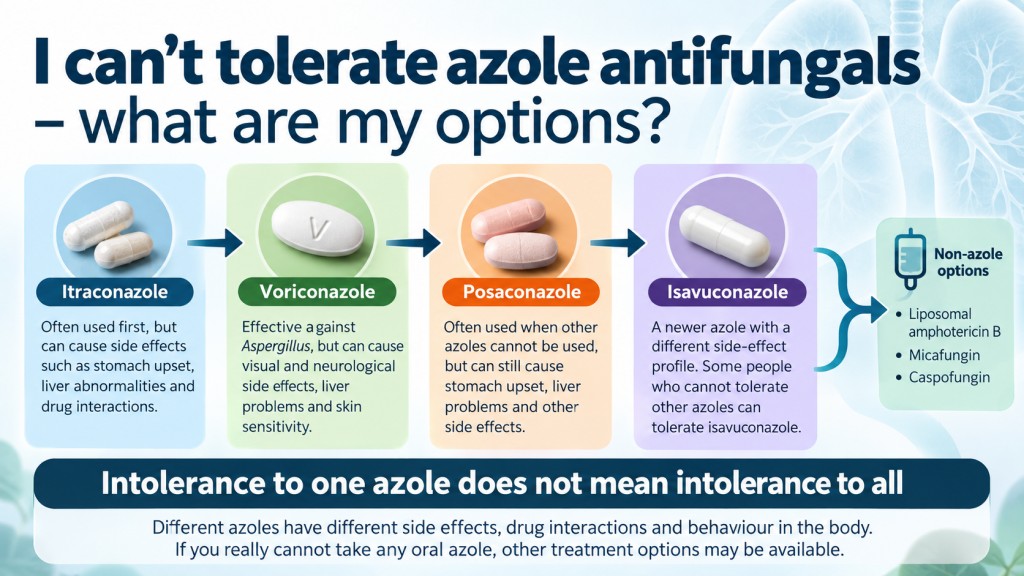
Azole antifungals such as itraconazole, voriconazole, posaconazole and isavuconazole affect the enzymes the body uses to process other medicines. Other drugs can also raise or lower antifungal levels, sometimes substantially.
Depending on the particular combination, interactions may affect:
- antifungal effectiveness;
- liver function;
- heart rhythm;
- steroid exposure;
- cholesterol-lowering medicines;
- blood thinners;
- some antibiotics;
- medicines for sleep, pain, anxiety or mood;
- immunosuppressive medicines.
Some interactions can be managed by choosing a different medicine, adjusting a dose or carrying out additional monitoring. Others mean that two medicines should not be used together.
For people taking an azole antifungal, it is particularly important that every prescriber, pharmacist and dentist knows about it before recommending something new. This includes medicines bought without a prescription and herbal products.
Medicines include more than tablets
A complete review should include everything being used regularly or occasionally:
- prescription tablets and capsules;
- inhalers and nebulised medicines;
- creams, ointments and eye or ear drops;
- injections and biologic treatments;
- painkillers, antihistamines and indigestion remedies bought from a pharmacy or shop;
- vitamins, minerals and dietary supplements;
- herbal and complementary products;
- medicines kept “just in case” or taken only when needed.
Patients do not always think of an inhaler, cream or supplement as a medicine, but these products can still cause side effects or interactions.
What is a structured medication review?
A structured medication review is more than checking boxes on a repeat-prescription screen. It is a detailed conversation between the patient and a suitably qualified healthcare professional about the complete medication plan.
NHS England describes it as a review in which the clinician and patient work as equal partners to understand the benefits, risks and alternatives, guided by the person’s needs, preferences and circumstances.
For every medicine, the review should consider:
- Why was it originally prescribed?
- Is there still a clear reason to take it?
- Is it producing a benefit that matters to the patient?
- Could it be causing symptoms or side effects?
- Does it interact with anything else?
- Is the dose still appropriate for the person’s age, weight, kidney and liver function?
- Is the necessary monitoring taking place?
- Can the person use it correctly and take it at the required time?
- Does its likely future benefit justify its present burden?
- Could anything be simplified, changed or safely stopped?
A review may result in fewer medicines, but that is not its only possible outcome. It may identify an undertreated symptom, improve inhaler technique, change the timing of doses, arrange overdue monitoring or replace a medicine with a safer alternative.
Who should review the medicines?
For many people, the best starting point is their GP practice. A GP or clinical pharmacist can examine the full prescription record and consider all the person’s conditions together.
Other professionals may also be involved:
- Clinical pharmacists are particularly skilled in interactions, side effects, monitoring and simplifying complicated regimens.
- Community pharmacists can identify possible problems and help with medicine use, although major changes may need discussion with the prescriber.
- Hospital specialists should review medicines prescribed for conditions requiring specialist expertise.
- Specialist antifungal pharmacists or clinicians should be involved when changes might affect antifungal treatment.
- Respiratory nurses and physiotherapists can help assess inhalers, nebulised treatments and airway-clearance burden.
When several specialists are involved, one person should ideally coordinate the overall plan. A patient should not be left to decide which specialist’s medicine is least important.
When might a review be particularly useful?
Consider asking for a medication review when:
- you take several regular medicines;
- a new medicine is being added to an already complicated list;
- you have recently left hospital;
- more than one clinic is prescribing for you;
- your kidney or liver function has changed;
- you have developed unexplained fatigue, dizziness, falls, confusion, nausea or other symptoms;
- you are unsure why you still take something;
- the treatment timetable has become difficult to manage;
- you have stopped taking something but it remains on the repeat list;
- your health priorities or quality of life have changed;
- no one has reviewed the complete list recently.
Medication should also be reconciled after a hospital admission. Hospital teams may start, stop or change medicines, and those changes do not always transfer perfectly between hospital, GP and community-pharmacy records.
Preparing for a medication review
Before the appointment, make a list of everything you actually take—not only what appears on the repeat prescription.
Include:
- the medicine name and dose;
- how often you really take it;
- what you believe it is for;
- whether it seems to help;
- any side effects or practical difficulties;
- non-prescription and herbal products;
- medicines prescribed by hospitals or private services;
- anything you have stopped or use differently from the instructions.
If making a list is difficult, bring the medicine boxes, inhalers, bottles and supplements with you. This is sometimes called a “brown bag review”. Photographs of packaging can also help during a telephone or video consultation.
Be honest about missed doses or treatments you have chosen not to use. This is valuable safety information, not a test of whether you are a “good patient”. If a treatment does not fit into daily life, the prescriber needs to know.
Questions worth asking
- What is each medicine for?
- How will we know whether it is working?
- Which medicines are essential and which are optional?
- Could any of my symptoms be side effects?
- Do any of these medicines interact with my antifungal treatment?
- Do I still need the same dose?
- Are there blood tests, ECGs, blood-pressure checks or drug levels that I need?
- Could the timing or number of doses be simplified?
- If we stop something, how will it be reduced and what should I watch for?
- Who should I contact if symptoms return?
- Who is responsible for coordinating my overall medication plan?
Deprescribing does not mean withdrawing care
Deprescribing means the planned and supervised reduction or stopping of a medicine when its harms or burdens outweigh its likely benefits.
It should be a shared clinical decision—not an automatic attempt to cut the number of prescriptions and not a way of denying useful treatment.
Some medicines can be stopped straightforwardly. Others must be reduced gradually to prevent withdrawal effects or a dangerous return of the condition they control.
Corticosteroids are a particularly important example. Long-term systemic steroids must not be stopped suddenly because the body’s natural steroid production may have been suppressed. Some antidepressants, sedatives, opioid painkillers and other medicines may also require a carefully planned reduction.
Do not stop a prescribed medicine simply because you suspect it is unnecessary or causing a side effect. Discuss the concern with a pharmacist or prescriber and agree a safe plan.
The aim is a treatment plan that fits the person
A medication review is not only about pharmacology. It is also about daily life.
A treatment can be medically effective but still create problems if it takes hours to complete, causes intolerable side effects or prevents someone doing what matters to them. These burdens should be part of the decision alongside test results and clinical guidelines.
The central question is not:
“How can we remove as many medicines as possible?”
It is:
“Does every part of this treatment plan still have a worthwhile purpose for this particular person?”
Sometimes the answer will be to continue everything. Sometimes a dose can be reduced, monitoring improved or treatment simplified. Occasionally, a medicine that has been taken for years can be safely withdrawn.
What matters is that the complete medication list is reviewed rather than allowed to grow indefinitely—and that the person taking the medicines is fully involved in deciding what happens next.
Further information
- NHS England: Structured medication reviews and medicines optimisation
- NICE: Medicines optimisation
- NICE: Shared decision-making about medicines
- MHRA: Multiple medicines and reporting suspected side effects
This information is intended to support, not replace, discussions with your doctor, pharmacist or specialist team. Do not stop or change prescribed medicines without appropriate clinical advice.

Did this page help you?
Tell us in one minute