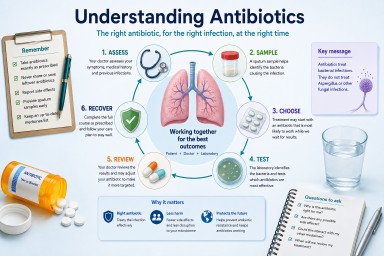
Why some people struggle with repeated antibiotic courses — and what can be done when essential treatment causes pain, nausea or digestive problems.
Antibiotics are among the most important treatments for bacterial infections. For people living with bronchiectasis, aspergillosis and other chronic respiratory conditions, they can be particularly important when bacterial infections complicate an already difficult illness.
But what happens when the treatment itself makes someone feel seriously unwell?
During our National Aspergillosis Centre Thursday patient discussion on 8 October 2026, members described repeated courses of antibiotics, severe digestive symptoms and the difficulty of balancing the benefits of treatment against its consequences.
These experiences raise an important question:
Can someone become intolerant of virtually every oral antibiotic — and, if so, why?
Antibiotic intolerance is not the same as antibiotic allergy
The word intolerance is often used to describe unpleasant reactions to medication, but it is important to distinguish several different possibilities.
- Antibiotic allergy: An immune response that may cause hives, swelling, wheezing or, rarely, life-threatening anaphylaxis. Some delayed reactions can cause serious skin or organ problems.
- Antibiotic intolerance: Unpleasant adverse effects that do not involve an allergic mechanism, such as nausea, abdominal discomfort, vomiting or diarrhoea.
- Other adverse drug reactions: Effects involving organs such as the liver, kidneys or nervous system, which may require specific investigations.
This distinction matters because someone who cannot tolerate one antibiotic may still be able to take another, including a medicine from a different antibiotic class.
The NICE guideline on drug allergy (CG183) recommends that suspected allergies are documented carefully and distinguished from other adverse drug reactions.
Why antibiotics affect the digestive system
Antibiotics are designed to kill bacteria or prevent them from multiplying. However, many also affect bacteria that normally live in the digestive tract.
These microorganisms form part of the gut microbiome, a complex community involved in digestion, metabolism and immune function.
Antibiotic treatment can temporarily alter the balance and diversity of this community.
Common digestive adverse effects include:
- Nausea and vomiting
- Abdominal discomfort or cramping
- Diarrhoea
- Bloating and altered bowel habits
- Reduced appetite
Different antibiotics have different effects. Doxycycline, for example, can irritate the oesophagus and stomach, while several broad-spectrum antibiotics are associated with diarrhoea.
Repeated courses can cause repeated disturbances to the gut microbiome, although this does not necessarily mean that permanent damage has occurred.
Can repeated antibiotics permanently damage the gut?
This was an important concern during the patient discussion.
Research confirms that antibiotics can alter gut microbial communities, sometimes for months after treatment. Recovery varies according to the antibiotic, duration, previous exposure and individual characteristics.
However, persistent digestive symptoms do not necessarily prove irreversible damage to the gut microbiome.
Other explanations may include medication-related irritation, pre-existing gastrointestinal disease, altered bowel motility, infection or a combination of factors.
One particularly important complication is Clostridioides difficile infection, which can develop after antibiotic treatment and cause significant diarrhoea and inflammation of the colon.
Persistent diarrhoea, severe abdominal pain, fever or blood in the stool should be assessed promptly.
When digestive symptoms repeatedly interfere with essential treatment, specialist gastroenterology advice may be valuable.
Why someone might react to several different antibiotics
There is no single explanation for intolerance to multiple antibiotics.
Similar adverse effects from different drugs
Several unrelated antibiotics can cause nausea or diarrhoea without sharing the same underlying mechanism.
Existing digestive problems
Gastritis, reflux, inflammatory bowel disease and other gastrointestinal conditions may make medication more difficult to tolerate.
Drug interactions
People with complex respiratory conditions often take several medicines. Some combinations increase adverse effects or alter drug concentrations.
Changes in drug handling
Kidney or liver impairment can affect the elimination of certain antibiotics, sometimes requiring dose adjustments.
Previous distressing experiences
Repeated severe reactions may understandably create anxiety about starting another course.
These possibilities are not mutually exclusive. Someone may have genuine physical adverse effects and also develop anxiety about future treatment.
The presence of anxiety does not mean that symptoms are imagined.
Can anxiety make antibiotic intolerance worse?
An interesting question raised by the discussion was whether anxiety might contribute when someone reports difficulty tolerating nearly every antibiotic.
The relationship between the brain and digestive system is well established.
The gut–brain axis involves communication between the nervous system, gastrointestinal tract, immune system and gut microorganisms.
Stress and anxiety can influence nausea, abdominal discomfort, bowel movements and the perception of pain.
Previous unpleasant experiences with medication may also create anticipatory anxiety, in which someone begins to feel distressed before taking another dose.
But it would be a mistake to assume that anxiety is the primary explanation without investigating physical causes.
Anxiety can amplify genuine symptoms, but it does not rule out a genuine adverse drug reaction.
For patients who have experienced severe vomiting, pain or hospital admission after treatment, fear of another course may be entirely understandable.
A compassionate assessment should consider both physical and psychological factors.
Does intolerance mean an antibiotic is not being absorbed?
Another concern raised during the meeting was whether persistent gastrointestinal problems could prevent oral antibiotics from being absorbed properly.
This is possible in certain circumstances, but intolerance and poor absorption are different problems.
Severe vomiting may prevent a medicine from remaining in the digestive tract long enough to be absorbed. Some gastrointestinal diseases can also impair absorption.
However, nausea or abdominal discomfort alone does not demonstrate that an antibiotic has failed to enter the bloodstream.
If treatment repeatedly fails despite an appropriate antibiotic, clinicians may consider whether:
- The organism is resistant to treatment
- The infection has been correctly diagnosed
- The antibiotic and dose are appropriate
- The medicine is being taken correctly
- Absorption may be impaired
Some medicines can be monitored through blood tests, although routine blood-level monitoring is not available or necessary for most oral antibiotics.
When antibiotics are needed repeatedly
For people with bronchiectasis, bacterial exacerbations may require repeated antibiotic courses.
However, not every increase in coughing or sputum production necessarily indicates a bacterial infection requiring antibiotics.
Clinicians may use symptoms, previous sputum culture results, microbiology and clinical assessment to guide treatment.
The NICE guideline on acute exacerbations of bronchiectasis (NG117) recommends obtaining a sputum sample for culture and susceptibility testing during an exacerbation and taking previous microbiology results into account when choosing antibiotics.
It also recommends seeking specialist advice when symptoms do not improve with repeated courses, bacteria are resistant to oral treatment or a patient cannot take oral medicines.
For patients experiencing repeated exacerbations, a respiratory team may review airway clearance, underlying causes, preventive treatments and whether long-term antibiotic strategies are appropriate.
The aim is not simply to avoid antibiotics.
It is to use the most appropriate antibiotic, at the right dose and duration, when there is a clear clinical benefit.
What can patients do if antibiotics repeatedly make them ill?
Patients should seek advice from their prescribing team before stopping or changing treatment, unless a suspected emergency reaction requires immediate action.
1. Keep a record of reactions
Record the antibiotic name, dose, start date, symptoms and how soon they appeared after taking the medicine.
Also note whether symptoms resolved when treatment finished and whether the same reaction occurred previously.
2. Ask whether an alternative is available
A different antibiotic class may have a more tolerable side-effect profile, provided it is suitable for the infection.
3. Review how the medicine should be taken
Some antibiotics are better tolerated with food, while others have specific instructions about meals, antacids, minerals or dairy products.
Always follow the instructions for the particular medicine.
4. Request a medication review
A pharmacist or prescribing clinician can assess interactions, doses, kidney and liver function, and whether other medicines may contribute to symptoms.
5. Discuss persistent digestive problems
Repeated severe symptoms may justify further investigation rather than simply accepting them as an unavoidable consequence of treatment.
6. Agree on a treatment plan
Patients who regularly develop respiratory infections may benefit from a written plan explaining when antibiotics are needed, which medicines have previously caused problems and whom to contact if treatment cannot be tolerated.
What about probiotics and restoring the microbiome?
Probiotics are frequently suggested as a way of reducing antibiotic-associated digestive problems.
Some preparations may reduce antibiotic-associated diarrhoea in certain populations, but the evidence varies considerably between products and patient groups.
There is no convincing evidence that a particular probiotic reliably restores everyone’s microbiome to its previous state.
Importantly, people who are severely immunocompromised or seriously ill should seek specialist advice before taking live microbial supplements because rare serious infections have been reported.
The US National Institutes of Health provides a useful evidence summary: Five Things to Know About Probiotics.
A balanced diet containing appropriate fibre may support general digestive health, but individual tolerance varies, particularly in people with existing gastrointestinal disease.
There is no established dietary treatment that reliably reverses all antibiotic-related microbiome changes.
When to seek urgent medical advice
Seek urgent assessment for:
- Severe or persistent vomiting
- Inability to retain fluids or essential medication
- Significant dehydration
- Severe abdominal pain
- Bloody diarrhoea
- Severe or persistent diarrhoea during or after antibiotic treatment
A suspected severe allergic reaction, particularly breathing difficulty, swelling of the tongue or throat, or collapse, requires emergency assistance. Call 999 in the UK.
Severe or persistent diarrhoea during or after antibiotics should also prompt assessment for possible C. difficile infection.
The importance of listening to patients
The Thursday discussion highlighted something that is easily overlooked.
Patients who repeatedly experience adverse effects may become reluctant to take medicines that clinicians consider essential.
That reluctance should not automatically be interpreted as non-compliance or irrational anxiety.
It may reflect years of difficult experiences, genuine physical symptoms and uncertainty about whether another course will provide enough benefit to justify the consequences.
Good treatment decisions require understanding both the infection and the patient’s experience of treatment.
Sometimes the most important question is not simply whether an antibiotic is effective against a particular bacterium.
It is whether the patient can realistically tolerate the treatment.
Successful treatment needs to be both clinically appropriate and manageable for the person receiving it.
Further reading and useful resources
- NICE CG183: Drug allergy — diagnosis and management. Guidance on recognising, recording and investigating suspected drug allergies, and distinguishing them from other adverse reactions.
- NICE NG117: Bronchiectasis — acute exacerbation antimicrobial prescribing. Guidance on sputum cultures, antibiotic selection, adverse effects and when specialist advice is needed.
- NICE: Evidence and rationale for antibiotic treatment in bronchiectasis. Explains the reasoning behind antibiotic choices and microbiology-guided treatment.
- NIH: Five Things to Know About Probiotics. A summary of evidence, limitations and safety considerations.
- Aspergillosis.org: Information for patients and carers. Resources on aspergillosis, respiratory health, treatment and living with chronic illness.
This article was inspired by the National Aspergillosis Centre Thursday patient discussion on 8 October 2026. Individual experiences are presented in general terms to respect participants’ privacy.
This information is educational and does not replace individual medical advice. Decisions about antibiotic treatment should be made with the prescribing healthcare professional.

Did this page help you?
Tell us in one minute