We encounter fungi every day, and most cause no harm. Yet the same fungus may be harmless in one person and contribute to serious illness in another. Why does this happen? And how do doctors distinguish fungal exposure, colonisation, allergy and infection?
1. Finding a fungus does not necessarily mean infection
Fungi are everywhere.
We breathe in fungal spores, eat foods containing fungi and live alongside fungal organisms that normally occupy parts of our bodies.
Most of these encounters cause no illness.
For example, Candida yeasts commonly live in the mouth, digestive system and other parts of the body without causing disease.
We also regularly inhale spores of Aspergillus, a fungus found in soil, decaying vegetation and the wider environment.
Our immune defences usually prevent these encounters from becoming a problem.
Finding a fungus is not the same as finding a fungal infection.
This distinction is particularly important when a laboratory reports Aspergillus in a sputum sample.
The result tells us that the fungus was present in the sample. It does not, by itself, tell us whether the fungus is causing disease.
To understand that, we need to consider both the organism and the person in whom it has been found.
2. Exposure, colonisation and infection: what is the difference?
These terms describe different relationships between fungi and the human body.
Exposure
Exposure means encountering a fungus or its spores.
We may inhale spores, touch fungal material or consume fungi in food.
Exposure is almost universal and usually harmless.
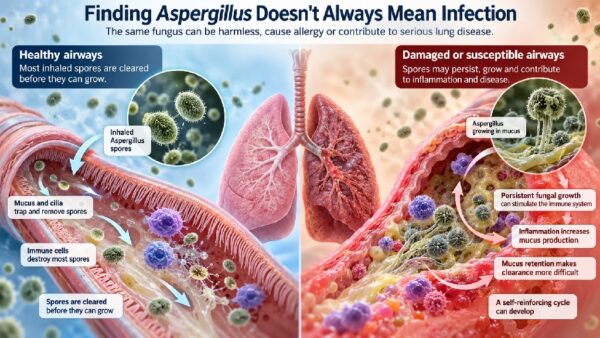
In healthy lungs, inhaled fungal spores are generally removed or destroyed before they can establish significant growth.
Colonisation
Colonisation means that a fungus is present and may be growing at a body site without necessarily causing disease.
For example, Candida may live harmlessly in the mouth, while Aspergillus may persist in the airways of some people with existing lung conditions.
Colonisation does not automatically require antifungal treatment.
However, the term can sometimes be misleading.
In damaged airways, persistent fungal growth may be associated with inflammation or symptoms, even when it is difficult to establish whether the fungus is responsible.
A positive sputum culture may therefore require further investigation rather than simply being dismissed as colonisation.
Infection
Infection occurs when a fungus establishes itself in the body and causes an infectious disease process.
Some fungal infections remain confined to a particular surface or body site. Others affect deeper tissues.
Importantly, infection does not always mean invasion of tissues.
A fungus can cause clinically significant disease within the airways without penetrating the lung tissue itself.
The distinction is not simply whether a fungus is present, but what it is doing and how the body is responding.
3. Why can the same fungus be harmless in one person and harmful in another?
An important part of the answer lies in our immune defences.
The skin, mucus, airway clearance mechanisms and immune cells provide several layers of protection against fungi.
In healthy lungs, inhaled Aspergillus spores are usually removed or destroyed before they can establish significant growth.
But circumstances can change.
For example:
- Damaged airways may make it harder to clear inhaled particles and microorganisms.
- Bronchiectasis creates widened, damaged airways where mucus can collect and organisms may persist.
- Asthma and allergic susceptibility can encourage exaggerated immune responses to fungal allergens.
- Existing lung cavities or scarring can provide spaces where Aspergillus may establish persistent growth.
- Weakened immune defences, including those caused by certain medicines or serious illnesses, can increase susceptibility to invasive fungal infection.
Individual genetics also influence immune recognition, inflammation and susceptibility to disease.
Why is Aspergillus fumigatus particularly important?
One reason is its ability to grow at human body temperature.
Many environmental fungi cannot grow efficiently at 37°C. Aspergillus fumigatus, however, grows readily at this temperature and can tolerate considerably higher temperatures.
This ability probably reflects its adaptation to warm environments such as decomposing vegetation and compost.
It also gives the fungus an important advantage when spores enter the human lungs.
But temperature tolerance is only one requirement.
To establish disease, the fungus must also survive the body’s normal defences, obtain nutrients and find conditions that allow continued growth.
Being able to grow at body temperature makes infection possible. It does not make infection inevitable.
The same fungus that is routinely cleared from healthy lungs may persist in damaged airways or cause serious disease when immune defences are weakened.
Fungal disease often develops because the relationship between the organism, the body and its defences has changed.
4. Can fungi cause illness without invading our tissues?
Yes. This is one of the most important distinctions in aspergillosis.
A fungus can contribute to illness through an allergic or inflammatory response without invading lung tissue.
Fungal allergy
In some people, the immune system recognises fungal proteins as allergens and responds excessively.
This may contribute to asthma symptoms or other allergic disease.
The fungus does not need to invade the body to trigger this response.
Allergic bronchopulmonary aspergillosis (ABPA)
ABPA is a complex allergic and inflammatory condition associated with Aspergillus in the airways.
The immune system reacts strongly to fungal allergens, potentially causing inflammation, mucus plugging and damage to the airways.
Although fungal growth in the airways can contribute to ABPA, the disease is not simply an infection invading lung tissue.
The immune response is a major part of the problem.
Why do some people develop such a strong inflammatory response?
This is one of the most interesting questions in ABPA research.
We all have slightly different immune systems. Some people are genetically and immunologically more susceptible to allergic inflammation than others.
ABPA involves an exaggerated type 2 immune response, including pathways associated with IgE antibodies, eosinophils and inflammatory signalling molecules such as IL-4, IL-5 and IL-13.
Genetic differences affecting immune recognition and regulation may contribute to susceptibility, although no single gene explains most cases.
The fungus itself may also be important.
Aspergillus fumigatus can persist and grow in airway mucus, particularly where normal clearance mechanisms are impaired.
This provides a continuing source of fungal allergens and other biologically active substances.
In susceptible people, these substances can stimulate airway cells and immune responses, sustaining inflammation.
Inflammation may then increase mucus production and contribute to mucus plugging.
The resulting mucus retention may make fungal clearance more difficult, allowing the stimulus to continue.
A potentially self-reinforcing process develops:
Persistent fungal growth → immune stimulation → inflammation → increased mucus and impaired clearance → further fungal persistence.
This is a useful model of how ABPA may become chronic or recurrent, although the precise contribution of each mechanism varies between patients.
The important point is that the immune system is not necessarily failing to recognise the fungus.
It may recognise the fungus very effectively, but respond in a way that causes considerable inflammation without adequately clearing it.
This helps explain why ABPA treatment may target both sides of the problem.
Corticosteroids and some biological medicines reduce particular inflammatory responses, while antifungal medicines aim to reduce fungal growth and the continuing antigenic stimulus.
The 2024 international ISHAM guidelines recognise oral corticosteroids or itraconazole as initial treatment options for acute ABPA, with combination treatment considered in particular circumstances, including recurrent exacerbations.
Treatment must be individualised because suppressing inflammation and controlling fungal growth are related but distinct objectives.
Severe asthma with fungal sensitisation (SAFS)
Some people with severe asthma develop allergic sensitisation to fungi without meeting the diagnostic criteria for ABPA.
This is known as severe asthma with fungal sensitisation, or SAFS.
SAFS and ABPA share important allergic and inflammatory mechanisms.
Both may involve IgE-mediated sensitisation, eosinophilic inflammation and increased airway responsiveness.
However, SAFS does not necessarily involve persistent fungal growth, and it should not simply be regarded as an early or milder form of ABPA.
The distinction between the conditions has also changed as diagnostic criteria have developed.
The revised 2024 ISHAM guidelines lowered the usual total IgE diagnostic threshold for ABPA from 1,000 to 500 IU/mL.
This means that some patients who would previously have fallen outside the ABPA criteria may now meet them, provided other required diagnostic findings are present.
An elevated total IgE level alone does not establish ABPA.
The revised criteria also require evidence of Aspergillus sensitisation and additional supporting findings, such as Aspergillus-specific IgG, eosinophilia or characteristic imaging abnormalities.
There are also circumstances in which ABPA may be diagnosed despite a total IgE below 500 IU/mL.
SAFS and ABPA have overlapping biology, but they are not interchangeable diagnoses.
This illustrates an important principle: diagnostic categories help clinicians make decisions, but the underlying biological processes do not always fit neatly into separate boxes.
For more detail, see the 2024 ISHAM guidelines for ABPA diagnosis and treatment.
5. What happens when fungi persist in damaged airways?
This is where the distinction between colonisation and infection becomes more complicated.
People with bronchiectasis, cystic fibrosis or other chronic airway diseases may repeatedly produce sputum samples containing Aspergillus.
Sometimes this reflects colonisation without clear evidence of fungal disease.
But persistent fungal growth can also contribute to airway inflammation and symptoms.
Aspergillus bronchitis
Aspergillus bronchitis is a form of airway disease particularly associated with structurally abnormal airways.
Patients may experience persistent cough, sputum production and recurrent respiratory symptoms.
Repeated detection of Aspergillus, together with the clinical picture and other investigations, may support the diagnosis.
Unlike ABPA, the dominant problem is not necessarily an exaggerated allergic response.
Instead, persistent fungal growth may contribute to chronic airway inflammation through interactions with airway cells and innate immune defences.
Neutrophils and other inflammatory mechanisms may be involved, although the precise processes are less well characterised than those in ABPA.
Aspergillus bronchitis also differs from invasive aspergillosis because fungal growth does not necessarily penetrate lung tissue.
A fungus can cause clinically significant airway disease without either a pronounced allergic response or invasive infection.
Are ABPA, SAFS and Aspergillus bronchitis variations of the same disease?
They are related, but not simply different degrees of severity.
In SAFS, allergic sensitisation and severe asthma dominate.
In ABPA, exaggerated allergic inflammation is central, often interacting with fungal persistence in the airways.
In Aspergillus bronchitis, persistent fungal growth and associated airway disease are more prominent, without necessarily producing the characteristic allergic response of ABPA.
These are useful distinctions rather than completely separate biological categories.
Patients may have overlapping features, and their clinical presentation can change over time.
The same fungus can contribute to different forms of illness depending on the person’s immune responses and the condition of their airways.
Why do other infections and allergies sometimes trigger a flare?
People with aspergillosis often notice that their symptoms worsen following a cold, another respiratory infection or increased exposure to allergens.
There are good biological reasons why this can happen.
Our lungs do not deal with fungi, bacteria, viruses and allergens independently. They all affect the same airways, mucus clearance mechanisms and immune defences.
A viral infection can increase airway inflammation and mucus production, temporarily making it harder to clear microorganisms.
Bacterial infections may add further inflammation, while allergic reactions can increase airway swelling and sensitivity.
In someone with ABPA, bronchiectasis or Aspergillus bronchitis, these effects can combine to produce a substantial worsening of symptoms.
Importantly, a flare does not necessarily mean that fungal growth has increased or that aspergillosis has progressed.
Sometimes the main problem is a viral or bacterial infection, an asthma exacerbation or another inflammatory trigger.
At other times, the fungal disease itself may have become more active.
For example, the 2024 ISHAM guidelines distinguish ABPA exacerbations from asthma and infective bronchiectasis exacerbations using clinical findings, imaging and changes in total IgE.
Distinguishing between these possibilities matters because they may require different treatments.
A worsening of symptoms tells us that something has changed. It does not, by itself, tell us what has changed.
6. When does fungal growth become chronic pulmonary aspergillosis?
Chronic pulmonary aspergillosis (CPA) usually develops in people whose lungs have already been damaged by another condition.
Previous tuberculosis, emphysema, bronchiectasis and other lung diseases can leave cavities or structural changes.
Aspergillus may establish persistent growth in these abnormal areas.
Over months or years, some people develop progressive lung damage, inflammation and symptoms such as cough, fatigue, weight loss or coughing up blood.
CPA is not diagnosed simply because Aspergillus appears in a sputum sample.
Doctors consider the combination of symptoms, CT scan appearances, blood tests such as Aspergillus-specific IgG and microbiological findings.
Some people develop an aspergilloma, sometimes called a fungal ball, within an existing lung cavity.
A stable, uncomplicated aspergilloma does not necessarily require immediate antifungal treatment, although appropriate specialist assessment and monitoring are important.
CPA illustrates how existing lung damage can change the relationship between a fungus and its host.
The same organism that is routinely cleared from healthy lungs may persist and contribute to progressive disease in an already damaged lung.
7. What is invasive aspergillosis?
Invasive aspergillosis is different.
Here, fungal growth penetrates tissues and causes damage.
This can occur when immune defences are substantially weakened, for example following certain cancer treatments, organ transplantation or intensive immunosuppressive therapy.
It can also occur in some critically ill patients, including those with severe respiratory infections, even without traditional risk factors.
Invasive aspergillosis is a serious condition requiring prompt specialist investigation and treatment.
Importantly, the word invasive has a specific medical meaning.
It does not simply mean that a fungus has been found in the lungs, or that someone has experienced severe symptoms.
Invasive disease means that the fungus is growing into tissues, not merely that it is present in the airways.
8. Why isn’t a positive sputum culture enough to diagnose aspergillosis?
Imagine two people whose sputum samples both grow Aspergillus fumigatus.
The first has no new respiratory symptoms, stable lung function and no imaging evidence of fungal disease.
The second has persistent cough, worsening breathlessness, abnormal CT findings and additional blood-test results suggesting aspergillosis.
Although the laboratory has identified the same fungus, the significance of the result may be very different.
Doctors therefore interpret fungal tests alongside the wider clinical picture.
This may include:
- Symptoms and how they have changed over time.
- Existing lung conditions and immune status.
- Repeated sputum cultures or fungal PCR tests.
- Blood tests measuring fungal sensitisation or immune responses.
- Chest X-rays or CT scans.
- Evidence of inflammation, airway damage or progressive disease.
A positive result may represent temporary exposure, colonisation or clinically important fungal disease.
Equally, a negative sputum culture does not reliably exclude aspergillosis, because fungi may not be recovered from every sample.
The purpose of testing is not merely to find a fungus. It is to understand whether that fungus is contributing to illness.
9. Does finding a fungus mean it needs to be eliminated?
Not necessarily.
We live alongside fungi throughout our lives, and attempting to eliminate every fungal organism from the body would be neither practical nor desirable.
Antifungal medicines can be extremely valuable when there is a recognised indication for treatment.
But they can also cause adverse effects, interact with other medicines and, in some circumstances, contribute to antifungal resistance.
For someone with harmless colonisation, treatment may provide no meaningful benefit.
For someone with Aspergillus bronchitis, CPA or invasive aspergillosis, antifungal treatment may be important.
For someone with ABPA, treatment decisions may also need to address the inflammatory and allergic response.
This is why treatment depends on the diagnosis rather than the presence of a fungus alone.
The aim is not to eliminate every fungus. It is to prevent or control fungal disease.
10. What should patients remember?
Fungi are normal inhabitants of our environment, and some live on or within our bodies without causing harm.
Finding a fungus does not automatically mean that someone has an infection.
Even when fungi contribute to illness, they can do so in different ways.
They may trigger allergy, persist in damaged airways, establish chronic disease or invade tissues when defences are weakened.
These conditions require different investigations and treatments.
For patients who receive a positive fungal test, the most useful question is not simply:
“How do we get rid of this fungus?”
It is:
“What does finding this fungus mean for my health?”
That question encourages a more accurate diagnosis and helps avoid both unnecessary treatment and missed fungal disease.
Part of our series: Understanding Fungi and Human Health
This is the third article in our series exploring the relationship between fungi, our immune defences and human disease.
- Article 1: Fungus: Friend or Foe? — Why living alongside fungi requires a balance between tolerance, immune defence and inflammation.
- Article 2: Mycotoxins: What Are They, and What Do They Actually Do? — Why fungal chemicals can be harmful, but detecting them does not automatically establish poisoning.
- Article 3: When Does a Fungus Become an Infection? — Why fungal presence, colonisation, allergy and infection are not the same thing.
Our next article will explore how fungi survive the body’s defences and why some organisms are particularly successful at establishing infection.
References and further reading
- ISHAM-ABPA Working Group (2024). Revised clinical practice guidelines for diagnosing, classifying and treating allergic bronchopulmonary aspergillosis/mycoses. European Respiratory Journal. https://pmc.ncbi.nlm.nih.gov/articles/PMC10991853/
- Infectious Diseases Society of America (IDSA). Clinical Practice Guideline for the Diagnosis and Management of Aspergillosis (2016). https://www.idsociety.org/practice-guideline/aspergillosis/
- European Respiratory Society. Fungal lung disease. https://doi.org/10.1183/13993003.00803-2024
- National Aspergillosis Centre. Patient information and condition guides on ABPA, SAFS, Aspergillus bronchitis, chronic pulmonary aspergillosis and invasive aspergillosis. https://aspergillosis.org/
This article provides general educational information and is not a substitute for individual medical advice.

Did this page help you?
Tell us in one minute