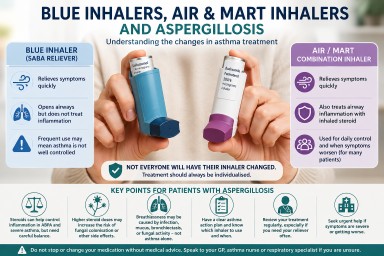
Patient comparing blue reliever inhaler and combination AIR MART inhaler for asthma and aspergillosis

Blue inhalers, combination inhalers and aspergillosis: what patients need to know

Recent news about “blue inhalers” has caused understandable concern for people with asthma, ABPA and other aspergillosis-related lung conditions. The key message is: do not panic and do not stop any prescribed inhaler suddenly.

Blue reliever inhalers, such as salbutamol or Ventolin, remain important medicines and can be lifesaving during asthma symptoms or an asthma attack. However, asthma guidelines have changed because doctors now recognise that relying too heavily on a blue inhaler can be a sign that the underlying airway inflammation is not being well controlled.

What is a blue inhaler?

A blue inhaler usually contains a medicine called a short-acting beta2 agonist, often shortened to SABA. Salbutamol is the best-known example.

These inhalers work quickly by relaxing the muscles around the airways. This can relieve wheeze, chest tightness and breathlessness within minutes. However, a blue inhaler does not treat the airway inflammation that often drives asthma symptoms.

You can read more about reliever inhalers from Asthma + Lung UK.

Why are asthma guidelines changing?

Asthma is not just a condition of narrowed airways. It is also an inflammatory condition. A reliever inhaler may make breathing feel easier for a short time, but if inflammation is not treated, asthma may remain poorly controlled.

Frequent use of a blue reliever inhaler can therefore be a warning sign. It may mean that asthma treatment needs reviewing, especially if someone is needing their reliever often, waking at night, having flare-ups, or finding their normal activities limited.

The updated NICE/BTS/SIGN asthma guideline supports greater use of treatment plans that combine symptom relief with anti-inflammatory treatment.

What are AIR and MART inhalers?

Some patients are now prescribed a combination inhaler that contains:

  • a fast-acting reliever medicine to open the airways
  • an inhaled corticosteroid to reduce inflammation

These approaches are known as:

  • AIR – Anti-Inflammatory Reliever
  • MART – Maintenance and Reliever Therapy

With these plans, the combination inhaler may be used when symptoms occur. In MART, it is also used regularly every day as maintenance treatment.

The important difference is that when symptoms increase, the patient receives more anti-inflammatory treatment as well as more reliever medicine. This aims to reduce the cycle of worsening symptoms, repeated blue inhaler use, and untreated inflammation.

Useful patient information is available from Asthma + Lung UK on AIR inhalers and MART inhalers.

Does this mean everyone should stop using their blue inhaler?

No. This is the most important point.

The new guidance does not mean that every patient must immediately stop using a blue inhaler. It also does not mean that blue inhalers are “bad” or banned.

For many people, nothing will change straight away. Some patients will remain on their current inhalers. Others may be changed to an AIR or MART plan after review by their GP, asthma nurse or respiratory specialist.

Will some patients have their blue inhaler taken away?

Sometimes, but not always.

If a patient is moved onto an AIR or MART plan, their combination inhaler may become both their preventer and their reliever. In that situation, they may no longer routinely need a separate blue inhaler.

However, some patients may still keep a blue inhaler as backup, and others may continue with separate preventer and reliever inhalers. This depends on the individual patient, their diagnosis, their inhalers, and their asthma action plan.

Not all combination inhalers can be used as relievers. Only specific inhalers containing a fast-acting medicine such as formoterol are suitable for AIR or MART use. Patients should only use inhalers in this way if they have been specifically prescribed and instructed to do so.

Why this is more complicated for aspergillosis patients

People with aspergillosis-related lung disease often have more complex respiratory problems than standard asthma alone.

This may include:

For these patients, breathlessness is not always caused by asthma-type inflammation alone. It may also be related to mucus, infection, bronchiectasis, fungal activity, or structural lung damage.

This means that simply taking more inhaler may not always address the real cause of worsening symptoms.

Steroids: useful but needing balance

Inhaled corticosteroids can be very helpful in asthma and ABPA because they reduce airway inflammation. Good control of inflammation may reduce symptoms, flare-ups and the need for oral steroid courses.

However, steroid exposure also needs careful management in aspergillosis patients. Higher steroid doses may increase the risk of side effects such as oral thrush and, in some situations, may affect the balance between inflammation control and fungal growth.

This does not mean patients should avoid inhaled steroids. It means that treatment should be individualised and reviewed by a clinician who understands the patient’s full lung condition.

What should aspergillosis patients do?

  • Do not stop your blue inhaler suddenly if it has been prescribed for you.
  • Do not change your preventer or steroid inhaler without medical advice.
  • Check your own asthma action plan. Make sure you know which inhaler is for daily prevention and which one is for symptoms.
  • Ask whether your combination inhaler is suitable for AIR or MART use. Do not assume that all combination inhalers can be used this way.
  • Request a review if you are using your reliever inhaler frequently, symptoms are worsening, or you are unsure what to do.

When to seek urgent help

Seek urgent medical help if your breathlessness is severe, your reliever is not helping as expected, you are struggling to speak in full sentences, your lips or fingers look blue, or your symptoms are rapidly worsening.

Follow your personal asthma action plan. If you think you are having an asthma attack, do not delay seeking emergency help.

The key message

The new guidance is not simply about “taking away blue inhalers”. It is about recognising that asthma symptoms often reflect airway inflammation, and that some patients do better when symptom relief and anti-inflammatory treatment are given together.

For people with aspergillosis, the message is especially important: inhaler treatment should be reviewed in the context of the whole lung condition, not changed because of a headline.

If you are unsure about your inhalers, speak to your GP, asthma nurse, respiratory consultant or aspergillosis team.


Further reading