Patient support groups can be an extraordinary source of information.
Someone who has lived with aspergillosis for ten years may be able to tell you things about fatigue, coughing, medication, appointments and everyday life that you will never find in a medicine information leaflet.
That lived experience is valuable.
But there is an important difference between someone telling you what happened to them and telling you what you should do.
Learning to recognise that difference can help you get the enormous benefits of patient communities without being misled by well-intentioned advice.
Why patient experience matters
Medical information usually tells us what happens to groups of people. Patient communities tell us what illness and treatment can actually feel like to an individual.
Someone might explain how they organise their medicines, cope with fatigue, manage nebulisers when travelling, deal with changes in taste or find the confidence to ask their consultant about a troublesome side effect.
They can also provide something equally important: reassurance that somebody else understands.
Research into online patient communities confirms that useful information and support are exchanged in these groups. However, research also finds inaccurate and misleading medical information, particularly in discussions about long-term and serious conditions.
A 2025 scoping review of health information in online peer-support groups found evidence of both good-quality information and misinformation. Importantly, the researchers also found that other patients frequently played an active role in correcting inaccurate claims.
The challenge isn’t to stop listening to other patients. It is to recognise what kind of information they are giving you.
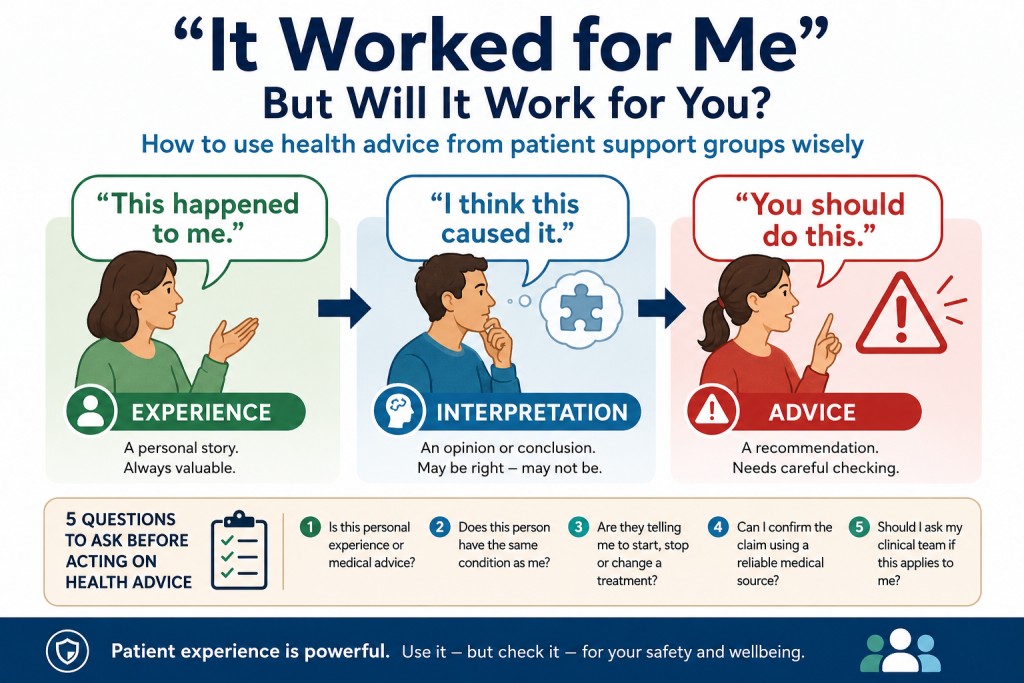
Experience, interpretation and advice are different things
Consider three statements:
1. Experience
“I started itraconazole and felt nauseous.”
That is someone’s personal experience. There is no reason to dispute it.
2. Interpretation
“Itraconazole caused my nausea.”
That may well be correct, but now an interpretation has been added. Nausea has many possible causes and sometimes establishing whether a medicine is responsible requires clinical assessment.
3. Advice
“Itraconazole made me ill, so you shouldn’t take it.”
Now the statement has changed completely. One person’s experience has become medical advice for another person.
That is where caution is needed.
The most useful question you can ask
When you read health information in a patient group, ask yourself:
“Is this person telling me what happened to them, or telling me what I should do?”
Personal experience can be extremely useful.
Instructions about changing your treatment require a much higher level of evidence.
Why completely honest patients can give conflicting advice
One person may say an antifungal transformed their life. Another may say the same medicine did nothing. A third may have experienced significant side effects.
All three can be telling the truth.
People differ in their diagnosis, severity of disease, other medical conditions, other medicines, drug absorption, genetics and many other factors.
Even two people who both say they have “aspergillosis” may have very different diseases.
Allergic bronchopulmonary aspergillosis (ABPA), chronic pulmonary aspergillosis (CPA), an aspergilloma and invasive aspergillosis are not interchangeable diagnoses. A treatment that is essential for one person may be unnecessary or inappropriate for another.
Before comparing your treatment with somebody else’s, therefore, one of the first questions should be:
“Do we actually have the same condition?”
Why frightening stories can seem more common than they really are
Imagine 100 people start a medicine.
Most take it without anything particularly interesting happening. A few experience dramatic side effects.
Who is most likely to write a long social media post about it?
Probably someone in the second group.
This doesn’t make their experience untrue or unimportant. But reading patient discussions cannot tell you how frequently something happens.
People experiencing problems often have a particularly strong reason to seek help and post about them. People whose treatment is working uneventfully may have much less reason to say anything.
This is one reason online discussions can unintentionally make rare or unusual experiences appear commonplace.
“It worked for me” doesn’t prove that a treatment works
The opposite problem occurs when somebody improves after trying a treatment, supplement, diet or other intervention.
If somebody says:
“I tried this and felt much better.”
their improvement may be completely genuine.
But that alone cannot establish why they improved.
The underlying illness may have changed, another treatment may have started working, symptoms may naturally have fluctuated, or several things may have changed simultaneously.
This is one reason clinical trials compare groups of patients rather than simply collecting success stories.
A testimonial can tell you that someone improved. It cannot by itself prove that the treatment caused the improvement.
Be particularly cautious when someone tells you to stop treatment
Statements such as these deserve particular caution:
“Stop taking it.”
“Reduce the dose yourself.”
“You don’t need that medicine.”
“Replace it with this supplement instead.”
There may be circumstances in which a medicine genuinely does need to be stopped or changed, particularly if serious side effects occur.
But another patient usually cannot know enough about your medical circumstances to make that decision for you.
If a patient describes a side effect that sounds similar to something you are experiencing, their experience may provide an extremely useful prompt to contact your doctor, pharmacist or specialist team.
That is very different from using their experience to change your own prescription.
Watch out for absolute statements
Medical misinformation often sounds unusually certain.
Be cautious about statements containing words such as:
- always
- never
- everyone
- no one
- guaranteed
- cure
For example:
“Everyone with aspergillosis needs antifungals.”
That isn’t correct. Different forms and clinical states of aspergillosis require different approaches.
Equally:
“Antifungals are toxic and should be avoided.”
is an unjustified generalisation from the fact that antifungals can cause important side effects in some people.
Good medical information often contains apparently less exciting words such as may, can, usually, in some patients and depending on the circumstances.
That isn’t uncertainty caused by ignorance. It often reflects the reality that medicine is complicated.
Popularity isn’t the same as evidence
A comment with dozens of likes can still be wrong.
Repeated claims can also start to feel more trustworthy simply because we have encountered them several times.
Patient communities can unintentionally amplify particular beliefs as people repeat information they originally heard from somebody else.
Before accepting an important medical claim, try to find out where it originated.
Was it:
- a patient’s personal experience?
- something their doctor apparently told them?
- a newspaper story?
- a research paper?
- a clinical guideline?
- an NHS or specialist medical information source?
These aren’t equivalent forms of evidence.
“My doctor said…” can still be difficult to interpret
People frequently share advice given by their own doctors, and this can be very useful.
But there is another important qualification.
The doctor was advising that particular patient.
There may have been scan findings, blood results, previous treatments, other illnesses or medications influencing that advice which aren’t mentioned in the social media post.
Even accurately remembered medical advice can therefore become misleading when removed from the circumstances in which it was given.
Check extraordinary claims
If you encounter something surprising – particularly a claim that contradicts what your medical team has told you – don’t assume either source must automatically be wrong.
Check it.
Reliable places to look include NHS information, recognised professional organisations, published clinical guidelines and specialist centres with expertise in the condition.
You can also take the question back to your clinical team:
“I’ve read this in a patient group. Does it apply to me?”
That is a perfectly reasonable question.
What should moderators do about incorrect information?
Good patient communities do not need to remove every incorrect statement.
People should normally be able to describe their own experiences – including difficult, unusual or negative experiences.
But there is an important distinction between:
“This happened to me.”
and:
“Everyone should do this.”
When a claim could cause somebody to stop necessary treatment, take an inappropriate treatment or misunderstand the seriousness of their condition, it is reasonable for moderators or knowledgeable members to add accurate information.
Research suggests that this kind of correction already happens naturally in patient communities. A 2025 scoping review of online peer-support groups found that fellow members often responded to false claims or subsequently provided correct information.
The researchers also suggested that clinical and academic experts could have a valuable role in helping to improve the quality of health information shared in these communities.
The objective isn’t to win an argument. It is to make sure that somebody reading the discussion six months later sees reliable information alongside the original claim.
A simple five-question check
Before acting on health advice from Facebook, Telegram or another patient community, ask:
- Is this personal experience or medical advice?
- Does this person actually have the same condition as me?
- Are they telling me to start, stop or change a treatment?
- Can I confirm the claim using a reliable medical source?
- Should I ask my clinical team whether this applies to me?
If the proposed action could significantly affect your health, questions four and five become particularly important.
Another useful way to check health information
NHS England has developed a free resource called Misinformation UnMASKED to help people decide whether health information they encounter online can be trusted.
It includes practical guidance for checking online health information and is designed for patients, families and carers as well as health and care staff.
Visit NHS Misinformation UnMASKED – checking online health information.
Patient groups and medical professionals provide different things
This doesn’t mean doctors are always right and patients are always wrong.
That would miss much of the value of patient communities.
A clinician may know far more about the evidence supporting a treatment. Someone who has taken that treatment for five years may know far more about what taking it every morning actually feels like.
Those are different kinds of knowledge.
The best patient communities bring them together.
Keep sharing your experiences
None of this should discourage people from talking openly about treatment.
If a medicine helped you, tell people.
If you experienced a side effect, tell people.
If you found a useful way of managing fatigue, mucus clearance, appointments or everyday life, other patients may benefit enormously from hearing about it.
Just remember the small distinction that makes patient communities safer:
Share what happened to you. Be much more cautious about telling somebody else what should happen to them.
That allows patient experience to remain one of the greatest strengths of a support community without accidentally turning experience into a prescription.
Online patient communities can provide valuable peer support and lived experience, but they cannot replace individual medical advice. If you are considering changing prescribed treatment, discuss it with your doctor, pharmacist or specialist team.

Did this page help you?
Tell us in one minute