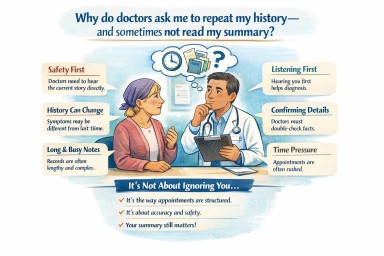
Why do doctors ask me to repeat my history — and sometimes not read my summary?

Last reviewed: 9 April 2026

Many patients, especially those with long-term or complex health problems, say the same thing: “Why do I always have to repeat everything?” Some also say that even when they bring a short written summary, it is put to one side and does not seem to be read straight away.

This can feel frustrating, tiring, and dismissive. In most cases, though, it is not because the doctor does not care. It is usually because of how medical appointments are structured, how clinicians are trained, and the time pressures built into the healthcare system.

This article explains what may be happening, why doctors often work this way, and what can sometimes help patients get more out of appointments.

Key points

  • Doctors are usually not ignoring you or your efforts.
  • They are trained to hear the story directly from the patient for safety and accuracy.
  • Medical notes can be long, incomplete, hard to access quickly, or spread across different systems.
  • A written summary can still be helpful, but it may work best as a support tool rather than a replacement for discussion.
  • The system is often particularly difficult for people with complex, long-term conditions.

Contents

Why do doctors ask patients to repeat information?

Many patients assume that if something is already in the notes, the doctor should simply read it and move on. In practice, clinicians are usually taught not to rely only on previous notes. They are expected to take a current history directly from the patient wherever possible.

1. They need a fresh history

Symptoms can change. A note written last week, last month, or even earlier the same day may no longer fully reflect what is happening now. A doctor needs to understand the present situation, not just the recorded one.

This matters because:

  • new symptoms may have appeared
  • older symptoms may have improved or worsened
  • important details may have been left out of earlier notes
  • previous notes can sometimes contain misunderstandings or errors

2. Hearing the story directly is part of diagnosis

Doctors do not just collect facts. They also listen to how symptoms are described, what concerns the patient most, what order things happened in, and whether there are any clues that do not fit the previous record.

For example, hearing a patient say “this is much worse than usual” or “the pain has changed completely” may matter just as much as what is already written down.

3. Each clinician is responsible for their own decisions

Every doctor is professionally responsible for the decisions they make in that consultation. Because of that, they usually need to confirm the key information for themselves rather than relying entirely on another person’s notes or summary.

4. Notes are not always as clear or complete as patients imagine

Patients often assume the notes tell the whole story. Sometimes they do not. They may be brief, scattered across different entries, missing key context, or written in a way that does not quickly explain the current problem.

Why might a written summary be set aside?

Patients who have made the effort to prepare a summary can feel especially upset when a doctor places it to one side. It may look like the document is being ignored. Often, however, the doctor is following a routine approach to consultation rather than rejecting the information.

1. Many consultations follow a familiar structure

Doctors are often trained to work in a rough sequence:

  1. listen to the patient’s account
  2. ask follow-up questions
  3. clarify the current concern
  4. review supporting information and records
  5. decide what to do next

So a written summary handed over at the start may be used later, not immediately.

2. They may not want the written summary to shape their thinking too early

Clinicians are often cautious about being overly influenced by somebody else’s wording before they have heard the patient directly. This is part of clinical reasoning and risk management. They may want to form their own understanding first, then compare it with the summary.

3. Reading while listening can be difficult

In a short appointment, a doctor may feel they cannot properly read a document, listen closely, ask questions, and maintain eye contact all at the same time. They may therefore choose to focus first on the conversation.

4. Some summaries are not easy to use quickly

Even a well-meant summary may be hard to absorb if it is too long, too detailed, or does not make the current issue obvious straight away. Doctors are often trying to answer one urgent question first:

What is the main problem today?

If that is not immediately clear from the page, they may return to direct questioning.

What are doctors trying to achieve?

From a patient’s point of view, repeating information can feel inefficient and unnecessary. From a clinician’s point of view, the consultation is often trying to achieve several things at once:

  • Accuracy: understanding what is happening now, not just what happened before
  • Safety: checking for changes, gaps, or warning signs
  • Clarity: identifying the most important issue for that appointment
  • Responsibility: making decisions based on information they have personally checked

That does not make the experience any less frustrating for patients, but it can help explain the behaviour.

Why is this harder for people with long-term conditions?

This problem is often worse for people who have:

  • complex diagnoses
  • multiple health conditions
  • long medical histories
  • many medications
  • appointments with different teams or hospitals

If you live with a chronic condition, you may have repeated the same history many times. You may also already be tired, breathless, in pain, stressed, or worried. In that situation, being asked again to explain everything can feel overwhelming.

This is a real systems problem. It is not a sign that you are failing to explain yourself properly, and it is not unreasonable to find it difficult.

What can help in appointments?

There is no perfect solution, but some approaches can make appointments easier and increase the chance that useful information is taken in.

Start with the main issue today

A helpful opening sentence can be:

“The main issue today is…”

This quickly gives the doctor a focus and may reduce the need to retell everything in full.

Keep written summaries short

A one-page summary is usually easier to use than a longer document. It can include:

  • main diagnoses
  • current medications
  • important recent events
  • relevant allergies or major problems
  • today’s main concern at the top

Offer the summary rather than relying on it

Instead of assuming it will be read immediately, it may help to say:

“I have brought a short summary in case it is useful.”

or:

“Would it help if I gave you a one-page summary of my background?”

This fits better with how many consultations flow.

Use the summary as a support tool

A written summary often works best as:

  • a memory aid for the patient
  • a quick reference for the doctor
  • a back-up in case important facts are missed

It may be less effective if used as a substitute for the whole conversation.

Say when repetition is difficult

If repeating your history is hard because of pain, fatigue, breathlessness, stress, memory problems, or the complexity of your condition, it is reasonable to say so politely.

“I’m happy to summarise, but I do find repeating the full history difficult.”

That can help the doctor understand the burden on you.

Common questions

Are doctors not reading my notes at all?

Sometimes they have read some of them, but not everything. Sometimes they have skimmed the record for key issues. Sometimes the most relevant information is hard to find quickly. The fact that they ask questions does not always mean they have read nothing.

Why do they not just read my summary instead of asking me?

Because they are usually expected to hear the current story directly, check the important facts for themselves, and understand what matters most right now.

Is there any point bringing a written summary?

Yes. A good summary can still be very helpful. It may save time, improve accuracy, and make it easier to communicate complex information. It is just not always used in the way patients expect.

Does putting my summary to one side mean it has been ignored?

Not necessarily. It may be read later in the appointment, after the consultation, or used as a reference rather than read word for word in front of you.

When to seek further support

You may want more support if:

  • you repeatedly feel that important information is not being understood
  • your condition is complex and hard to explain in a short appointment
  • you feel too unwell or distressed to repeat your history each time
  • you think communication problems are affecting your care

Possible options include:

  • asking whether a clinic letter or care plan summary can be used
  • bringing a relative, friend, or advocate to appointments
  • keeping a short up-to-date medical summary with you
  • asking whether the main issue for that appointment can be agreed early on

Final thought

It can be upsetting to feel that your effort has been overlooked or that you are being asked to say the same things again and again. Usually, though, what you are seeing is not indifference but the way modern consultations are structured around safety, time pressure, and direct assessment.

Your summary is still worth bringing. The most useful expectation is often not that it will replace the conversation, but that it may support it.

Important note

This article is general educational information. It is not medical advice and cannot explain every individual consultation or healthcare setting.

Author and review information

Prepared as general patient information to help explain common experiences in healthcare appointments.