Isavuconazole in Aspergillosis

A balanced guide for patients and clinicians

Isavuconazole (given as the prodrug isavuconazonium sulfate) is a newer broad-spectrum triazole antifungal used in:

  • Chronic pulmonary aspergillosis (CPA)

  • Invasive aspergillosis

  • Patients who cannot tolerate other azoles

  • Selected refractory Allergic bronchopulmonary aspergillosis (ABPA) cases

It is available as oral capsules and intravenous (IV) formulation and is often chosen for its favourable tolerability profile.


1️⃣ What Isavuconazole Does

Like other azoles, isavuconazole inhibits fungal CYP51 (14-α-demethylase), blocking ergosterol synthesis and impairing fungal cell membrane formation.

It:

  • Suppresses Aspergillus growth

  • Reduces fungal burden

  • Helps stabilise lung disease

  • Provides systemic antifungal coverage

Clinical improvement is gradual over weeks.


2️⃣ How Long Is Treatment?

In CPA

  • Often 6–12 months or longer

  • May be used when other azoles cause side effects

  • Sometimes used as long-term suppressive therapy

In Invasive Aspergillosis

  • Duration depends on immune recovery and response

  • Often several months

In ABPA

  • Used selectively when other azoles are not tolerated

As with all azoles, stopping too early may lead to relapse.


3️⃣ Pharmacokinetics – Why It’s Different

Isavuconazole has more predictable pharmacokinetics than itraconazole or voriconazole.

Key features:

  • High oral bioavailability

  • Not dependent on gastric acidity

  • Food has minimal impact

  • Linear pharmacokinetics (dose–level relationship more predictable)

  • Long half-life (~100–130 hours)

Importantly:

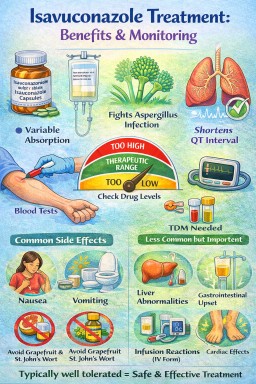
It shortens the QT interval (unlike other azoles, which may prolong it).

This can make it preferable in patients with QT prolongation risk.


4️⃣ Do We Need Blood Level Monitoring?

Therapeutic Drug Monitoring (TDM) is not routinely required in all patients.

However, levels may be considered in:

  • Treatment failure

  • Drug interactions

  • Extreme body weight

  • Severe liver disease

  • Long-term therapy

This is a practical advantage compared with voriconazole.


5️⃣ Common Side Effects (Usually Mild)

  • Nausea

  • Vomiting

  • Diarrhoea

  • Headache

Generally fewer visual or skin-related effects compared with voriconazole.


6️⃣ Less Common but Important Effects

Liver Abnormalities

Routine liver monitoring is recommended.

Most abnormalities are mild and reversible.


Gastrointestinal Upset

Can occur early in therapy but often settles.


Infusion Reactions (IV Form)

Occasional mild reactions with IV administration.


Cardiac Effects

Unlike other azoles:

  • Isavuconazole may shorten QT interval

  • It is not associated with QT prolongation

This makes it attractive in patients with:

  • Existing QT prolongation

  • Multiple QT-prolonging drugs

However, ECG review may still be prudent in complex cardiac patients.


7️⃣ Drug Interactions

Isavuconazole:

  • Moderately inhibits CYP3A4

  • Has fewer interactions than some other azoles

Still review carefully, especially with:

  • Immunosuppressants

  • Statins

  • Certain anticoagulants

Avoid:

  • St John’s Wort

  • Strong enzyme inducers

Grapefruit has less impact than with other azoles but is generally avoided as a precaution.


8️⃣ Comparison Snapshot

Feature Itraconazole Voriconazole Posaconazole Isavuconazole
Acid-dependent absorption Yes (capsules) No No (tablet) No
Genetic metabolism impact Low High (CYP2C19) Low Low
QT prolongation Minimal Possible Possible No (shortens QT)
Visual side effects Rare Common Rare Rare
TDM required Yes Essential Recommended Usually not
Long-term tolerability Moderate Sometimes limited Often good Often very good

Balanced Summary for Patients

Isavuconazole is a newer antifungal that is often easier to tolerate and has more predictable levels in the body. Blood tests and monitoring help ensure treatment remains safe and effective.


Clinician Checklist

  • Confirm indication and prior azole exposure

  • Baseline liver function tests

  • Review interacting medications

  • Consider ECG if complex cardiac history

  • Consider TDM only if clinically indicated