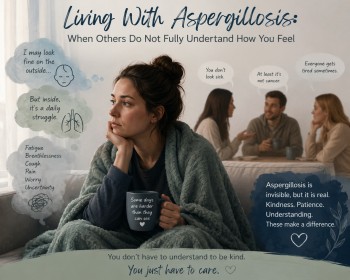
Illustration of a woman living with aspergillosis sitting wrapped in a blanket looking exhausted and thoughtful while people in the background make dismissive comments, highlighting the emotional burden and invisible symptoms of chronic lung disease.

Living With Aspergillosis: When Others Do Not Fully Understand How You Feel

Illustration of a woman living with aspergillosis sitting wrapped in a blanket looking exhausted and thoughtful while people in the background make dismissive comments, highlighting the emotional burden and invisible symptoms of chronic lung disease.
Many people living with aspergillosis experience fatigue, breathlessness, anxiety, and uncertainty that are not always visible to others. Understanding and compassion can make a real difference.

Living with aspergillosis can affect far more than the lungs. Many patients have symptoms that are difficult to explain, difficult to measure, and difficult for other people to fully understand.

Breathlessness, fatigue, coughing, chest tightness, sleep disruption, anxiety during flare-ups, medication side effects, and uncertainty about the future can all become part of daily life. These symptoms may fluctuate from day to day, and people may appear well at times even when they are struggling.

This can leave patients feeling misunderstood, dismissed, or even blamed for focusing too much on their health.

Key points

  • Symptoms of aspergillosis and chronic lung disease are real, even when they are invisible to others.
  • Feeling anxious, frustrated, or preoccupied with health is understandable when symptoms affect daily life.
  • Validation from family, friends, and clinicians can reduce distress.
  • Finding meaningful things to do beyond illness can also help patients cope.
  • The aim is balance: being heard and supported, while also protecting quality of life.

Why aspergillosis can be hard for others to understand

Many people with chronic pulmonary aspergillosis (CPA), allergic bronchopulmonary aspergillosis (ABPA), severe asthma, bronchiectasis, or other long-term lung conditions live with symptoms that are not always visible.

A patient may look well, speak normally, or have reasonable oxygen levels at rest, but still experience severe fatigue, breathlessness on exertion, anxiety during breathing difficulty, or a long recovery after simple activities.

Symptoms may also fluctuate. Someone may manage an activity one day but be unable to do the same thing the next. This inconsistency can be confusing for family, friends, employers, and sometimes even healthcare professionals.

“Stop obsessing” is usually not helpful

Patients with chronic illness are sometimes told to “stop obsessing” about their health. This may be said with good intentions, but it can feel dismissive.

Patients may hear:

“You are making too much of this.”

or:

“It is all in your head.”

In reality, many patients are not choosing to focus on illness. The illness is already demanding attention through symptoms, medication routines, appointments, uncertainty, and changes to daily life.

However, there is also a useful point hidden inside the poor wording. Constantly monitoring every symptom can become exhausting and may increase anxiety. The better message is not “stop obsessing”, but:

“Your symptoms are real, but you also deserve space in your life that is not only about illness.”

Validation matters

Validation means recognising that a person’s experience is real and understandable. It does not mean agreeing that every symptom is dangerous, or that every worry needs urgent medical action.

Useful validating phrases include:

  • “I believe you.”
  • “That sounds exhausting.”
  • “I know this affects much more than people can see.”
  • “How is today compared with your usual baseline?”
  • “What would help you most today?”

Validation can reduce distress. When patients feel dismissed, they may feel driven to repeat themselves, seek reassurance, or prove how unwell they are. When they feel heard, they may find it easier to step back from constant symptom monitoring and focus on other parts of life.

The mind and body interact

Breathlessness is not just a physical sensation. It can trigger fear very quickly. This is a normal human response: breathing difficulty naturally makes the brain more alert to danger.

This does not mean symptoms are imaginary. It means chronic respiratory illness affects the whole person: physically, emotionally, socially, and psychologically.

Anxiety, uncertainty, poor sleep, and repeated flare-ups can all increase awareness of symptoms. At the same time, genuine physical symptoms can increase anxiety. The two can reinforce each other.

Recognising this interaction can help patients and clinicians work together without blame.

Finding something else to think about can help

For many patients, finding meaningful activities beyond illness is genuinely helpful. This might include hobbies, gentle exercise, time outdoors, music, crafts, reading, gardening, photography, volunteering, family activities, or peer support.

This is not the same as ignoring illness. It is a way of protecting identity and quality of life.

The aim is not to deny symptoms, but to prevent illness becoming the only focus of every day.

“Your illness is real, but it should not be allowed to take over every part of who you are.”

What families and friends can do

Family members and friends may not be able to fully understand what chronic aspergillosis feels like. They do not need perfect understanding to be supportive.

Helpful support includes:

  • believing the person’s symptoms are real;
  • recognising that fatigue and breathlessness may not be visible;
  • avoiding dismissive comments;
  • asking what would help rather than assuming;
  • understanding that symptoms may fluctuate;
  • encouraging enjoyable activities without pressuring the person to “push through”.

Less helpful comments include:

  • “You look fine.”
  • “You were able to do it yesterday.”
  • “You need to stop thinking about it.”
  • “Everyone gets tired.”

What clinicians may be trying to say

Sometimes clinicians may say things such as “try not to focus on it too much” because they believe further tests or treatments may not currently help. They may be trying to avoid unnecessary antibiotics, steroids, scans, or procedures.

That can be a reasonable clinical concern, but the message needs to be communicated carefully.

A better way to say it might be:

“I believe your symptoms are real and distressing. We will continue to look for changes that need treatment. At the same time, some symptoms may persist despite treatment, so we also need to support your quality of life.”

This keeps the patient heard, while also being honest about the limits of medical treatment.

Practical ways to find balance

  • Use structured symptom tracking: a brief daily note may be more helpful than constant checking.
  • Know your baseline: understanding what is normal for you makes changes easier to spot.
  • Agree an action plan: ask your healthcare team what changes should prompt medical advice.
  • Protect non-illness time: plan small, realistic activities that are not centred on health.
  • Use peer support carefully: support groups can reduce isolation, but try to avoid constant comparison or fear-based searching.
  • Ask for emotional support: counselling, psychological therapies, pulmonary rehabilitation, or breathing physiotherapy may help some people.

When to seek medical advice

This article is general information and does not replace medical advice. Patients should seek medical help if they experience significant or worrying change, especially:

  • worsening breathlessness;
  • falling oxygen saturations if they monitor them;
  • new or worsening chest pain;
  • coughing up blood;
  • high fever, rigors, or signs of serious infection;
  • new confusion, fainting, or severe weakness;
  • rapid deterioration from their usual baseline;
  • symptoms that feel different from their usual pattern.

If symptoms are severe or rapidly worsening, urgent medical help should be sought.

Final thought

Living with aspergillosis can be physically and emotionally demanding. Patients deserve to be believed, heard, and supported. At the same time, they also deserve help to build a life that is not entirely defined by illness.

A helpful message for patients, families, and clinicians is:

“Your illness is real. Your distress is understandable. You deserve support. And you also deserve a life with meaning, connection, and moments of relief beyond illness.”

Further support and reading

If you are living with aspergillosis and feel that others do not fully understand what you are going through, these resources may help. They offer information about long-term illness, mental wellbeing, breathlessness, invisible symptoms, and patient support.

Important: If your symptoms suddenly worsen, you develop severe breathlessness, chest pain, coughing up blood, confusion, fainting, or signs of serious infection, seek urgent medical advice. In the UK, call NHS 111 for urgent advice or 999 in an emergency.