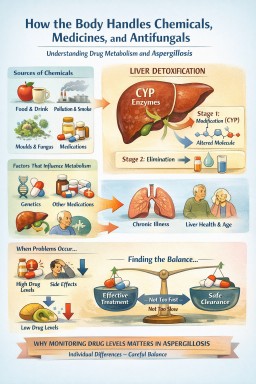
How the Body Handles Chemicals, Medicines, and Antifungals

Why metabolism differs between people — and why this matters in aspergillosis


The big idea (in one sentence)

Your body uses an ancient liver detox system to handle chemicals from food, air, and medicines — and differences in that system explain why people with aspergillosis respond so differently to antifungal drugs.


What is metabolism?

Every day, your body is exposed to chemicals from many sources:

  • Food and drink

  • Air pollution and moulds

  • Natural plant chemicals

  • Hormones your body makes itself

  • Medicines, including antifungals and steroids

Many of these chemicals cannot be safely removed in their original form.
They first need to be chemically modified so they can be excreted in urine or bile.

This process is called metabolism, and it happens mainly in the liver.


The liver’s chemical processing system

The liver contains a large family of enzymes called cytochrome P450, often shortened to CYP.

Important clarification

  • CPA = Chronic Pulmonary Aspergillosis (a lung disease)

  • CYP = Cytochrome P450 (liver enzymes)

They sound similar but are completely different things.


What CYP enzymes really do

CYP enzymes did not evolve to deal with medicines.
They evolved to protect us from chemicals in the environment.

They help process:

  • Plant toxins and food chemicals

  • Smoke and air pollution

  • Mould and fungal by-products

  • Alcohol and caffeine

  • Hormones such as cortisol and sex hormones

  • Medicines (which are treated as “foreign chemicals”)

Medicines simply use a system that already existed.


How CYP enzymes “recognise” chemicals

CYP enzymes do not recognise chemicals like the immune system recognises germs.

Instead, they recognise chemical patterns, such as:

  • Fat-solubility (hard to excrete)

  • Size and shape

  • Reactive chemical groups

If a molecule:

  • Fits into the enzyme’s binding pocket, and

  • Can be chemically modified,

then CYP will act on it.

This makes CYP enzymes:

  • Broad (they work on many substances)

  • Flexible

  • Imperfect by design


The two main stages of metabolism (simplified)

Stage 1 – Modification

  • Mainly done by CYP enzymes

  • The chemical is altered (often oxidised)

  • This may:

    • Reduce activity

    • Prepare it for removal

    • Occasionally create a more toxic intermediate

Stage 2 – Packaging for removal

  • The altered chemical is “tagged”

  • It becomes water-soluble

  • It can now leave the body safely


Why metabolism differs between people

This is especially important for aspergillosis patients.

1. Genetics (the biggest factor)

People inherit different versions of CYP enzymes.

Some people:

  • Break drugs down slowly → higher levels → side effects

  • Break drugs down quickly → low levels → reduced effectiveness

Two people on the same antifungal dose can have very different blood levels.


2. Other medicines

Some medicines:

  • Block CYP enzymes (slowing breakdown)

  • Speed up CYP enzymes (lowering drug levels)

Antifungals, steroids, antibiotics, antidepressants, and heart drugs often interact.


3. Inflammation and chronic illness

During infection or chronic inflammation:

  • CYP activity is often reduced

  • Drug levels may rise unexpectedly

This matters in:

  • Chronic Pulmonary Aspergillosis (CPA)

  • Allergic Bronchopulmonary Aspergillosis (ABPA)

  • Bronchiectasis

  • Severe asthma

Drug handling can change during disease flares.


4. Liver health and age

  • Liver disease can slow metabolism

  • Older adults often process drugs differently


Why something can become a “poison”

A substance can cause harm if it:

  • Escapes CYP processing

  • Is metabolised too slowly

  • Overwhelms the system at high dose

  • Blocks CYP so other substances build up

  • Is converted into a toxic by-product

This explains:

  • Why some foods are toxic to dogs but safe for humans

  • Why “natural” substances are not automatically safe

  • Why dose really matters


A key question:

Why not design medicines that CYP can’t break down?

This is a real goal in drug development, and your instinct is correct.

If a drug:

  • Is broken down very slowly, or

  • Avoids CYP metabolism altogether,

then:

  • It stays in the body longer

  • Blood levels are steadier

  • Fewer doses are needed

This is why some medicines are once-daily, once-weekly, or long-acting injections.


But there is a trade-off

CYP metabolism is not just an inconvenience — it is also a safety system.

If a drug:

  • Cannot be metabolised, and

  • Cannot be excreted easily,

then:

  • It may accumulate

  • Side effects last much longer

  • Toxicity is harder to reverse

  • Stopping the drug does not stop the problem quickly

So completely avoiding CYP can increase long-term risk, especially when medicines are taken for months or years.


How drug designers manage this balance

Most modern drugs aim for a middle ground:

  • Broken down slowly, not zero

  • More predictable metabolism

  • Fewer interactions with major CYP enzymes

  • Alternative clearance routes where possible

  • Long-acting formulations (slow release, depots) rather than permanent persistence

In other words:

Long enough to work — but short enough to stay safe


Why this is especially relevant in aspergillosis

Antifungal drugs are particularly challenging because:

  • Fungi are biologically similar to humans

  • Drugs often interact with human CYP enzymes

  • Treatment is long-term

  • Patients often take multiple other medicines

Because of this:

  • Blood level monitoring is common

  • Dose adjustments are expected

  • Side effects do not mean failure

  • Low levels do not mean non-compliance

This variability reflects normal biology, not poor care.


A simple way to think about it

  • Your liver is a chemical processing plant

  • CYP enzymes are general-purpose machines

  • Everyone’s machines run at slightly different speeds

  • Illness and other drugs change how they behave

  • Antifungals depend on these machines being “just right”


Key take-home messages for patients

  • CYP enzymes are part of your body’s everyday detox system

  • They evolved to handle food chemicals, pollution, moulds, and hormones

  • Medicines use the same system

  • People differ because of genetics, illness, and other drugs

  • In aspergillosis, variable drug levels are expected

  • Monitoring and dose adjustment are signs of good specialist care

  • Drugs are not designed to avoid metabolism completely — safety matters as much as convenience