National Aspergillosis Centre, Antifungal Therapeutic Drug Monitoring (TDM), Molecular Resistance Testing & Antimicrobial Stewardship

How the National Aspergillosis Centre Supports UK Clinicians

Long-term antifungal therapy in aspergillosis presents a distinct antimicrobial stewardship (AMS) challenge. Treatment is often prolonged, drug exposure is highly variable, and resistance may emerge during therapy.

The National Aspergillosis Centre (NAC), working closely with the Mycology Reference Centre Manchester (Manchester UK"], provides national expertise through:

  • Therapeutic drug monitoring (TDM)

  • Molecular resistance testing

  • Specialist Advice & Guidance

  • Remote multidisciplinary team (MDT) review

  • Standardised laboratory processes

Together, these services enable UK clinicians to optimise antifungal therapy while aligning with national AMS strategy and antimicrobial resistance (AMR) policy.


The National AMS Framework: Why This Matters

Antifungal stewardship sits within the wider UK antimicrobial resistance strategy.

Key national resources include:

1️⃣ NHS England – Digital Vision for Antimicrobial Stewardship

https://www.england.nhs.uk/long-read/digital-vision-for-antimicrobial-stewardship-in-england/

Emphasises:

  • Data-driven optimisation

  • Decision support

  • Clear documentation

  • Measurable stewardship interventions


2️⃣ Antimicrobial Prescribing & Stewardship Competency Framework

https://www.gov.uk/government/publications/antimicrobial-prescribing-and-stewardship-competencies

Defines clinician responsibilities including:

  • Right drug

  • Right dose

  • Right duration

  • Monitoring for toxicity

  • Review and stop decisions


3️⃣ English Surveillance Programme for Antimicrobial Utilisation and Resistance (ESPAUR)

https://www.gov.uk/government/publications/english-surveillance-programme-for-antimicrobial-utilisation-and-resistance-espaur-report

Supports:

  • National resistance monitoring

  • Stewardship benchmarking

  • Reduction of inappropriate antimicrobial exposure


4️⃣ Chronic Pulmonary Aspergillosis (CPA) Service Specification

https://www.england.nhs.uk/publication/chronic-pulmonary-aspergillosis-service-adults/

This specialised service model explicitly includes:

  • Optimisation of antifungal therapy

  • Toxicity monitoring

  • Therapeutic drug monitoring

Antifungal stewardship is embedded within the commissioned service design.


Why Aspergillosis Requires Enhanced Stewardship

Unlike short-course antibacterial therapy, aspergillosis often involves:

  • Long-term triazole therapy

  • Structural lung disease

  • High interaction burden

  • Emerging environmental resistance

  • Potential for treatment failure despite adequate adherence

Effective stewardship therefore requires both:

  1. Assurance of adequate drug exposure (TDM)

  2. Assurance of organism susceptibility (molecular testing)


1️⃣ Therapeutic Drug Monitoring (TDM)

Triazole antifungals demonstrate:

  • High pharmacokinetic variability

  • Concentration-dependent toxicity

  • Reduced efficacy if under-dosed

TDM enables:

✔ Early detection of subtherapeutic exposure
✔ Prevention of toxicity
✔ Dose optimisation
✔ Reduction of avoidable escalation

This directly fulfils AMS competency expectations.


2️⃣ Molecular Resistance Testing

Azole resistance in Aspergillus fumigatus is increasingly recognised in the UK.

Through MRCM, NAC supports:

CYP51A Mutation Analysis

Common mutations include:

  • TR34/L98H

  • TR46/Y121F/T289A

These may arise:

  • Environmentally (azole fungicide pressure)

  • During long-term therapy


Phenotypic Susceptibility Testing

Where viable isolates are available:

  • Minimum inhibitory concentration (MIC) testing

  • Clinical interpretation to guide therapy


Why Resistance Testing Is Essential for AMS

If a patient deteriorates despite adequate serum levels:

  • Continuing the same azole is not stewardship

  • Escalating empirically without evidence increases antimicrobial pressure

Molecular confirmation ensures:

✔ Rational switching
✔ Avoidance of ineffective therapy
✔ Contribution to national resistance surveillance

This aligns with ESPAUR and national AMR objectives.


3️⃣ Remote Advice & Guidance & MDT Review

The NAC provides structured national clinician support.

This strengthens stewardship by:

✔ Refining diagnosis
✔ Preventing indication drift
✔ Setting defined review points
✔ Supporting stop decisions
✔ Reducing empirical prolonged therapy

Early specialist review is one of the most effective stewardship interventions.


Integrated Stewardship Model

Clinical Situation TDM Molecular Testing
Initiation of azole Yes Not routine
Poor response + low level Adjust dose Not primary
Poor response + adequate level Confirm exposure Essential
Long-term therapy Periodic monitoring Consider if progression
Relapse on therapy Check level Strongly consider

Exposure optimisation + susceptibility confirmation = complete antifungal stewardship.


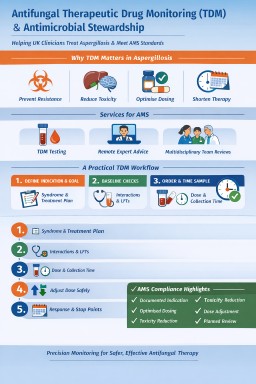
Practical Workflow for UK Teams

Step 1 – Define Indication

  • Syndrome

  • Treatment objective

  • Planned review date

Step 2 – Baseline Safety Checks

  • Interaction review

  • Liver function tests

  • ECG where appropriate

Step 3 – Perform TDM

Include:

  • Drug

  • Dose

  • Time of last dose

  • Time of sampling

Step 4 – If Clinical Failure Occurs

  • Confirm adequate drug exposure

  • Consider molecular resistance testing

Step 5 – Define Stop/Review Criteria

Avoid open-ended therapy without documented reassessment.


Demonstrating AMS Compliance in Practice

Using NAC-supported services allows Trusts to evidence:

✔ Documented indication
✔ Dose optimisation
✔ Toxicity mitigation
✔ Rational escalation
✔ Defined review intervals
✔ Resistance surveillance contribution
✔ Specialist consultation

This is measurable, defensible antimicrobial stewardship.


Conclusion

Antifungal stewardship in aspergillosis cannot rely on restriction alone.

It requires:

  • Precision dosing

  • Genetic resistance detection

  • Structured specialist review

  • Alignment with national AMS frameworks

Through integrated therapeutic drug monitoring, molecular resistance testing, and national clinical support, the National Aspergillosis Centre provides a UK model for precision antifungal stewardship aligned with national antimicrobial resistance strategy.